
OSHA News

New Cal/OSHA Rules Came Into Effect in the New Year
Sacramento, CA: A new year often brings changes and updates to regulations requiring the attention of employers in order to avoid the scornful gaze of the California Division of Occupational Safety and Health (known variously as DOSH or Cal/OSHA). With the health and safety of employees coming into greater focus and scrutiny with each passing year, it behooves not only the employer to become conversant with the new rules, but also employees. To wit, an educated employee is better able to know if, and when his rights have been violated under OSHA if properly conversant with the rules, perhaps with help from a Cal/OSHA lawyer.
To that end the California state budget bill that came into effect at the first of the year also carries various updates to Cal/OSHA regulations any employer interested in avoiding a OSHA lawsuit would be wise to become familiar with.
As well as monetary changes in fines and penalties, Senate Bill 96 (SB 96) increases the window through which the Division of Occupational Safety and Health can investigate a retaliation claim. Under the old rules, Cal/OSHA had but 60 days to complete an investigation. Under updated rules, DOSH now has a full year to spend with the file.
As noted above, penalties are going up: the hit for repeated violations against Cal/OSHA on the part of employers rises from $70,000 to $124,709, while at the same time maximum fines for civic penalties increase from $7,000 to 12,471 for every violation deemed as not serious.
For industrial applications, maximums have been removed from fines levied for violations related to carcinogens or crane safety orders.
While the changes came into effect the first of the year, enforcement is not expected to occur until a public rule-making process has been completed.
Labor Commissioner starts the New Year with the issuance of citations
In the meantime, the Office of the California Labor Commissioner began 2018 with a citation issued against the owner of six residential care homes in Los Angeles for wage theft and other violations against the California Labor Code. According to a press release issued on January 9, Adat Shalom Board & Care, Inc. was assessed citations totaling over $7 million for the underpayment of wages and other penalties associated with 149 current and former employees providing care to elderly residents. The Labor Commissioner noted that some of those employees took home little more than $3 per hour.
“Adult care facilities require caregivers to work around the clock, making workers in this industry vulnerable to wage theft and exploitation,” said Labor Commissioner Julie A. Su, in a statement. “We encourage other residential caregivers to speak up and report wage theft if they are not paid for the work they do.”
The investigation was opened in June of last year. Amongst other violations, workers were not paid overtime and were not relieved from their duties in order to take rest break and meal periods.

Operator of Ski Resort Cited by Cal/OSHA over Death of Employee
Squaw Valley, CA: The ski resort where a ski patroller died this past January has been cited by the California Division of Occupational Safety and Health for safety code violations. Fines totaling $20,250 have been levied against the operators of Squaw Valley Ski Resort. The operator, Squaw Valley Ski Holdings, is not commenting on the citations beyond sharing its intention to appeal the rulings.
“We are respectful of the guidelines put forth by the Occupational Safety and Health Administration, and have immediately appealed this citation,” Squaw Valley said in a statement issued to NBC News 4 & Fox 11 (08/09/17).“Because of that, we have no comment due to the ongoing nature of the legal process.”
According to NBC News 4 & Fox 11, Joe Zuiches – the victim in the accident – was participating in avalanche control activities at the summit of Gold Coast Ridge at the ski resort. Documents associated with the investigation reveals that two teams of patrollers were assigned to the Gold Coast Ridge for avalanche control. The patrollers were blasting by hand and hang cord deployment with “Dyno AP Plus 1.8-pound explosives with cap and fuse with a 90-second burn rate,” the investigators said.
On the morning of the accident, at 8:30am on January 24 of this year, investigators say Zuiches instructed his partner at the particular work area to join other team members, and that Zuiches would catch up with them once he had performed a hanging cord blast at the site.
The worker noted that at some point after he joined up with the other team members, he heard explosive detonations in the area from whence he had come. When the worker radioed Zuiches about thirty seconds following the blast and received no response, the team returned to the last known location of Zuiches, only to find him deceased.
There had been no witnesses.
Following an investigation, Cal/OSHA cited Squaw Valley for “failing to correct an identified unsafe working condition by implementing a procedure for protection against the workplace hazards associated with hang cord entanglement during hang cord blasting operations” for a fine of $11,250.
Squaw Valley was also cited by Cal/OSHA for “failing to ensure that all crewmembers maintained visual contact or awareness of physical location of crewmembers at all times during avalanche control activities” for a fine of $9,000.
Total fines of $20,250 were associated with alleged violations of two workplace safety codes.
It is not known if the family of the deceased patroller has, or intends to file an OSHA lawsuit.

Chevron Settles Cal OSHA Issues over Richmond Refinery Fire for $20 Million
Los Angeles, CA: An oil refinery fire in California in 2012 that injured five workers and sent thousands of nearby residents to the hospital has resulted in a $1 million fine assessed to Chevron Corp. under OSHA and an agreement to make $20 million in improvements to its refinery in Richmond, the site of the fire five years ago.
The agreement brings an end to years of wrangling between the oil giant and the California Division of Occupational Safety and Health over the Chevron refinery. The stakes were high, with no fewer than 15,000 Richmond and area residents impacted by the fire.
The inferno that affected so many resulted from a reported leak at one of the crude oil units at the refinery. The resulting investigation into the fire by Cal/OSHA determined that Chevron’s own inspectors and metallurgical scientists had recommended as early as 2002 that corroded pipes at the facility warranted replacement.
However, the pipes were not replaced. Ten years later, a leak occurred which resulted in a full rupture and a serious fire. Additionally, it was determined that Chevron failed to follow its own emergency shutdown procedures when the breach was identified. It was alleged that Chevron also dropped the ball when it came to protecting its own employees, and those of a scaffolding company who had been working at the site of the leak.
In 2013 Chevron agreed to plead no contest to criminal misdemeanor charges brought by the California Department of Justice and Office of the Contra Costa County District Attorney for violation of state health and labor codes. Chevron also agreed to pay $2 million in restitution.
Later that year Chevron faced the ire of the US Environmental Protection Agency – and last year, California proposed new regulations aimed at beefing up environmental and workplace safety at oil refineries.
Chevron had appealed a series of citations from by the Division of Occupational Safety and Health for California, which totaled 17.
The agreement concludes the matter, which was not an OSHA lawsuit per se but was nonetheless brought as a matter before the Office of Administrative Law, which still has to approve the deal. The Cal/OSHA board approved the deal in May.
Chevron agreed to replace all of its carbon steel pipes that carry corrosive liquids with chrome alloy pipes. Chrome alloys are more robust and have a longer shelf life. The company will also make various changes and updates to its Richmond refinery that will go beyond current safety requirements mandated by the State of California at significant cost.
The whole package is worth $20 million.
“The settlement requires Chevron to exceed current and upcoming requirements and to use new and innovative methods recently developed by engineering experts in the petroleum refining industry to ensure the safe operation of process safety equipment,” said Cal/OSHA Chief Juliann Sum. “This means safer operations at the refinery, which will help protect refinery workers and those who work and live nearby.”

Former Wells Fargo Branch Manager Reinstated with $577,500 in Compensation
Pomona, CA: The continuing fallout over allegations that a major corporate bank encouraged its employees to open customer accounts without their client’s knowledge or permission has hit Wells Fargo yet again, this time through an investigation by the California Division of Occupational Safety and Health. That investigation led to a reinstatement order issued by the US Department of Labor (DOL) that will see a former Wells Fargo branch manager in Pomona reinstated to her former job and paid back wages and other costs.
Last year an investigation by the Consumer Financial Protection Bureau (CFPB) uncovered a massive scheme whereby upwards of 5,000 employees of Wells Fargo were found to have opened some 1.5 million bank accounts and more than a half million credit card accounts without the knowledge or authorization of Wells Fargo customers, allegedly to meet aggressive sales targets.
The unnamed branch manager had reported to her superiors that at least three private bankers working at her branch had been engaged in the unlawful practice of opening accounts on behalf of existing Wells Fargo customers, as well as enrolling them into other Wells Fargo products and services without their knowledge, consent or the securing of appropriate disclosures.
As her reward for reporting the activity, the branch manager was let go in September, 2011.
OSHA, which is mandated to look out for the health and safety of employees and oversee healthy and safe work environments, conducted an investigation and found that reports filed by the branch manager were in some way a contributing factor in her termination. As such, her termination was wrongful under provisions of the Sarbanes-Oxley Act and the Consumer Financial Protection Act of 2010.
A representative with the Division of Occupational Safety and Health indicated that the investigation into the Pomona termination was related to some 700 whistleblower complaints received by the Office of the Comptroller of the Currency (OCC), but offered no further elaboration.
It should be noted that the OCC, for its part turned the focus inwards back in the spring of this year and determined in April following an internal review that the agency was overly slow to respond to what was alleged to be a massive effort to generate fake accounts at Wells Fargo. The OCC had received upwards of 700 complaints from current and former Wells Fargo employees and had been aware of the allegedly fraudulent activity since as early as 2010.
The wrongful termination complaint was not an OSHA lawsuit per se, but was resolved nonetheless through an investigation by Cal/OSHA and a reinstatement order made through the DOL. Wells Fargo had signaled it did not agree with the findings of the investigation or the reinstatement order, taking the view that the order was based on preliminary findings only and not a full hearing, the latter Wells Fargo signaled, it intended to pursue.
An appeal to the DOL’s Office of Administrative Law Judges would not stay the preliminary reinstatement order, which will also expunge and clear the whistleblower’s personnel file, and pay her full back pay, compensatory damages and attorneys’ fees for her OSHA lawyer.
The total sum going to the whistleblower comes in at over a half-million dollars: $577,500.

California Employer Cited Following Death of Employee
Weed, CA: A forklift trainee who had been on the job four months with Crystal Geyser Roxane (CGR) in Weed, California and suffered fatal injuries when the forklift he was operating at the job site tipped over, had passed all requisite safety and evaluation tests. The California Division of Occupational Safety and Health(OSHA) nonetheless issued four citations against CGR following the death of the young trainee.
According to the Mt. Shasta Herald (05/10/17)) the victim was a temporary employee provided to CGR by Personnel Preference, a temp firm. Nathan Hubbard had been a trainee on the forklift for a period of four months, before “taking over the position as a qualified forklift operator,” according to a statement issued by CGR as part of its submission to OSHA.
On the day of the accident Hubbard had been operating the forklift when the mast of the machine struck the bottom of an overhead catwalk while the forklift was in motion, and the forklift began to tip. Hubbard – who had not been wearing the required seatbelt at the time – instinctively jumped clear of the forklift only to suffer crushing injuries when the forklift toppled on top of him. Hubbard did not survive.
It is not clear if the family of Hubbard has filed an OSHA lawsuit. However, Cal/OSHA is reported to have issued citations to CGR for violations of California labor code. Two citations classified as serious, according to the report, state that the forks were not carried as low as possible, and the forklift was not kept under “positive control” at all times.
In other words, the mast of the forklift – which is adjustable by the operator – had been too high for the forklift to be in motion, making the unit dangerously top-heavy. Striking the catwalk immediately above the moving forklift was the catalyst that led to the accident.
Two other violations cited by the Division of Occupational Safety and Health (DOSH) were more general in nature. One violation pertained to the California labor code which states an operator shall not “place any part of their bodies outside the running lines of an industrial truck or between mast uprights or other part of the truck where shear or crushing hazards exist.”
The other violation centered on the failure of Hubbard to use the restraint system provided as part of the forklift operator’s position. The California labor code states that where a manufacturer of heavy equipment provides an operator restraint – a seatbelt – in the operator’s compartment, the operator is required to wear the seatbelt and the employer should ensure the operator does so.
Hubbard was not wearing the restraint at the time of the accident, and attempted to jump clear of forklift as it tipped over. OSHA and California labor codes require the operator to be strapped in, and stay within the operator compartment in the event a piece of heavy equipment is up-ended for any reason.
CGR, according to the Herald report, appealed the OSHA citations. “The Company firmly believes that it took all steps a reasonable and responsible employer would take in the like circumstances, before the violation occurred, to anticipate and prevent the violation and took effective actions to eliminate employee exposure pursuant to Labor Code Section 6432(c).
“In an effort to mitigate the inherent risk of operating a forklift, the Company has established OSHA compliant procedures that are communicated to all individuals through extensive training relevant to preventing employee exposure to risk” and they ensure that employees have learned “all pertinent information via field session evaluations for operator proficiency and a written exam.”
Hubbard, according to documentation submitted to Cal/OSHA, had undertaken forklift safety and operation evaluation testing, had passed those tests, and had otherwise met all requirements.
The Bureau of Investigations is currently looking into the case, given that there was a fatality involved. Until then the case in on hold. CGR, which indicated it had taken steps to improve its compliance, appealed all four of the OSHA citations, which would result in combined penalties of $33,100 if convicted.

Former Wells Fargo Manager Ordered Reinstated, Earns $5.4 Million Payday
Los Angeles, CA: An OSHA whistleblower lawsuit filed by a former manager at Wells Fargo & Co. (Wells Fargo) in California has ended with an order by the US Department of Justice(DOJ) that the plaintiff be re-hired by his former employer, together with the repayment of about $5.4 million in back pay and legal fees. The order, issued by the Occupational Safety and Health Administration, is yet another blemish on an institution that has been the subject of massive amounts of ill will and bad press in recent months.
The OSHA lawsuit and the facts pertinent to the case are not connected with the accounts scandal that was revealed in 2016.
The Wells Fargo employee wasn’t named. However, the individual was a manager in the wealth management group for Wells Fargo based in Los Angeles. The manager had apparently uncovered incidents of wrongdoing involving bank, mail and wire fraud undertaken by two individuals under his supervision.
According to records contained in the re-instatement order, the manager duly reported his findings to his superiors. The whistleblower’s reward was job termination. That happened in 2010, and the individual in question was unable to find another job in the banking industry.
It is somewhat ironic that the manager was fired for blowing the whistle on alleged fraudulent activity six years before the 2016 investigation by the Consumer Financial Protection Bureau (CFPB) uncovered a massive scheme whereby upwards of 5,000 employees of Wells Fargo were found to have opened some 1.5 million bank accounts and more than a half million credit card accounts without the knowledge or authorization of Wells Fargo customers, in order to meet aggressive sales targets. Some 5,300 employees lost their jobs when the scandal was revealed, together with the termination of four senior managers and the loss of Wells Fargo’s Chairman and CEO, who resigned.
Wells Fargo agreed to pay $185 million in civil penalties related to the fraud. There are also dozens of lawsuits filed by Wells Fargo clients incensed with the unsavory practices of the bank. Last month, Wells Fargo agreed to a settlement worth $110 million to resolve 12 proposed class action lawsuits related to the scandal.
California Division of Occupational Safety and Health noted that the unnamed former manager had received positive job performance reviews prior to his termination. OSHA also said the manager’s revelations of potential fraud were, in the very least, a contributing factor to the man’s termination.
A spokesperson for Wells Fargo noted the order issued by the Division of Occupational Safety and Health was preliminary in nature, and that no hearing had been undertaken to explore the merits of the case. Thus, the spokesperson noted that Wells Fargo intended to appeal the OSHA ruling.
The DOSH order requires Wells Fargo to reinstate the former employee to his previous position in Los Angeles and clear his personnel file, as well as pay his lost earnings dating back to 2010 and legal fees.

Medical Supplier of Surgical Gowns on Trial for Defective Products, Non-Compliance
Los Angeles, CA: A California OSHA lawsuit that alleges protective surgical gowns were rendered less protective due to cost-cutting on the part of the manufacturer, is meandering its way through US District Court for the Central District of California.
The class action lawsuit heard testimony last week that manufacturer Kimberly-Clark put profits ahead of safety when surgical gowns originally designed and manufactured to be impermeable against the transference of infectious pathogens, turned out to be porous and thus offered less protection than their design and approval would otherwise suggest.
The Division of Occupational Safety and Health is an organization that exists both at the federal and state level. Its mandate is to protect workers from any unnecessary hazard stemming from the workplace. The lawsuit is not brought by California OSHA, but rather by individuals and organizations that purchased, and used the allegedly defective garments.
The spirit of the lawsuit, however, is in line with Cal/OSHA tenets of safety in the workplace. Such efforts do not exclude medical staff, or patients in the surgical arena.
In the surgical and medical sector, various precautions are implemented to ensure surgeons, surgical nurses and other support staff is allowed to work in a relatively safe environment free from grievous harm. Surgical gowns are designed to ward against the transference of pathogens from a patient to the medical staff through an otherwise porous garment.
According to court documents, lead plaintiff in the OSHA lawsuit is Bahamas Surgery Center LLC. The plaintiff is accusing defendants Kimberly-Clark Corp. and Halyard Health Inc. of misleading buyers and the industry as to the safety and efficacy of its line of MicroCool surgical gowns. The allegation is that the gowns do not comply with the AAMI 4 Medical Safety Standard for pathogen barriers.
The gowns in question were sold to both individuals and surgical facilities between February 2012, and January 2015. The gowns were approved by the US Food and Drug Administration (FDA) through an FDA 510(k) Clearance, which fast-tracks medical devices through what is normally a more rigorous testing and clinical trial process. Nonetheless, certain conditions are required to be met. A former director of Kimberly-Clark testified at trial last week that the manufacturer not only misled customers and clients as to the protective capacity of the gowns, but that Kimberly-Clark also provided inaccurate information to the FDA to secure the necessary 510(k) clearances.
Whatever tests and trials carried out to secure approvals, are alleged to have been conducted in “ideal conditions” that may not have adequately represented the real-world aspects of an operating theatre.
The former executive – who left the employ of Kimberly-Cark in 2014 – testified that design changes were made to the gowns after the FDA approved the design in 2010.
“All of those changes were driven by cost reduction, to improve the bottom line; they were not implemented to improve performance,” former Kimberly-Clark executive Keith Edgett testified.
Another former member of senior staff with the manufacturer, also identified as a former commissioned officer with the US Army, testified that a defective product such as a porous surgical gown can result in a surgeon becoming infected, or a patient becoming infected.
The MicroCool surgical gowns were marketed as providing the highest level of liquid barrier protection, “impermeable” and effective against such robust pathogens as Ebola. And yet, the plaintiff asserts Kimberly-Clark knew their gowns were failing compliance tests as early as February, 2012.
One round of tests by an independent lab found that 48 out of 96 gowns tested failed compliance tests. Of those 48 failures, the vast majority – 32 gowns – were found to have failed catastrophically.
Kimberly-Clark is standing behind its product, and its reputation.
The lawsuit is Shahinian v. Kimberly-Clark et al., Case No. 2:14-cv-08390, in the US District Court for the Central District of California.

Cal / OSHA’s Role in Ski and Snowboarding Resort Oversight
June Lake, CA: It appears prevailing opinion does not quite align when it comes to regulating the safety of ski and snowboard hills in the state of California. Two experts on ski, and snowboard safety opine that federal and state regulations with regard to trail safety are either sorely lacking, or non-existent altogether. However that position is in deference to one taken by the head of a ski industry association, who holds that standards and regulations do exist, including regulations and guidelines issued by California Division of Occupational Safety and Health (Cal / OSHA).
Skiing and snowboarding remains a growing trend, with more families taking up the sports for either recreational enjoyment or within competition. Middle-aged and newly-retired Californians are also skiing into their twilight years for the fresh air, exercise and vitality.
However, according to The Davis Enterprise (01/04/17), there is some disagreement with regard to safety regulations. Ski safety expert Richard Penniman, an avid skier and expert for some four decades, notes there is a voluntary code of safety and conduct for skiers and snowboarders – known popularly as the Responsibility Code – but no similar code for ski and snowboard resorts.
“We assume when we drive that the highways are in good shape, the signs are posted, etc.,” Penniman said, in comments published in the Davis Enterprise. “The exact same mentality exists at the ski resorts; you assume that the ski resorts have done what is necessary.”
But Penniman maintains there are no slope and safety trail laws, regulations or standards. Dr. Daniel Gregorie, president of the SnowSport Safety Foundation, echoes those comments. Both maintain that given an absence of standards and guidelines regulating all resort operators against a common template, each resort must use its own discretion in choosing how to administer safety policies and practices.
However that position doesn’t sit well with Michael Reitzell, president of the California Ski Industry Association. Reitzell holds that resorts “follow rigid standards and protocols established by state and federal regulatory agencies.”
That includes Cal / OSHA, which administers regulations for lifts, tows and conveyances. The US Forest Service, says Reitzell, requires all resorts to prepare operating plans that cover a variety of safety issues – including lift maintenance, ski patrol, accident investigation procedures, avalanche mitigation, slope maintenance, snow placement, terrain parks and transportation. There are further guidelines issued by the American Society of Safety Engineers, amongst others.
Reitzell admits “there is no one-size-fits-all safety handbook that applies to each resort.” He went on to say, however, that “resorts share safety information and work together on safety issues, but they also consider the differences that exist at each resort,” he said.
How does a lawsuit, such as the potential for an OSHA lawsuit, fit into all of this?
Take the design and build of winter snow park jumps. Regulations or no, Mont Hubbard, UC Davis professor emeritus of aerospace and mechanical engineering who has written academic papers on the subject of designing and building winter snow park jumps, notes that “resorts just don’t know or appreciate the laws of physics.” He said a terrain park manager is often promoted through the ranks from beginnings as a lift operator. No disrespect, Hubbard said, “But you wouldn't want Honda or Ford to design its cars by people coming up as car washers, then mechanics…”
“I’ve been an expert witness in lawsuits against ski resorts, for paralyzed skiers and riders and un-designed jumps,” Hubbard explained. In these cases, he said, it always turns out that there is no “analytical engineering design” available for the jump in question.

Former Employee at Odds with Sonoma State University over Cal/OSHA Concerns
Santa Rosa, CA: A whistleblower lawsuit currently being litigated in California accuses Sonoma State University of improperly handling contamination from asbestos and lead in multiple buildings on the campus, and that testing according to standards required under the California Division of Occupational Safety and Health (OSHA, Cal/OSHA) was inadequate.
According to a report in the Sonoma State Star (Sonoma State University, 02/06/17), plaintiff Thomas Sargent is an asbestos consultant with knowledge of the hazards related to the known carcinogen. Sargent is also identified as a former employee with Sonoma State University (SSU).
The OSHA lawsuit is currently underway at Santa Rosa, in Sonoma County Superior Court. Sargent – who seeks $15 million in damages from the defendant – alleges he was mistreated by SSU after blowing the whistle with regard to the presence of asbestos in various buildings on campus, including Stevenson Hall.
SSU, for its part, is not disputing the presence of asbestos in the venue. However, the university counters that testing for levels of toxic materials in Stevenson Hall were conducted by a third party, identified in the trial as RHP Risk Management (RHP). The university noted, in its submissions that levels of toxic materials submitted by RHP found levels were within the parameters considered by Cal/OSHA as safe, or at the very least not unsafe.
Sargent countered that in his view the testing was inadequate, given that testing was alleged to have been conducted at a time in which asbestos sources were not being disturbed. Sargent testified further, according to the report, that to obtain a true picture of the potential for levels of toxic materials in the air, testing needs to be completed during a time when the venue is populated, at a time when sources of asbestos have the potential to be disturbed.
Thus, in the plaintiff’s view, the testing undertaken by the university through a third party failed to adequately measure the threat.
It has been reported that Sargent notified the Division of Occupational Safety and Health for California, as well as the California Department of Public Health Childhood Lead Poisoning Prevention Branch, and the Sonoma Department of Emergency Services. Having done so he alleges retaliation by his employer after going to OSHA with his findings, claiming he received his lowest scores in job performance after he blew the whistle on the asbestos situation. Sargent claims to have resigned from the university “in protest.”
The trial continues.
Meanwhile, in an official release earlier this month it was announced that California Governor Jerry Brown has appointed Chris Laszcz-Davis, of Orinda, to the California Occupational Safety and Health Standards Board. The release notes Laszcz-Davis brings a wealth of experience in the areas of environmental affairs, health and safety, risk assessment and compliance to the OSHA board.
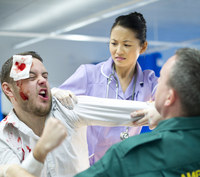
New California OSHA Workplace Violence Standard for Healthcare Workers
Sacramento, CA: There is little doubt that healthcare workers, second only perhaps to police officers, are amongst the highest groups of workers potentially exposed to workplace violence. Police have to worry about aggressiveness from criminals and suspects. For the healthcare worker, aggressiveness in the workplace can originate with patients showing aggression towards their healthcare provider. For 2017, the California Division of Occupational Safety and Health Administration (Cal/OSHA) is addressing this head-on with new guidelines which could come into effect as early as January.
What this means for the healthcare worker, is that employers will now have strict guidance with regard to minimizing, and even mitigating aggression and violence in the workplace. At the same time, however, some of the provisions are reported to be broad in nature and subject to interpretation. For the healthcare worker in the state of California, an employer’s due diligence (or lack thereof) with regard to enforcing the new rules could provide the basis for a California OSHA lawsuit amidst allegations the employer dropped the ball in enforcing the new guidelines.
Federally, OSHA has only broad guidelines with no specific standard of guidance with regard to workplace violence and aggression – especially for hospitals. California is reported to be the first state to bring in specific guidelines, through Cal/OSHA, for dealing with and preventing aggression and violence directed towards healthcare workers in hospitals.
The new California OSHA standard was not without pushback from hospitals. It has been reported that two labor unions representing healthcare workers in California lobbied the California Occupational Safety and Health Standards Board to adopt a new standard for specific protection against violence in the workplace. However, the California Hospital Association (CHA) opposed the standard (the CHA represents more than 400 hospitals in the state).
There was no reason given as to why the CHA opposed the standard. However it is presumed the hospitals took exception to broad terms used to reference “health care facilities” without more specific language suggesting which facilities, specifically, are covered by the standard. Thus, there could be broad interpretations employed. Same goes for the broad definitions employed for workplace violence, and threats of violence. The standard does specify aggression and violent behavior towards healthcare workers on the part of patients, visitors, fellow employees, non-facility workers, or anyone who might have had a personal relationship with a healthcare worker. However, specifics with regard to the acts, and types of aggression or violence, are described as overly broad.
The Cal/OSHA standard puts the onus on the employer to implement protocols and procedures, design and provide training for employees, and provide whatever equipment is deemed appropriate and necessary in order to mitigate workplace violence. However, the standard is short on specifics, leaving the employer to interpret the standard according to the employer’s own point of view and reference.
This could provide a challenge for both the employer, as well as the litigant should a healthcare worker file a California OSHA lawsuit citing failure to maintain a standard that has a number of ill-defined, moving parts.
There doesn’t appear much time for revising the Cal/OSHA standard, as speculation suggests it could be enacted as early as January. It is also expected that other states will use the California OSHA standard for workplace violence against healthcare workers as a template for their own governance with regard to violence, threats of violence and / or acts of aggression against healthcare workers.
Whether or not the standard will be amended going forward remains to be seen.



About . TOS . Privacy . Disclaimer . Contact . Advertise . Member Login
This work is licensed under a Creative Commons Attribution-NoDerivs 3.0 Unported License ©2026 Online Legal Media. All rights reserved.
Visit other Online Legal Media Websites: