Retail News

California FMLA Lawsuit Stymied by Tribal Immunity
However, there are various twists in this case given that the lawsuit was filed against the Morongo Band of Mission Indians - the operator of the slot facility - resulting in a ruling that sovereign immunity protects the tribe and its casino from FMLA claims.
The plaintiff in the California FMLA case is Crystal Muller, a former slot machine attendant who filed her complaint last November. According to court documents, Muller alleged she had fallen ill in 2010, requiring sick leave under FMLA. The leave had been approved. However, in mid-2013, Muller was terminated from her position. According to the California FMLA lawsuit, a manager at the casino had reported that Muller’s health issues were related to drug use, and that she was not capable of performing her job.
Muller countered that the drugs she was taking were prescribed for her disability - which wasn’t identified - and that the drugs did not impede her work performance in any way.
According to court documents, Muller lobbied for an appearance before the tribal council to plead her case. In her view, the real reason for her termination had little to do with drug use or job performance and everything to do with approved FMLA leave, and she sought arbitration for her case before her approved FMLA leave was set to expire. However, the plaintiff noted that she did not receive a response from the tribal council until a year later, only to be denied.
In her lawsuit, Muller was seeking either a court ruling forcing arbitration with the tribe through a court order or a grant of equitable relief. The defendants, in their response, moved to have the case dismissed - a move opposed by the plaintiff as being premature, given that in her view she had not exhausted all available remedies at the tribal level.
However, in her ruling, US District Judge Virginia A. Phillips noted that sovereign immunity protected the tribe and the casino it operated from claims under FMLA. Judge Phillips said the tribe did not consent to face FMLA claims by entering a gaming compact with the state of California that obligates the tribe to meet Fair Labor Standards Act requirements and waives sovereign immunity to casino-related personal injury and property damage claims.
“The court will not infer a waiver of immunity as to certain types of claims based on a separate, unrelated waiver of different categories of claims,” she wrote.
“Defendants correctly point out that no tribal remedies are available,” she wrote. “Exhaustion is not required, in a case such as this, where it would be futile.”
The judge also dismissed Muller’s claims against two individual tribal officers, finding their official actions are protected by the tribe’s immunity.
The case is Crystal A. Muller v. Morongo Casino Resort and Spa et al., Case No. 5:14-cv-02308, in the US District Court for the Central District of California.

Class-Action Status Given to Apple Wage and Hour Lawsuit
The initial lawsuit - which was dismissed in 2014 after a Supreme Court decision in a different case - was refiled. It alleges that because the security check is for the sole benefit of Apple and is done in all Apple retail stores across the US, that employees should be paid. Typically, employees undergo security screening after they have clocked out for their meal break or at the end of the day, meaning any time spent waiting for a manager to be free to do a check is unpaid time.
According to the initial lawsuit, that time can add up. For an employee leaving twice during a shift, the wait can mean anywhere from 10 to 15 unpaid minutes. For full-time employees, that adds up to uncompensated overtime.
The lawsuit calls Apple’s conduct regarding the unpaid security checks “illegal and improper” and says employees throughout the US are owed millions of dollars in wages and overtime. Amanda Frlekin, a named plaintiff in the original lawsuit, recorded between 10 and 15 uncompensated minutes during every shift, adding up to between 50 and 90 minutes over the course of the week.
“This daily 10-15 minute uncompensated waiting time during security checks was done in order to undergo searches for possible contraband and/or pilferage of inventory,” the lawsuit alleges. “Because such screening is designed to prevent and deter employee theft, a concern that stems from the nature of the employee’s work (specifically, their access to high value electronics and merchandise), the security checks and consequential wait time are necessary to the employee’s primary work as retail Specialists and done solely for Apple’s benefit.”
Workers are allegedly prohibited from leaving the store prior to a screening, and employees who refuse the security checks can face disciplinary action, including termination.
Apple has argued that the time spent undergoing bag checks is negligible and therefore should not be compensated. It also argues that not all managers conduct security screenings.
Will Paid Sick Leave Spur California Labor Lawsuits?
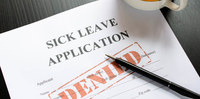
If an employer denies an employee accrued paid sick leave and/or retaliates in any way when an employee tries to use paid sick leave, that employee can now file a labor law complaint with the California Labor Commissioner’s Office. After a complaint is filed, the Commissioner’s Office has the authority to investigate the complaint and determine if damages and penalties will be awarded.
Many of those 6.5 million workers (about three-quarters of the state’s low-wage workers) who will benefit from this new law for the first time are parents who have to take care of their children. Too often children would show up at school sick because the (often single) parent feared getting fired if they didn’t show up at work. Having to send a sick child to school or leaving a sick child at home alone is heart-wrenching. Hillary Clinton said that no one should have “to choose between keeping a paycheck and caring for a new baby or a sick relative.”
And many employees who were never given paid sick leave, or any paid time off, are workers earning minimum wage. People in restaurants and retail who are barely scraping by and go to work sick (yes, the person who cooked your food could have the flu). Assembly member Lorena Gonzalez, D-San Diego, said that “We just want employers to know it’s not an option, and employees can’t be penalized for using their paid sick days. They can’t be fired or have their hours cut. It’s important for them to know they have the right to earn these paid sick days.”
The new law is complicated, and another reason why paid sick leave complaints may spur lawsuits. But every employee should know their rights and exactly what is covered. In a nutshell, for each 30 hours that somebody works, they get one hour of sick leave. The AB 1522 says that businesses will be required to show how many hours of paid sick leave workers have earned on their pay stubs. Employers can either choose to have workers accrue one hour of paid sick leave for every 30 hours worked, or grant employees three days of paid sick leave upfront, to be used within a one-year period.
Every business is required to provide this benefit, even if it only has one employee. Whenever possible, employees must provide “reasonable advance notification” orally or in writing of their desire to use the leave when the need for sick leave is foreseeable. Of course you can’t always know beforehand when you will be sick but you can also use sick leave for the following:
• the diagnosis, care or treatment of an existing health condition
• the preventive care of an employee
• an employee’s personal family member (including spouses, registered domestic partners, children, parents, grandparents, and siblings)
• employees who are victims of domestic violence, sexual assault, or stalking
If they haven’t done so already, employers might want to familiarize themselves with the new paid sick leave law and revise their policies and procedures. And employees shouldn’t rely on their employers to explain their benefits.

Manager Who Was Injured While Stopping Robbery at Rite Aid Recovers $3.7 million
The Los Angeles Superior Court jury ruled in the case of Robert Leggins against Rite Aid Corporation, which had employed Leggins since 1985.
After more than 20 years of exemplary performance, Leggins was injured in 2007 while attempting to stop a robbery at his store. The injury required several surgeries and a number of medical leaves and made it difficult for Leggins to lift, push or pull heavy objects. He still performed these tasks but with pain.
Escalating and repeated harassment
In his complaint, Leggins charged that in the years following his injury he endured escalating and repeated harassment and discrimination based on his disability. For example, he was subjected repeatedly to racial slurs like “I can get your old black ass fired” by his supervisors, managers, and directors, who also engaged in intentional actions that resulted in Leggins being treated less favorably after he returned to work from his neck surgery.
His lawyer, Carney Shegerian of Shegerian & Associates, Inc., in Santa Monica, detailed the series of increasingly discriminatory actions, including the fact that his direct supervisor harassed and discriminated against him and often maliciously forced him to perform physically challenging tasks when he was in pain.
He explained to the court how he endured racial slurs from co-workers, was told, “I can get your old black ass fired” and was ignored and further criticized and harassed when he complained to supervisors of these and other derogatory statements.
Fired on pretext
Ultimately, in 2013, after enduring years of steady harassment and discriminatory behavior and having multiple requests to be transferred to a different store rejected and ignored, Leggins was suspended for closing his store at 5:30 p.m. on New Year’s Day, despite the fact that he had received permission from his manager to close early.
A month later, Rite Aid terminated Leggins after 27 years of employment.
Shegerian and Leggins explained to the court how Leggins’ disability, and complaints of harassment and discrimination, and need for medical leaves were substantial motivating reasons for the termination.
As a direct result of the wrongful termination and discriminatory and harassing behavior of his former employers, Leggins suffered humiliation, emotional distress, and mental and physical pain and anguish.
Employers on notice
The jury ruled unanimously in favor of Leggins on all counts, including wrongful termination, disability discrimination, retaliation for making complaints of harassment and discrimination and failure to prevent discrimination, among other claims.
With the help of Shegerian & Associates, Leggins will now receive compensation for his suffering. The breakdown of the money that will be awarded includes $213,213 for past economic loss; $1,055,915 for future economic loss; $1,500,000 for past non-economic loss; $1,000,000 for future non-economic loss; and $5,000,000 in punitive damages, for a grand total of $8,769,128.
“Hopefully this verdict and the justice served in Mr. Leggins’ case will put all employers on notice that they simply cannot discriminate against employees for any reason - not based on race, on age, because of disabilities - not for any reason,” said Shegerian.

California Labor Paid Sick Leave Laws Clarified, Still Complicated
In sum, The Healthy Workplaces, Healthy Families Act of 2014 (AB 1522) was signed into law by Governor Jerry Brown last year for a planned two-stage implementation at the beginning of 2015. Various changes to record keeping and the posting of notices were brought in at the first of the year, followed by the implementation of changes to accruals and reporting on July 1.
The aforementioned changes to the California labor code were part of the original adoption of AB 1522. However, employers found the rollout somewhat overwhelming, requiring an update to AB 1522 in an effort to straighten out some of the confusion.
That update came in the form of AB 304, a bill that Governor Brown swiftly signed into law on July 14 and is effective immediately. The amendments provide some clarification with regard to compliance over payments, provisions for time off and so on. The clarifications are important not only for the employer - in order to properly comply - but also the employee, for whom a basic understanding of the new provisions is important in order to identify whether or not an employer is properly conforming to the new guidelines.
One of the clarifications with regard to California and labor law stemming from the quick passage of AB 304 has to do with record keeping: while an employer can know the reason(s) and purposes for which an employee uses paid sick time, there is no requirement in record-keeping protocols for maintaining documentation to that end.
Were an employer to maintain documentation with regard to the purposes for paid sick leave, or were an employee to find himself getting stiffed on sick pay and sick leave, he needs to be able to identify incidents of noncompliance in order to initiate and pursue a California labor lawsuit, as required.
AB 304 clarifies protocols for calculating paid sick leave, and the employer now has two options for doing so: 1) a calculation formula akin to the regular rate of pay for overtime calculation for the workweek in which paid sick time is used, and 2) the original calculation protocol dividing the employee’s total wages, not including overtime premium pay, by the employee’s total hours worked in the full pay periods of the prior 90 days of employment.
The July 14th amendment also provides for alternate accrual methods beyond the formula of one hour for each 30 hours worked, provided the accrual is on a regular basis and the employee will have 24 hours of paid sick leave available by the 120th calendar day of employment.
There is also clarification, for the purposes of California labor employment law, with regard to the right an employer has in limiting an employee’s use of paid sick days to 24 hours or 3 days either: (1) in each year of employment (by anniversary year, for example); or (2) in each calendar year; or (3) in any specified 12-month period.
Among other provisions in AB 304 is clarification over the requirement that an employee, to be eligible for paid sick leave, must be in a position to have worked for the same employer for 30 days, as opposed to simply working for any employer in the state of California.
There is a somewhat complicated grandfather clause for those employees who were provided paid sick leave or paid time off prior to the implementation of AB 1522 at the first of the year, and for whom a different method for accruing sick time may have been used. This clause allows for a more gradual accrual, provided the employee accrues eight hours of paid sick leave in the first three months of employment and was eligible to earn 24 hours of sick leave or paid time off within nine months of employment.
At the end of the day, California state labor laws are intended to level the playing field and provide fairness for the employee. A mutual understanding of California employee labor law is an important prerequisite for the employer to properly implement new laws, and for the employee to understand when those statutes are being accidentally or purposefully circumvented…

Respecting Caitlin Jenner and Her Community Under the Law
For some time now, California labor law has protected transgendered individuals from discrimination and harassment. However, a decision by the Superior Court of California, County of Sacramento last spring held that denying transgender employees the right to use gender-identity appropriate facilities remains a violation of the state’s anti-discrimination laws, and other statutes entrenched in the California Labor Code.
That decision, released in March of 2014, held that transgendered employees in the state of California have the right to use gender-identity appropriate change room and washroom facilities in the state of California. Various other states have enacted similar updates to their laws.
Now, the Feds have finally entered the pool with an update to federal codes that mirror California and labor law, as well as similar laws in other jurisdictions related to transgendered individuals.
To that end, the Occupational Safety and Health Administration (OSHA) on June 1 published A Guide to Restroom Access for Transgender Workers.
“The core principle is that all employees, including transgender employees, should have access to restrooms that correspond to their gender identity,” said Assistant Secretary of Labor for Occupational Safety and Health Dr. David Michaels, in a released statement. “OSHA’s goal is to assure that employers provide a safe and healthful working environment for all employees.”
The guide itself is detailed, but in sum, the rule is stated simply thus: if a female has transgendered, either emotionally or physically (or both) to male and therefore identifies as male, then that individual has the right and freedom to use the men’s washroom.
The same holds true for Bruce Jenner, who now identifies as Caitlin. It wasn’t that long ago that Jenner was being interviewed on national television about his story and his ongoing transition to female, the gender to which Jenner now identifies. This week, the release of the Caitlin Jenner photo shoot for the cover of Vanity Fair is a stark representation of what Jenner was revealing just a few weeks ago.
Therefore, applying the Bruce Jenner/Caitlin Jenner example to the rule of law, Bruce Jenner identifies as female now (as Caitlin Jenner) and thus, has the right to use the women’s washroom.
The OSHA guide, and the corresponding law, is founded upon the core belief that all employees in the workplace should be permitted, without retaliation, use of the facility that best matches his or her gender identification. At the end of the day, however, the OSHA guide notes that the employee should determine “the most appropriate and safest option for him - or herself.”
OSHA also identifies best polices that provide additional options that transgendered employees may choose, but are at the same time not a requirement. Such options, as available, could include: “Single-occupancy gender-neutral (unisex) facilities, and: Use of multiple-occupant, gender-neutral restroom facilities with lockable single occupant stalls.
“Under these best practices, employees are not asked to provide any medical or legal documentation of their gender identity in order to have access to gender-appropriate facilities,” states the guideline. “In addition, no employee should be required to use a segregated facility apart from other employees because of their gender identity or transgender status. Under OSHA standards, employees generally may not be limited to using facilities that are an unreasonable distance or travel time from the employee’s worksite.”
The guidelines also speak to the existence of local and state laws and statutes, such as California labor employment law, about which all employees should be conversant.
To summarize, transgendering has long passed the signpost of sensationalism. Rather, gender identification in any form has progressed from tolerance to widespread acceptance; and yet another indication of this is the release, this summer, of Becoming Us, an unscripted “docuseries” on ABC Family, documenting the life of 17-year-old Ben Lehwald of Evanston, Illinois. In the series, which is produced by Ryan Seacrest Productions, Ben’s father Charlie transitions to Carly. The narrative is told from Ben’s perspective as he watches his dad go through his divorce from Ben’s mom Suzy, before undergoing gender reassignment surgery.
In the grand scheme of things, washroom assignment (or reassignment) should be the least of a transgendered individual’s worries. Nonetheless, it is an issue that many states have been grappling with for some time - including California and labor law observed by the state. Now, the Department of Labor through the OSHA guideline will ensure that the rights of everyone are quite properly observed and respected behind the washroom stall.
Caitlin Jenner will use the women’s washroom. It’s only appropriate. And it’s also the law.

AT&T Faces California Labor Lawsuit
The lawsuit (Walton v. AT&T Inc., Case No. 2:15-cv-03716, in the US District Court for the Central District of California, Western Division) was filed on behalf of AT&T training specialists and delivery workers in California and across the US. Plaintiffs allege they were misclassified as exempt from overtime pay and therefore were denied overtime wages that they were entitled to.
“Pursuant to a centralized, company-wide policy, pattern, and/or practice, AT&T has unlawfully classified Plaintiff and other Training Specialists as exempt from overtime payments under federal and state laws, despite the fact that they should have been classified as nonexempt,” the lawsuit alleges (as found in court documents). As such, training specialists were not paid for all hours worked, including time above 40 hours in a week. The plaintiff alleges AT&T
Furthermore, the lawsuit alleges that AT&T did not keep accurate work records.
The named plaintiff, Wendell Walton, alleges he was employed by AT&T from July 2000 through the present and worked as a Senior Training Manager Design. Despite regularly working more than 40 hours in a workweek, Walton claims he was not paid for any hours in excess of 40.
The lawsuit refers to AT&T’s practices as “widespread, repeated, and consistent.” Plaintiffs seek damages, including liquidated damages, a declaratory judgment that the practices are unlawful, and attorneys’ fees and costs.
Under state and federal law, all non-exempt employees must be paid for overtime hours worked. Employees who are eligible for overtime pay but are misclassified as exempt are able to file a lawsuit to recover unpaid wages.
According to The Associated Press (4/28/15), AT&T also faces a $100 million discrimination lawsuit after a president at the company was found to have been using his work phone to send racist texts.

American Apparel Hit with Proposed California Labor Law Class Action
The proposed class action also alleges that many employees who had little proficiency with the English language were pressured into signing separation agreements described in court documents as “paltry,” and were also allegedly pressured into signing separation agreements they were unable to understand that left them little recourse for legal claims after the fact.
According to various media reports, American Apparel claimed the layoffs were necessary to ensure the future health and viability of the company. The proposed California labor lawsuit, however, notes that various requirements related to adequate severance and notice of layoff were not properly followed.
The lawsuit noted that various state and federal statutes that require 60 days’ notice prior to a layoff or job termination were not followed, and severance terms were described as “unconscionable,” with some employees offered as little as $300 in severance.
“As American Apparel’s management was well aware, many of these employees receiving these agreements did not speak, read, or write English. Several of these employees did not read or write at all,” the lawsuit said. “Notwithstanding the same, American Apparel’s management insisted that these employees sign these agreements immediately, even if they could not read or understand them.”
The lawsuit also notes the layoffs and terms fly in the face of a retooled ethics policy released by American Apparel in the wake of the recent termination of American Apparel founder Dov Charney in December of last year amidst various allegations of sexual harassment.
The proposed California and labor law class action also alleged that the CEO and other top management within the corporation awarded themselves additional stock options and salary increases, while stiffing laid-off employees with minimal severance, or so it is alleged.
The lawsuit seeks 60 days’ worth of pay for each laid-off worker, as well as backpay and other benefits for the affected workers of American Apparel.
The case is Hirschberg et al v. American Apparel Inc., Case No. 2:15-cv-02827, filed April 16 in the US District Court for the Central District of California.

Wal-Mart Hit with California Labor Lawsuit
Named plaintiff Afrous Nikmanesh worked as a pharmacist with Wal-Mart from November 2003 through September 2014. In addition to the allegation of missed rest periods, Nikmanesh claims that the retailer did not pay him and other pharmacists in the class for time studying for and completing APhA Immunization Training Programs. Plaintiffs assert that such training “was directly related” to the responsibilities of a pharmacist.
The California labor code lawsuit was originally filed in Orange County Superior Court in December of last year. The case was removed to federal court February 6.
“There is a well-defined community of interest in the questions of law and fact affecting the classes plaintiff seeks to represent,” the lawsuit said. “The class members’ claims against defendant involve questions of general or common interest, in that the claims are based on the defendant’s implementation and utilization of a policy under which [employees] ... did not receive any overtime compensation, minimum wage or any compensation whatsoever during the years in question.”
The California labor lawsuit seeks to represent current and former Wal-Mart employees who worked as pharmacists at Wal-Mart establishments across the US within the previous four years, according to the lawsuit.
California and labor law observes various state laws in concert with federal statutes under the Fair Labor Standards Act (FLSA) that mandate rest breaks, meal periods and overtime for non-management employees. Employers have, in the past and currently, attempted to circumvent such regulations by improperly classifying hourly employees as managers, even though they perform few, if any management tasks.
Wal-Mart is easily one of the largest retailers in the country, with scores of locations across the greater US as well as Canada, in addition to the state of California.
The California labor lawsuit case is Nikmanesh v. Wal-Mart Stores, Inc. et al., Case No. 8:15-cv-00202, in the US District Court for the Central District of California.

$1.6 Million California Labor Law Settlement Involving Sears Approved
The plaintiffs claimed that the giant retailer failed to pay minimum wage and overtime to Sears employees whose jobs entailed traveling to client homes and undertaking appliance repair, an affront to the California labor code, or so it was alleged. The amended settlement, approved by US District Judge Cormac J. Carney, is worth $1.6 million.
Lead plaintiff Nikola Lovig filed the lawsuit in April 2011. An employee of Sears for a period of one year prior to filing his California labor lawsuit, Lovig was amongst Sears technicians who traveled to, from and between the homes of customers to undertake repairs to various Sears appliances and products. The employees would use company vans that were tricked out with the various parts and tools required to affect the repairs, as needed.
In his California and labor law action, filed at US District Court for the Central District of California, Lovig accused Sears of failing to pay minimum wage and overtime, withholding payment for paid vacation days after employees quit, and failing to provide adequate meal and rest breaks in violation of the California Labor Code and California Business & Professions Code. Lovig also held Sears’ feet to the fire for its alleged failure to reimburse employees for expenses. He also accused Sears of issuing incomplete wage statements.
Judge Carney initially rejected the settlement, indicating that in his view the release terms were overly broad. However, less than a month after rejecting the initial settlement, Carney granted preliminary approval to an amended settlement, noting that in his view the settlement was fair.
“Having reviewed the negotiation process and substantive terms of the settlement agreement, the court finds no obvious deficiencies or grounds to doubt its fairness,” the order noted. Judge Carney found that the previous settlement agreement had issues pertaining to the release of claims beyond the scope of the allegations of the operative, fourth amended complaint to include claims from other iterations of the original complaint.
The amended terms of the settlement are said to have satisfied the judge’s concerns.
According to the terms of the settlement, mobile services technicians working for Sears from April 8, 2007 forward are to receive about $1.1 million based upon a typical class member’s weeks of employment within the aforementioned window. Lead plaintiff Lovig may receive as much as $10,000 as an incentive award in the California labor employment law settlement.
The California labor lawsuit is Lovig v. Sears Roebuck & Co., Case No. 5:11-cv-00756, in the US District Court for the Central District of California.



About . TOS . Privacy . Disclaimer . Contact . Advertise . Member Login
This work is licensed under a Creative Commons Attribution-NoDerivs 3.0 Unported License ©2026 Online Legal Media. All rights reserved.
Visit other Online Legal Media Websites: