
Retail News

ERISA Not Just About Protecting Investments
employee stock plans, the truth is that ERISA covers much more than retirement plans. Included in ERISA benefits are insurance provided through an employer, meaning that any claims about employer-provided insurance are covered by ERISA.
Covered by the Employee Retirement Income Security Act of 1974 (ERISA) are retirement, health, life insurance, and disability insurance plans. Covering only private employers, ERISA does not require employers to provide health insurance or other benefits plans; it simply sets out rules for when employers choose to offer such benefits. If employers choose not to offer benefits as covered by ERISA, they are not governed by ERISA rules. Furthermore, ERISA does not cover insurance policies that are purchased privately. It only covers those provided by an employer.
Under ERISA, those in charge of health plans and other benefits must provide information about the plan's funding and features, must abide by their fiduciary responsibilities and must provide an appeals process for people who have a grievance with their plans. Finally, ERISA gives participants the right to sue plan fiduciaries in cases where there is a breach of fiduciary duty.
Before a lawsuit can be filed, however, under ERISA the claimant must exhaust administrative remedies before filing a lawsuit. This means that if the insurance company has an internal appeals process, the claimant must file an appeal before filing a lawsuit, if the insurance policy in question is provided by the employer (private insurance, because it is not covered by ERISA, does not have such a requirement and a lawsuit can be filed once the first denial is received.)
Many insurance companies have rules for filing appeals, including a set time in which to file. Certain medical records and an appeal letter may also be required. If that appeal is then denied, a lawsuit can be filed to enforce the claimant's rights. A plan beneficiary or participant can file the lawsuit, depending on the circumstances, and the lawsuit is typically filed against the plan fiduciary or administrator.
It is important to note that under ERISA a claimant will not be awarded punitive damages; all that can be claimed are costs associated with the insurance policy.
Walmart Retaliation—California Labor Law Violation
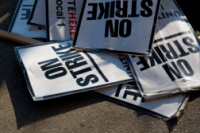
October 4, 2012 was an historic day for Walmart. More than 70 Los Angeles Walmart workers from nine stores walked off the job, even though they are not unionized. It was the first strike by Walmart retail employees in the retailer’s 50-year history. More workers and supporters rallied with the protesters, carrying signs saying "On Strike for the Freedom to Speak Out" and "Walmart Strike Against Retaliation”. Workers claim Walmart has threatened, suspended and even terminated employees for speaking out about working conditions and low pay.
Walmart employees claim the company constantly violates the California labor employment law and federal employment laws. In recent weeks alone, Walmart has received more than 20 charges of unfair labor practices nationwide from the National Labor Relation Board.
Workers claim that they have either been fired or had their hours cut back after being involved with OUR Walmart, according to Dan Schlademan, director of Making Change at Walmart, the campaign behind OUR Walmart. (OUR Walmart is a labor group backed by the United Food and Commercial Workers that defends Walmart workers' rights.) Schlademan further said workers have been told not to talk to OUR Walmart organizers and that doing so could shut down stores, which would mean they would be out of work.
Walmart has had more than its share of employment issues recently. Just one month ago, Walmart “lumpers”-- warehouse workers who load trucks to deliver to Walmart--walked off the job protesting against working conditions. (Walmart responded by saying that service providers and subcontractors are expected to comply with the law??"warehouse workers are employed by subcontractors, and not hired directly by Walmart.)
Walmart continued to hit the news when it responded to a “series of unprecedented labor strikes”, according to the Huffington Post (10/13/12). The largest retailer in the world is viewing the protests as “serious attacks” and at the same time, urging its managers not to “discipline” employees who engage in walkouts, sit-ins or sick-outs. It would appear that the company has taken an “about face” regarding retaliation than it had in the past.
Black Friday (Nov 23) is the deadline given to Walmart by striking employees, who demand the company end its retaliatory practices against workers attempting to organize. Along with demanding that Walmart stop retaliating against workers who want to unionize, employees at 28 stores nationwide are also asking for better pay and benefits.
So far Walmart in the US is not unionized, although the majority of stores worldwide are, according to Bloomberg (Jun 2011).

Is Cost-Cutting Wal-Mart Bad for California Labor Law?
That retailer is Wal-Mart Stores Inc. The National Employment Law Project, a labor organization advocating for low-wage workers, released a study critical of Wal-Mart and how it has decimated wages and benefits in the name of cost control. Some of the criticism translates as an affront to California labor code.
The Los Angeles Times (6/6/12) reported on the study, which relates to a large warehouse wholly-owned by Wal-Mart in Mira Loma, south of the Los Angeles / Ontario International Airport. The massive retailer has a partial ownership stake in another warehouse facility as well.
The study, according to the LA Times report, found that Wal-Mart has cut its costs on the supply side by outsourcing the operation of its warehousing, and the delivery of inventory. Those third-party entities, according to the study, will often hire Latino workers and pay them less??"sometimes at rates which fall below the stated minimum wage as identified under California labor code.
The Times report referenced a California labor lawsuit filed this past October against Wal-Mart's prime subcontractor, Schneider Logistics Inc., as well as Impact Logistics Inc. and Premier Warehousing Ventures. The complaint included allegations that employees were "forced to work long hours, under oppressive conditions for legally inadequate pay," sometimes below the state minimum wage of $8 an hour, according to the Times report.
The study "is not in any way suggesting that using subcontractors is a bad thing in and of itself," said Catherine Ruckelshaus, one of the authors of the study. But "when you're acting like Wal-Mart and exercising control at the warehouse and insisting on low cost, low cost, it puts pressure on the contractors and others in the chain to do work for subpar wages and under unhealthy working conditions," she said.
The state of California has previously levied fines in excess of $1 million against Impact Logistics and Premier Warehousing for violations of California labor employment law. Those violations are said to have included improper pay records and the failure to maintain itemized pay statements for hundreds of temporary workers.
Critics of the Wal-Mart model have observed other major retailers have dipped their toes into the third-party waters, in an effort to cut their own costs and compete with the retail juggernaut.
The California and labor law report noted that Schneider denied any wrongdoing, while Premier and Impact failed to respond to requests for comment. The Times repot noted that Premier cancelled its contract with Wal-Mart, while Schneider agreed to hire the workers as direct employees and pay them a wage of $12.75 per hour plus benefits. Under California labor employment law, workers must be paid a minimum of eight dollars per hour, and be provided with regular meal, and rest breaks.
A spokesperson for Wal-Mart noted in a statement that the giant retailer holds "contractors and subcontractors to the highest standards and expects them to comply with all applicable laws," according to California employee labor law, noted Dan Fogleman, in comments published in the LA Times.

Class Action Lawsuit Attempts to Clean Up the Car Wash
The latest blight on the car wash horizon was revealed this week in the Los Angeles Times (5/22/12) following the filing of a lawsuit by the Mexican American League Defense and Educational Fund against the operators of a trio of car washes in the state.
According to the report, Bijan, Edna and Kambiz Damavandi are the defendants in a class action lawsuit alleging unpaid overtime and other California labor law violations.
In their lawsuit, the plaintiffs allege the owners of Lincoln Millennium Car Wash, at 2454 Lincoln Blvd. in Venice; Santa Monica Car Wash, at 2510 Pico Blvd. in Santa Monica; and Bumble Bee Car Wash, at 2711 Del Amo Blvd. in Lakewood required workers to arrive at the facilities early, yet allowed them to formally clock in only when there were sufficient cars to wash.
Allegations include the denial of proper lunch and water breaks.
Plaintiffs are buoyed by previous settlements, which have favored workers in their California overtime law disputes with operators. The most recent was this past January when a settlement was announced by California Attorney General Kamala D. Harris benefitting workers employed at a collection of eight car wash facilities peppered throughout the state.
Akin to the current action, defendants were alleged to have denied workers meal breaks and rest periods, falsified payment records, and engaged in the non-payment of overtime. The settlement was worth $1 million.
Various efforts have been undertaken to enforce overtime pay laws and other labor statutes in the car wash industry, a sector that leans towards the employment of undocumented immigrants from Mexico and Central America. With fierce competition and diminished profit margins, many owners attempt to increase their already meager profits through the exploitation of their workers.
The lawsuit was filed May 21 in LA County Superior Court. Spokesperson for the plaintiffs Marcial Hernandez revealed he had toiled at Lincoln Millennium Car Wash for eight years prior to resigning, often working as many as 50 hours but paid for only 40. Adhering to overtime laws was never part of the equation. "(The owners) often insult you to get you to work faster," he said.
In Attempting to Thwart Theft, Retailer Accused of Stealing Wages
Business Wire (1/18/12) reported last month that five lead plaintiffs have accused managers of routinely delaying them during their lunch hours and upon the conclusion of their workday, in order to conduct bag searches. Legal professionals close to the California labor lawsuit make the point that many retail associates at Forever 21 are under 18 and still in high school - and thus, don't understand their rights under the California labor code.
The five lead plaintiffs - Jazzreeal Jones, Jessica Ramos, Shanelle Thompson, Alyssa Elias and Tiffinee Linthicum - accuse Forever 21 of unnecessarily detaining them and potentially thousands of participatory plaintiffs after hours, when employees are on their own time and not getting paid.
Thus, the California labor lawsuit alleges that such delays result in unpaid wages.
This is not the first time Forever 21 has been on the radar of California and labor law. Eleven years ago, workers in six factories complained of unsafe and unsanitary working conditions. A lawsuit was launched, but the action was dropped when Forever 21 agreed to improve working conditions in their factories and duly pay workers the wages they were owed.
Forever 21 operates various factories and has about 500 retail locations in eight countries, with 100 stores in California.
The California and labor law complaint against Forever 21 is similar to an action filed against Polo Ralph Lauren in 2010, according to Business Wire. That California labor lawsuit resulted in a $4 million settlement. At issue is the practice, described as industry-wide, of detaining employees at the end of their shifts for routine bag checks, in an effort to thwart potential acts of shoplifting.
In so doing, however, legal advocates claim that the practice, in reality, is robbing innocent employees of wages. In detaining their employees, Forever 21 is requiring them to remain on the premises until the bag check is complete, while not paying them to stay later in order to facilitate the check. Legal experts claim that such a practice runs afoul with workers' rights under California labor employment law.

California Labor Law: Discrimination Caused Wrongful Termination?
Laquisha started working in sales at Verizon in 2007. She says that everything was fine until last November. "I got along with everyone at work except for one of my co-workers," says Laquisha. "I'm an African-American lesbian who dresses 'kind of butch,' and I guess this bothered him. He made some comments about how gays shouldn't be allowed to work in this environment. This wasn't the first time he had made discriminatory remarks??"someone I worked with told me as much??"so this time I decided to report him to the new director.
"I emailed the director??"he had told us to call him directly with any complaints rather than go to HR??"and he replied immediately. 'I am so sorry this has happened and I will get back to you a.s.a.p.' But instead of hearing from him, my immediate supervisor began monitoring my sales calls excessively. Our calls are always monitored at random, usually three or four every few days. The first day I worked after my complaint, she monitored five of my calls.
"Then my supervisor, who is white and straight, accused me of talking to my sister (who also works at Verizon but in a different department) while I was on the clock. But my sister asked this supervisor if she could talk to Sherita, who works nearby, and she was given permission to do so."
According to Laquisha, it would seem like her supervisor was intent on making trouble for her. Even though Laquisha has been "number one" in sales month after month, she got a verbal warning from this supervisor in early November. She kept her head down and concentrated on work, but by the end of the month, the stress was too much to handle.
"I was getting sick from so much stress," explains Laquisha. "I had anxiety and panic attacks, and my blood pressure reached an all-time high so I got a doctor's note and took stress leave."
Laquisha was scheduled to return to work December 23, but her supervisor phoned on December 19 and told her that she was fired. "She said that a customer called and complained about me, about how the sale went," says Laquisha, "and that is all she said. I was in utter shock, I couldn't believe it. She said that details would be in the mail. The only thing I received was a letter stating that if I have any property belonging to Verizon, to return it immediately. Then I received my final check.
"I bought my first house in June and I live alone. Now I'm wondering how I'm going to make the next mortgage payment. I firmly believe that I was terminated because I am black. And I am the fourth black person to be terminated since this new director was hired??"three of my co-workers were fired in December and the company wasn't downsizing. My sister thinks her days are numbered too.
"I worked here for four years and had a stellar work record. I have never been in any trouble regarding my performance. As well, my understanding is that you get a verbal warning and a written warning, then a final warning before termination. I just got a verbal warning, and that wasn't even justified.
"It's crazy to think this discrimination goes on in 2011; that a company such as Verizon could violate the California labor code in this manner. Since I was fired, I have received a number of phone calls from different employees and even supervisors at Verizon saying how wrong they are in firing me.
"I contacted an employment attorney through LawyersandSettlements and they are currently getting my employment records. I am looking for work but I don't want my job back. I think it would be fair to get compensated at my regular rate of pay??"including the average rate of my commission??"from the time I was terminated until I find a new job. That isn't asking much. But even more than that, Verizon should not be allowed to discriminate against anyone!"
Discrimination and wrongful termination are clearly violations of the California labor law. As well, Verizon may have violated the Americans with Disabilities Act by firing Laquisha while she was on disability leave. Her employment attorney is investigating…

California Labor Law Agreement Reached for Grocers
According to the news source, the negotiators for the grocery chains and the United Food and Commercial Workers (UFCW) reached a deal that will prevent a strike of more than 54,000 workers throughout Southern California.
The agreement comes after a number of months of public disagreements, with negotiations ultimately heating up after a recent deadline passed. The sides reportedly worked through the weekend to reach the agreement, which is reportedly for three years, the news source said.
The actual details of the deal were not made available to the public, as union members have received the proposal and still need to vote on it. Union officials said that the contract would be approved if at least 50 percent of the members plus one additional vote ratified the agreement, according to the Times.
In separate statements, representatives from the grocery chains and the union said they were satisfied with the deal that was reached.
"We are pleased to have reached a tentative settlement agreement with the union that continues to preserve good wages, secure pensions and access to quality, affordable healthcare??"while allowing us to be competitive in the marketplace," Ralphs, Vons and Albertsons said in the statement, according to the news source.
Rick Icaza, president of UFCW Local 770 in Orange County, added that the deal "protects grocery workers' jobs and healthcare, and keeps the employers' profitable."
Reuters reports that the dispute in this instance dates back to a 141-day strike in Southern California during 2003 and 2004. The strike, which was the longest work stoppage in the history of the US grocery industry, reportedly cost the chains more than $1 billion in sales.
According to the news source, the strike also had an effect on the loyalty of customers, many of whom flocked to nonunion food vendors including Wal-Mart Stores Inc., Costco Wholesale Corp. and Target Corp. Additionally, other competitors such as Whole Foods Market and other upscale chains have increased competition.
Andrew Wolf, an analyst for BB&T Capital Markets, told the news source that both sides were likely forced to make compromises to come to the deal, saying it probably involved "mutual pain and compromise."

Little-Known California Labor Law in Good Standing with Employees
California labor code is said to be one of the most stringent in the US, governing everything from overtime computation to meal and rest breaks. It's the latter that retail employees, or those who spend an inordinate part of their day on their feet, come to rely on for relief from standing.
However, according to a recent report by the Associated Press (AP) that was carried earlier this month in the Washington Post, many retailers in the state of California - including such national chains as Wal-Mart, Home Depot and Target - are facing lawsuits alleging that plaintiffs are not afforded "suitable seating" for relief from standing.
According to the AP report, the obscure statute is known as the private attorney general provision and lurks in California labor employment law. Long since accustomed to standing for hours at a time, plaintiffs are now demanding the means by which to take a load off while they're at their workstation.
According to AP, a couple of recent appellate decisions have allowed for workers and their legal advisers to employ the private attorney general provision - which apparently opens the door for a complaint to management about lack of proper seating, according to provisions in California and labor law.
Observers have noted that major retailers could be facing millions of dollars in damages. A first violation reportedly carries a fine equaling $100 per employee per pay period. The penalty is said to be doubled for any subsequent violation.
Employees who work as checkout consultants in supermarkets have sometimes required special footwear due to the need to constantly stand while at their workstation. Others have experienced back problems due to the inability to take a load off their feet outside of designated break periods.
The private attorney general provision in California state labor laws apparently provides plaintiffs with a framework to try and effect change.

Levi Strauss Agrees to Pay Back Wages in California, US
The root issue of the violation is misclassification. But not everyone. The investigation found that the issue depended upon when an employee was hired by the company. To that point, it was found that employees working at previously existing stores were exempt from overtime. However, newly hired employees were not. It was found, according to an investigation by the US Department of Labor, that new hires were treated the same as existing employees.
They shouldn't have…
Assistant store managers were required to work off-clock during openings and closings early in the morning and late at night, respectively. Staff shortages were also occasions when assistant store managers were called upon to take up the slack, without fair compensation. As the investigation was first conducted by the San Francisco District Office of the Labor Department's Wage and Hour Division, the violations are rooted in California labor code.
Levi Strauss Co. is based in San Francisco.
"Misclassification of employees has serious and adverse consequences for employees, as well as for corporations," said Secretary of Labor Hilda L. Solis. "When violations of federal labor laws are discovered, this department will take appropriate action to ensure that workers receive the wages they deserve."
Even though the issue affects employees across the country, the investigation also uncovered misclassifications at Levi Strauss headquarters in California??"although it is was not clear why employees with more tenure were exempt from overtime, whereas more recent hires were not.
As a result of the California and labor law investigation, Levi Strauss agreed to pay back wages for a period covering two years to affected employees. The company also made a commitment to undertake an upgrade of its systems governing tracking time and attendance.
Levi Strauss has operations in Santa Clara, and thus is bound by California labor employment law.

California Labor Law: Discrimination Goes Both Ways
"My daughter worked at this theater for more than a year but she never got any training except for the concession," says Leo in an e-mail. "She was promised full-time employment, but sometimes she only got a few hours per week if her Asian co-workers needed the hours." Leo goes on to say that his daughter was harassed and discriminated against to the point where she had a mental breakdown and had to be hospitalized. She didn't return to work.
According to Leo, the managers, all of Asian descent, gave their Asian employees promotions, better positions and more hours.
"Employees who are Hispanic or African American are treated like third class citizens. They have even been physically pushed and humiliated. My daughter was laughed at by one manager who later asked her 'What are you going to do about it?' These same managers have been reported by other managers for abusive behavior and discrimination, but HR has not done anything. For the last seven months that my daughter worked there, the harassment escalated, week after week. There are many other employees with similar situations??"they have felt displaced by their newly hired Asian co-workers and have suffered some form of California labor abuse but have been told that they would be fired if they complained." Not only is discrimination and some forms of harassment against the California labor code, so is retaliation.
Sexual harassment is a California labor law violation, as Cindy (not her real name) is aware of. What happened to Ian (also not his real name) is the flip side of the above situation.
"Part of my job as department manager is to monitor the staff, including their breaks," says Ian, in an e-mail. "I had to write up a female employee for abusing break time (her 15-minute break became 55 minutes on several occasions, and again for yelling and insulting me in front of staff). In response to my reports, she falsified an e-mail and falsely accused me of sexual harassment."
Ian states that upper management looked for evidence of the e-mail in question but can't find it. However, if you dig deep enough, just about every e-mail is traceable. According to Ian, he then asked local management to pull all of his e-mails, but they refused, saying there was too much work to be done and they didn't have the resources to investigate.
"So that leaves me in extreme stress as this woman daily displays and promotes hatred, discrimination and harassment towards me."



About . TOS . Privacy . Disclaimer . Contact . Advertise . Member Login
This work is licensed under a Creative Commons Attribution-NoDerivs 3.0 Unported License ©2026 Online Legal Media. All rights reserved.
Visit other Online Legal Media Websites: