
Professional Service News

California Labor Laws Extend to Undocumented Workers
The truth is, however, even undocumented workers can file complaints about workplace violations without having their residency called into question. A 2002 California law provides undocumented workers full protection under state and federal law. In other words, if a worker who does not have legal documentation has his or her rights violated by an employer, he or she can file a claim against the employer.
This includes violations of discrimination laws. In 2014, according to the Los Angeles Times (6/26/14), California’s Supreme Court ruled that an undocumented worker who alleged he suffered disability discrimination was eligible for protection. Vicente Salas filed a discrimination lawsuit against his employer, alleging he was retaliated against for filing a workers’ compensation claim. The workers’ compensation claim was filed when Salas injured his back while at work.
Although the lawsuit was dismissed by two lower courts - after the employer found out allegedly Salas used someone else’s Social Security number to obtain employment - California’s Supreme Court found Salas could sue for back pay. In its ruling, the court noted the employer had to pay legally mandated wages to employees. Job protections extend to all workers “regardless of immigration status,” the Supreme Court wrote.
Many immigrants who enter the U.S illegally do not speak up about on-the-job violations because they are afraid of deportation. This means they are vulnerable to workplace abuses, although they have the same rights as all other employees.
Among the employment protections undocumented workers are entitled to are minimum wage, overtime, workplace safety - including protection from harassment and assault - certain discrimination laws and retaliation. Furthermore, it is illegal for an employer to report or threaten to report undocumented workers in retaliation for asserting their rights. If these rights are violated, workers can file claims against their employers.

California FMLA Lawsuit Stymied by Tribal Immunity
However, there are various twists in this case given that the lawsuit was filed against the Morongo Band of Mission Indians - the operator of the slot facility - resulting in a ruling that sovereign immunity protects the tribe and its casino from FMLA claims.
The plaintiff in the California FMLA case is Crystal Muller, a former slot machine attendant who filed her complaint last November. According to court documents, Muller alleged she had fallen ill in 2010, requiring sick leave under FMLA. The leave had been approved. However, in mid-2013, Muller was terminated from her position. According to the California FMLA lawsuit, a manager at the casino had reported that Muller’s health issues were related to drug use, and that she was not capable of performing her job.
Muller countered that the drugs she was taking were prescribed for her disability - which wasn’t identified - and that the drugs did not impede her work performance in any way.
According to court documents, Muller lobbied for an appearance before the tribal council to plead her case. In her view, the real reason for her termination had little to do with drug use or job performance and everything to do with approved FMLA leave, and she sought arbitration for her case before her approved FMLA leave was set to expire. However, the plaintiff noted that she did not receive a response from the tribal council until a year later, only to be denied.
In her lawsuit, Muller was seeking either a court ruling forcing arbitration with the tribe through a court order or a grant of equitable relief. The defendants, in their response, moved to have the case dismissed - a move opposed by the plaintiff as being premature, given that in her view she had not exhausted all available remedies at the tribal level.
However, in her ruling, US District Judge Virginia A. Phillips noted that sovereign immunity protected the tribe and the casino it operated from claims under FMLA. Judge Phillips said the tribe did not consent to face FMLA claims by entering a gaming compact with the state of California that obligates the tribe to meet Fair Labor Standards Act requirements and waives sovereign immunity to casino-related personal injury and property damage claims.
“The court will not infer a waiver of immunity as to certain types of claims based on a separate, unrelated waiver of different categories of claims,” she wrote.
“Defendants correctly point out that no tribal remedies are available,” she wrote. “Exhaustion is not required, in a case such as this, where it would be futile.”
The judge also dismissed Muller’s claims against two individual tribal officers, finding their official actions are protected by the tribe’s immunity.
The case is Crystal A. Muller v. Morongo Casino Resort and Spa et al., Case No. 5:14-cv-02308, in the US District Court for the Central District of California.

Class-Action Status Given to Apple Wage and Hour Lawsuit
The initial lawsuit - which was dismissed in 2014 after a Supreme Court decision in a different case - was refiled. It alleges that because the security check is for the sole benefit of Apple and is done in all Apple retail stores across the US, that employees should be paid. Typically, employees undergo security screening after they have clocked out for their meal break or at the end of the day, meaning any time spent waiting for a manager to be free to do a check is unpaid time.
According to the initial lawsuit, that time can add up. For an employee leaving twice during a shift, the wait can mean anywhere from 10 to 15 unpaid minutes. For full-time employees, that adds up to uncompensated overtime.
The lawsuit calls Apple’s conduct regarding the unpaid security checks “illegal and improper” and says employees throughout the US are owed millions of dollars in wages and overtime. Amanda Frlekin, a named plaintiff in the original lawsuit, recorded between 10 and 15 uncompensated minutes during every shift, adding up to between 50 and 90 minutes over the course of the week.
“This daily 10-15 minute uncompensated waiting time during security checks was done in order to undergo searches for possible contraband and/or pilferage of inventory,” the lawsuit alleges. “Because such screening is designed to prevent and deter employee theft, a concern that stems from the nature of the employee’s work (specifically, their access to high value electronics and merchandise), the security checks and consequential wait time are necessary to the employee’s primary work as retail Specialists and done solely for Apple’s benefit.”
Workers are allegedly prohibited from leaving the store prior to a screening, and employees who refuse the security checks can face disciplinary action, including termination.
Apple has argued that the time spent undergoing bag checks is negligible and therefore should not be compensated. It also argues that not all managers conduct security screenings.
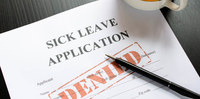
Will Paid Sick Leave Spur California Labor Lawsuits?
If an employer denies an employee accrued paid sick leave and/or retaliates in any way when an employee tries to use paid sick leave, that employee can now file a labor law complaint with the California Labor Commissioner’s Office. After a complaint is filed, the Commissioner’s Office has the authority to investigate the complaint and determine if damages and penalties will be awarded.
Many of those 6.5 million workers (about three-quarters of the state’s low-wage workers) who will benefit from this new law for the first time are parents who have to take care of their children. Too often children would show up at school sick because the (often single) parent feared getting fired if they didn’t show up at work. Having to send a sick child to school or leaving a sick child at home alone is heart-wrenching. Hillary Clinton said that no one should have “to choose between keeping a paycheck and caring for a new baby or a sick relative.”
And many employees who were never given paid sick leave, or any paid time off, are workers earning minimum wage. People in restaurants and retail who are barely scraping by and go to work sick (yes, the person who cooked your food could have the flu). Assembly member Lorena Gonzalez, D-San Diego, said that “We just want employers to know it’s not an option, and employees can’t be penalized for using their paid sick days. They can’t be fired or have their hours cut. It’s important for them to know they have the right to earn these paid sick days.”
The new law is complicated, and another reason why paid sick leave complaints may spur lawsuits. But every employee should know their rights and exactly what is covered. In a nutshell, for each 30 hours that somebody works, they get one hour of sick leave. The AB 1522 says that businesses will be required to show how many hours of paid sick leave workers have earned on their pay stubs. Employers can either choose to have workers accrue one hour of paid sick leave for every 30 hours worked, or grant employees three days of paid sick leave upfront, to be used within a one-year period.
Every business is required to provide this benefit, even if it only has one employee. Whenever possible, employees must provide “reasonable advance notification” orally or in writing of their desire to use the leave when the need for sick leave is foreseeable. Of course you can’t always know beforehand when you will be sick but you can also use sick leave for the following:
• the diagnosis, care or treatment of an existing health condition
• the preventive care of an employee
• an employee’s personal family member (including spouses, registered domestic partners, children, parents, grandparents, and siblings)
• employees who are victims of domestic violence, sexual assault, or stalking
If they haven’t done so already, employers might want to familiarize themselves with the new paid sick leave law and revise their policies and procedures. And employees shouldn’t rely on their employers to explain their benefits.

California Labor Paid Sick Leave Laws Clarified, Still Complicated
In sum, The Healthy Workplaces, Healthy Families Act of 2014 (AB 1522) was signed into law by Governor Jerry Brown last year for a planned two-stage implementation at the beginning of 2015. Various changes to record keeping and the posting of notices were brought in at the first of the year, followed by the implementation of changes to accruals and reporting on July 1.
The aforementioned changes to the California labor code were part of the original adoption of AB 1522. However, employers found the rollout somewhat overwhelming, requiring an update to AB 1522 in an effort to straighten out some of the confusion.
That update came in the form of AB 304, a bill that Governor Brown swiftly signed into law on July 14 and is effective immediately. The amendments provide some clarification with regard to compliance over payments, provisions for time off and so on. The clarifications are important not only for the employer - in order to properly comply - but also the employee, for whom a basic understanding of the new provisions is important in order to identify whether or not an employer is properly conforming to the new guidelines.
One of the clarifications with regard to California and labor law stemming from the quick passage of AB 304 has to do with record keeping: while an employer can know the reason(s) and purposes for which an employee uses paid sick time, there is no requirement in record-keeping protocols for maintaining documentation to that end.
Were an employer to maintain documentation with regard to the purposes for paid sick leave, or were an employee to find himself getting stiffed on sick pay and sick leave, he needs to be able to identify incidents of noncompliance in order to initiate and pursue a California labor lawsuit, as required.
AB 304 clarifies protocols for calculating paid sick leave, and the employer now has two options for doing so: 1) a calculation formula akin to the regular rate of pay for overtime calculation for the workweek in which paid sick time is used, and 2) the original calculation protocol dividing the employee’s total wages, not including overtime premium pay, by the employee’s total hours worked in the full pay periods of the prior 90 days of employment.
The July 14th amendment also provides for alternate accrual methods beyond the formula of one hour for each 30 hours worked, provided the accrual is on a regular basis and the employee will have 24 hours of paid sick leave available by the 120th calendar day of employment.
There is also clarification, for the purposes of California labor employment law, with regard to the right an employer has in limiting an employee’s use of paid sick days to 24 hours or 3 days either: (1) in each year of employment (by anniversary year, for example); or (2) in each calendar year; or (3) in any specified 12-month period.
Among other provisions in AB 304 is clarification over the requirement that an employee, to be eligible for paid sick leave, must be in a position to have worked for the same employer for 30 days, as opposed to simply working for any employer in the state of California.
There is a somewhat complicated grandfather clause for those employees who were provided paid sick leave or paid time off prior to the implementation of AB 1522 at the first of the year, and for whom a different method for accruing sick time may have been used. This clause allows for a more gradual accrual, provided the employee accrues eight hours of paid sick leave in the first three months of employment and was eligible to earn 24 hours of sick leave or paid time off within nine months of employment.
At the end of the day, California state labor laws are intended to level the playing field and provide fairness for the employee. A mutual understanding of California employee labor law is an important prerequisite for the employer to properly implement new laws, and for the employee to understand when those statutes are being accidentally or purposefully circumvented…

Respecting Caitlin Jenner and Her Community Under the Law
For some time now, California labor law has protected transgendered individuals from discrimination and harassment. However, a decision by the Superior Court of California, County of Sacramento last spring held that denying transgender employees the right to use gender-identity appropriate facilities remains a violation of the state’s anti-discrimination laws, and other statutes entrenched in the California Labor Code.
That decision, released in March of 2014, held that transgendered employees in the state of California have the right to use gender-identity appropriate change room and washroom facilities in the state of California. Various other states have enacted similar updates to their laws.
Now, the Feds have finally entered the pool with an update to federal codes that mirror California and labor law, as well as similar laws in other jurisdictions related to transgendered individuals.
To that end, the Occupational Safety and Health Administration (OSHA) on June 1 published A Guide to Restroom Access for Transgender Workers.
“The core principle is that all employees, including transgender employees, should have access to restrooms that correspond to their gender identity,” said Assistant Secretary of Labor for Occupational Safety and Health Dr. David Michaels, in a released statement. “OSHA’s goal is to assure that employers provide a safe and healthful working environment for all employees.”
The guide itself is detailed, but in sum, the rule is stated simply thus: if a female has transgendered, either emotionally or physically (or both) to male and therefore identifies as male, then that individual has the right and freedom to use the men’s washroom.
The same holds true for Bruce Jenner, who now identifies as Caitlin. It wasn’t that long ago that Jenner was being interviewed on national television about his story and his ongoing transition to female, the gender to which Jenner now identifies. This week, the release of the Caitlin Jenner photo shoot for the cover of Vanity Fair is a stark representation of what Jenner was revealing just a few weeks ago.
Therefore, applying the Bruce Jenner/Caitlin Jenner example to the rule of law, Bruce Jenner identifies as female now (as Caitlin Jenner) and thus, has the right to use the women’s washroom.
The OSHA guide, and the corresponding law, is founded upon the core belief that all employees in the workplace should be permitted, without retaliation, use of the facility that best matches his or her gender identification. At the end of the day, however, the OSHA guide notes that the employee should determine “the most appropriate and safest option for him - or herself.”
OSHA also identifies best polices that provide additional options that transgendered employees may choose, but are at the same time not a requirement. Such options, as available, could include: “Single-occupancy gender-neutral (unisex) facilities, and: Use of multiple-occupant, gender-neutral restroom facilities with lockable single occupant stalls.
“Under these best practices, employees are not asked to provide any medical or legal documentation of their gender identity in order to have access to gender-appropriate facilities,” states the guideline. “In addition, no employee should be required to use a segregated facility apart from other employees because of their gender identity or transgender status. Under OSHA standards, employees generally may not be limited to using facilities that are an unreasonable distance or travel time from the employee’s worksite.”
The guidelines also speak to the existence of local and state laws and statutes, such as California labor employment law, about which all employees should be conversant.
To summarize, transgendering has long passed the signpost of sensationalism. Rather, gender identification in any form has progressed from tolerance to widespread acceptance; and yet another indication of this is the release, this summer, of Becoming Us, an unscripted “docuseries” on ABC Family, documenting the life of 17-year-old Ben Lehwald of Evanston, Illinois. In the series, which is produced by Ryan Seacrest Productions, Ben’s father Charlie transitions to Carly. The narrative is told from Ben’s perspective as he watches his dad go through his divorce from Ben’s mom Suzy, before undergoing gender reassignment surgery.
In the grand scheme of things, washroom assignment (or reassignment) should be the least of a transgendered individual’s worries. Nonetheless, it is an issue that many states have been grappling with for some time - including California and labor law observed by the state. Now, the Department of Labor through the OSHA guideline will ensure that the rights of everyone are quite properly observed and respected behind the washroom stall.
Caitlin Jenner will use the women’s washroom. It’s only appropriate. And it’s also the law.

Claim Adjusters May Not Be in Good Hands with Allstate
Under California and labor law, non-exempt employees are to be paid overtime for any work performed above 40 hours per week or beyond 5 days per week, as well as extra pay for missed meal breaks and rest periods as mandated by the California labor code, if an employee is required to work through a rest period or meal break.
However, according to the California labor lawsuit, policy and protocol observed by Allstate effectively discourages managers from paying overtime, allegedly due to incentives afforded Allstate managers to stay within mandated budgets. Such incentives, according to the lawsuit, included paid bonuses to managers who kept within budgetary parameters.
Plaintiffs claimed that such incentives for managers to stay on budget - not to mention the pursuit of a good performance review that might hinge on a manager’s capacity to stay within budgetary guidelines - dissuaded managers from recording overtime hours.
“The complaint alleges that Allstate’s managers are required to stay within an annual budget that includes overtime compensation, and that the performance evaluations and bonuses paid to managers are dependent on how closely they conform to the budget,” said attorney Alexander R. Wheeler, of the R. Rex Parris Law Firm, which represents the plaintiffs. “This would mean that a manager would have a disincentive to approve and report overtime, the class claims.”
That’s a violation of California labor employment law.
Plaintiffs allege that managers would witness workers performing tasks off the clock and outside of their normal work hours, but make no inquiry as to whether or not overtime was to be requested. The California labor lawsuit also suggests that repeated requests for overtime were seen as a performance issue, rather than incidents that suggested claims adjusters were given too much work to complete within the allotted hours.
Rather than suggest a requisition for overtime, an employee might be counseled as to alternative work methods through better training and increased efficiency in order to avoid overtime hours. However, given the incentives allegedly afforded by the defendant to stay within budget suggests Allstate managers did not have the best interests of their underlings at heart, but rather their own and those of the defendant.
“The potential recovery in this case is expected to be in the hundreds of millions for wage theft by Allstate,” said R. Rex Parris, founding partner of the R. Rex Parris Law Firm. “Casualty adjuster Jack Jimenez brought the suit in 2010 on behalf of any claims adjuster working for the insurer in the state of California since Sept. 29, 2006.”
California state labor laws are clear with regard to the requirement to pay overtime for non-exempt workers. While an employer always has the right to offer training in order to improve efficiency in an effort to avoid overtime, an employer does not have the right to deny an employee overtime pay for extra hours worked, when the overtime was unavoidable.
The case is Jack Jimenez v. Allstate Insurance Company - Case No. 2:10-cv- 10-8486-JAK-FFM, in the United States Court of Appeals for the Ninth Circuit.

California Wrongful Termination So Wrong
Robert (not his real name) worked for three years as a service technician for a car dealership. He was paid a flat rate, something like commission. He teamed up with another technician and they had the highest hours of production. “If we did the job in 30 minutes we would still get paid for an hour’s work,” Robert explains. “We worked really well together and we were efficient.”
So efficient were they that the boss thought it was physically impossible to complete the allocated work on a vehicle in that amount of time. “We completed one job on Monday, handed over the paperwork and left after finishing our shift,” he says. “On Tuesday we worked only half a day and the manager called us into the office before we left. He told us there was no way we could have finished the job. But the customer didn’t complain; in fact, I never had a customer complain that we didn’t finish the job, ever.
“We worked a full day Wednesday stewing over whether we would get fired or not. By Thursday they brought us into the office. They gave us our final checks but made us sign the pink slip first - it stated that we were terminated for falsification of documents and flagging hours on repair orders and charging customers on work not performed.”
In other words, they were accused of stealing - up-selling to a customer and not completing the job. “For example, a vehicle would need an oil change. We were responsible for checking the vehicle and giving our report to the service manager, who would in turn talk to the customer and sell the work based on our recommendations. Perhaps the car needed a power steering flush or it was due for transmission service. But this service manager decided that we couldn’t do this up-sell in such a short period of time. He basically screwed us.”
Sounds like the dark ages: guilty until proven innocent. The dealership didn’t have any evidence to back up the accusation: It didn’t have a video camera and not one customer complaint. Robert doesn’t even think they checked the vehicle in question after they left work on Monday. “Unless you take a scope and check the fuel injectors there is no way of telling whether the work was done and I know they didn’t do that,” he says.
Robert can only surmise that they were fired because the guy he worked with was written up more than a few times over the years. “For instance, he almost got into a fistfight with the service advisor - the guy who I believe instigated our wrongful termination,” says Robert. “They both got written up for misconduct but I had never been written up. Instead I got a $3 per hour raise just a few months ago so I was making $19 per hour.
“And just a week before I was fired, the service manager told me how he appreciated all the hard work I do, ‘busting my ass.’ But when we were reprimanded, he treated us like jerks. He is the epitome of company man. He wasn’t around when we worked 6-day shifts; when we came into work on our days off to finish jobs. He had no idea how much I bled for this place.”
After he was wrongfully terminated, Robert was concerned about whether he would qualify for unemployment benefits so he called the manager, who said he could just appeal it. Robert was fired seven weeks ago and still doesn’t know if he can collect. And he hasn’t found another job.
“I have applied for work at numerous places but when a potential employer phones my former employer and finds out I was terminated, guess what - they aren’t going to hire me. I worked seven years in the automotive industry and I get shafted. I am only 30 years old and the only job experience I have is in this business. I have $2 in my bank account and my credit cards are maxed out. I’m not sure if an attorney can help so maybe it’s time I have a career change.”

Correctional Officer Forced to Work California Overtime
Alan says they were paid overtime according to the California labor laws and they had a choice: work overtime or lose your job and walk away from retirement benefits. He says there are many unhappy employees in the nation’s prisons.
Alan, who retired in 2008, worked in state prisons anywhere from level 1-4, where the more dangerous inmates are placed in level 4 with minimum security being level 1. “In the last decade or so, the prison population increased to such an extent that building new facilities couldn’t keep up,” he says. “As a consequence, there weren’t enough officers to cover the new housing units.” According to “the general rule of thumb,” at least two officers must be allocated per 100 inmates, but Alan says most units contained hundreds of inmates with only two officers.
“Judging from the amount of complaints going around I believe that hundreds of officers didn’t want to work so much overtime,” he says. “One former co-worker retired last year after working 26 years. He had seniority but said it was unfair to those starting out, especially officers with families.”
With seniority you can choose to work overtime or not. Seniority also means that officers with the least seniority can wind up working 16-hour days, five days a week. “Sure the money is great but those hours are brutal and it’s dangerous,” Alan explains. “It’s not fair to your co-workers because you cannot be alert when you are exhausted. We even had a few officers who fell asleep at the wheel because of fatigue: It is a serious problem.
“We were forced to work a minimum of three overtime shifts per week (we would work our regular 8-hour shift and then we were held over: They needed us to work another eight hours. So 16-hour days, sometimes 3 or 4 days per week were common and often we were required to work 16 hours five days a week. We were paid time and a half over eight hours and double time was paid weekends and holidays.”
Before talking to LawyersandSettlements, Alan wasn’t aware that he is owed a lot of overtime pay: if he adds up all those 16-hour days, Alan is owed a big chunk of change because he should have been paid double time after 12 hours. The California overtime law states the following:
• One and one-half times the employee’s regular rate of pay for all hours worked in excess of eight hours up to and including 12 hours in any workday, and for the first eight hours worked on the seventh consecutive day of work in a workweek;
and
• Double the employee’s regular rate of pay for all hours worked in excess of 12 hours in any workday and for all hours worked in excess of eight on the seventh consecutive day of work in a workweek.
Alan has another complaint regarding overtime. His salary averaged about $110,000 due to working so much overtime but he had to take an early retirement five years ago at the age of 55 due to a work-related injury. “They calculated my salary on my hourly rate working eight hours per day and didn’t include overtime pay,” he says. “What is most unfair is that if you refused to work overtime, that was grounds for dismissal. They wanted it both ways.”
Alan has filed an overtime complaint against the California Correctional Institute.

Cupcakes with Termination Tasteless
Maryann, a paralegal, was given less than 24 hours termination notice. “I was called into the conference room just before 5 p.m.,” says Maryann. “First of all, my boss explained that my position was being eliminated due to financial difficulties and then he asked if I wanted a cupcake to celebrate a new change and transition.”
She didn’t quite have the appetite for a cupcake - chalk it up to bad timing and bad taste - her employer usually brought cupcakes to celebrate an employee’s birthday.
“I was the operations manager for a small immigration law firm that comprised 15 or so staff,” says Maryann. “My title was operations manager so I wore many hats for the attorneys, from handling HR to working with the tech guy. I couldn’t see how they could manage without someone working in this capacity. ‘Who is going to do my job?’ I asked the boss when he gave me the news that I was fired. ‘We’d like you to help us figure it out,’ he replied. ‘And when would you like me to do that?’ I asked.
“He wanted me to help him out the very next day. I was in a state of shock. The controller of the firm had recently left without notice so I was also doing some of her duties, including payroll.
“He could tell this news wasn’t sitting well with me. ‘Would you like to have an exit interview?’ he asked, and then had the nerve to ask what I liked about working here and what could they do better next time around. This really floored me: did he want me to help find a replacement?”
Maryann went to work the next day to ensure that she would be paid for vacation and sick leave. After all, there was no one else in charge of payroll. And she had the “exit interview” that more or less consisted of describing her job description.
“I knew the point of this interview was so that someone taking my place would be prepared, and that my employer would be better equipped to pick up the pieces,” she explains. “Then I simply left. I didn’t get paid for doing the payroll that day, nor did I get my last paycheck, which is another violation of the California labor code. In fact, I didn’t get my paycheck until two weeks later.
“There was more to being terminated than their excuse of financial difficulties. My boss told me that I wasn’t a good manager because I treated people like adults. ‘If you treat people like children they will act like children,’ I replied. (The firm consisted of three middle-aged lawyers and the rest of the employees were in their early 20s.) I took unpaid personal time when my father died and I think that is another reason why I was fired.”
Maryann asked her boss if she was getting severance pay - she thought one month’s salary would be fair for both employee and employer. He hadn’t thought about that. She followed up a week later via e-mail. He replied that the company was “broke” so she wouldn’t be receiving any severance pay.
“I had asked for a month but figured I would get two weeks’ pay; I had worked here for two years,” Maryann says. “I wasn’t expecting nothing - it was like a slap in the face. I believe they have money but I should focus on moving forward and not deal with a crappy past.”
Maryann is now collecting unemployment but she expects to be employed before it runs out. Adding insult to injury, she recently got a call from the accounting coordinator, asking Maryann if she could walk her through the payroll process - with no mention of compensation. “I helped her because it was important to me that people got paid,” she says.
“Before I got my first unemployment check, I consulted with two attorney friends: they recommended that I contact LawyersandSettlements because I wasn’t sure if I had a leg to stand on or not regarding wrongful termination. Then I found out that California is an at-will state. If I didn’t qualify for unemployment, I would definitely have filed a California labor lawsuit, but in the end, I am glad to be gone from that toxic environment with their cupcakes and moving on…”
(In 1978, Dan White gunned down mayor George Moscone and supervisor Harvey Milk. White’s defense team argued that consuming Twinkies had diminished his mental capacity and therefore White was not capable of premeditation required to be charged with first degree murder: he got off with voluntary manslaughter.)



About . TOS . Privacy . Disclaimer . Contact . Advertise . Member Login
This work is licensed under a Creative Commons Attribution-NoDerivs 3.0 Unported License ©2026 Online Legal Media. All rights reserved.
Visit other Online Legal Media Websites: