
Education News

Class-Action Status Given to Apple Wage and Hour Lawsuit
The initial lawsuit - which was dismissed in 2014 after a Supreme Court decision in a different case - was refiled. It alleges that because the security check is for the sole benefit of Apple and is done in all Apple retail stores across the US, that employees should be paid. Typically, employees undergo security screening after they have clocked out for their meal break or at the end of the day, meaning any time spent waiting for a manager to be free to do a check is unpaid time.
According to the initial lawsuit, that time can add up. For an employee leaving twice during a shift, the wait can mean anywhere from 10 to 15 unpaid minutes. For full-time employees, that adds up to uncompensated overtime.
The lawsuit calls Apple’s conduct regarding the unpaid security checks “illegal and improper” and says employees throughout the US are owed millions of dollars in wages and overtime. Amanda Frlekin, a named plaintiff in the original lawsuit, recorded between 10 and 15 uncompensated minutes during every shift, adding up to between 50 and 90 minutes over the course of the week.
“This daily 10-15 minute uncompensated waiting time during security checks was done in order to undergo searches for possible contraband and/or pilferage of inventory,” the lawsuit alleges. “Because such screening is designed to prevent and deter employee theft, a concern that stems from the nature of the employee’s work (specifically, their access to high value electronics and merchandise), the security checks and consequential wait time are necessary to the employee’s primary work as retail Specialists and done solely for Apple’s benefit.”
Workers are allegedly prohibited from leaving the store prior to a screening, and employees who refuse the security checks can face disciplinary action, including termination.
Apple has argued that the time spent undergoing bag checks is negligible and therefore should not be compensated. It also argues that not all managers conduct security screenings.
Will Paid Sick Leave Spur California Labor Lawsuits?
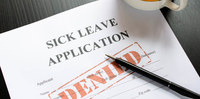
If an employer denies an employee accrued paid sick leave and/or retaliates in any way when an employee tries to use paid sick leave, that employee can now file a labor law complaint with the California Labor Commissioner’s Office. After a complaint is filed, the Commissioner’s Office has the authority to investigate the complaint and determine if damages and penalties will be awarded.
Many of those 6.5 million workers (about three-quarters of the state’s low-wage workers) who will benefit from this new law for the first time are parents who have to take care of their children. Too often children would show up at school sick because the (often single) parent feared getting fired if they didn’t show up at work. Having to send a sick child to school or leaving a sick child at home alone is heart-wrenching. Hillary Clinton said that no one should have “to choose between keeping a paycheck and caring for a new baby or a sick relative.”
And many employees who were never given paid sick leave, or any paid time off, are workers earning minimum wage. People in restaurants and retail who are barely scraping by and go to work sick (yes, the person who cooked your food could have the flu). Assembly member Lorena Gonzalez, D-San Diego, said that “We just want employers to know it’s not an option, and employees can’t be penalized for using their paid sick days. They can’t be fired or have their hours cut. It’s important for them to know they have the right to earn these paid sick days.”
The new law is complicated, and another reason why paid sick leave complaints may spur lawsuits. But every employee should know their rights and exactly what is covered. In a nutshell, for each 30 hours that somebody works, they get one hour of sick leave. The AB 1522 says that businesses will be required to show how many hours of paid sick leave workers have earned on their pay stubs. Employers can either choose to have workers accrue one hour of paid sick leave for every 30 hours worked, or grant employees three days of paid sick leave upfront, to be used within a one-year period.
Every business is required to provide this benefit, even if it only has one employee. Whenever possible, employees must provide “reasonable advance notification” orally or in writing of their desire to use the leave when the need for sick leave is foreseeable. Of course you can’t always know beforehand when you will be sick but you can also use sick leave for the following:
• the diagnosis, care or treatment of an existing health condition
• the preventive care of an employee
• an employee’s personal family member (including spouses, registered domestic partners, children, parents, grandparents, and siblings)
• employees who are victims of domestic violence, sexual assault, or stalking
If they haven’t done so already, employers might want to familiarize themselves with the new paid sick leave law and revise their policies and procedures. And employees shouldn’t rely on their employers to explain their benefits.

California Labor Paid Sick Leave Laws Clarified, Still Complicated
In sum, The Healthy Workplaces, Healthy Families Act of 2014 (AB 1522) was signed into law by Governor Jerry Brown last year for a planned two-stage implementation at the beginning of 2015. Various changes to record keeping and the posting of notices were brought in at the first of the year, followed by the implementation of changes to accruals and reporting on July 1.
The aforementioned changes to the California labor code were part of the original adoption of AB 1522. However, employers found the rollout somewhat overwhelming, requiring an update to AB 1522 in an effort to straighten out some of the confusion.
That update came in the form of AB 304, a bill that Governor Brown swiftly signed into law on July 14 and is effective immediately. The amendments provide some clarification with regard to compliance over payments, provisions for time off and so on. The clarifications are important not only for the employer - in order to properly comply - but also the employee, for whom a basic understanding of the new provisions is important in order to identify whether or not an employer is properly conforming to the new guidelines.
One of the clarifications with regard to California and labor law stemming from the quick passage of AB 304 has to do with record keeping: while an employer can know the reason(s) and purposes for which an employee uses paid sick time, there is no requirement in record-keeping protocols for maintaining documentation to that end.
Were an employer to maintain documentation with regard to the purposes for paid sick leave, or were an employee to find himself getting stiffed on sick pay and sick leave, he needs to be able to identify incidents of noncompliance in order to initiate and pursue a California labor lawsuit, as required.
AB 304 clarifies protocols for calculating paid sick leave, and the employer now has two options for doing so: 1) a calculation formula akin to the regular rate of pay for overtime calculation for the workweek in which paid sick time is used, and 2) the original calculation protocol dividing the employee’s total wages, not including overtime premium pay, by the employee’s total hours worked in the full pay periods of the prior 90 days of employment.
The July 14th amendment also provides for alternate accrual methods beyond the formula of one hour for each 30 hours worked, provided the accrual is on a regular basis and the employee will have 24 hours of paid sick leave available by the 120th calendar day of employment.
There is also clarification, for the purposes of California labor employment law, with regard to the right an employer has in limiting an employee’s use of paid sick days to 24 hours or 3 days either: (1) in each year of employment (by anniversary year, for example); or (2) in each calendar year; or (3) in any specified 12-month period.
Among other provisions in AB 304 is clarification over the requirement that an employee, to be eligible for paid sick leave, must be in a position to have worked for the same employer for 30 days, as opposed to simply working for any employer in the state of California.
There is a somewhat complicated grandfather clause for those employees who were provided paid sick leave or paid time off prior to the implementation of AB 1522 at the first of the year, and for whom a different method for accruing sick time may have been used. This clause allows for a more gradual accrual, provided the employee accrues eight hours of paid sick leave in the first three months of employment and was eligible to earn 24 hours of sick leave or paid time off within nine months of employment.
At the end of the day, California state labor laws are intended to level the playing field and provide fairness for the employee. A mutual understanding of California employee labor law is an important prerequisite for the employer to properly implement new laws, and for the employee to understand when those statutes are being accidentally or purposefully circumvented…

Respecting Caitlin Jenner and Her Community Under the Law
For some time now, California labor law has protected transgendered individuals from discrimination and harassment. However, a decision by the Superior Court of California, County of Sacramento last spring held that denying transgender employees the right to use gender-identity appropriate facilities remains a violation of the state’s anti-discrimination laws, and other statutes entrenched in the California Labor Code.
That decision, released in March of 2014, held that transgendered employees in the state of California have the right to use gender-identity appropriate change room and washroom facilities in the state of California. Various other states have enacted similar updates to their laws.
Now, the Feds have finally entered the pool with an update to federal codes that mirror California and labor law, as well as similar laws in other jurisdictions related to transgendered individuals.
To that end, the Occupational Safety and Health Administration (OSHA) on June 1 published A Guide to Restroom Access for Transgender Workers.
“The core principle is that all employees, including transgender employees, should have access to restrooms that correspond to their gender identity,” said Assistant Secretary of Labor for Occupational Safety and Health Dr. David Michaels, in a released statement. “OSHA’s goal is to assure that employers provide a safe and healthful working environment for all employees.”
The guide itself is detailed, but in sum, the rule is stated simply thus: if a female has transgendered, either emotionally or physically (or both) to male and therefore identifies as male, then that individual has the right and freedom to use the men’s washroom.
The same holds true for Bruce Jenner, who now identifies as Caitlin. It wasn’t that long ago that Jenner was being interviewed on national television about his story and his ongoing transition to female, the gender to which Jenner now identifies. This week, the release of the Caitlin Jenner photo shoot for the cover of Vanity Fair is a stark representation of what Jenner was revealing just a few weeks ago.
Therefore, applying the Bruce Jenner/Caitlin Jenner example to the rule of law, Bruce Jenner identifies as female now (as Caitlin Jenner) and thus, has the right to use the women’s washroom.
The OSHA guide, and the corresponding law, is founded upon the core belief that all employees in the workplace should be permitted, without retaliation, use of the facility that best matches his or her gender identification. At the end of the day, however, the OSHA guide notes that the employee should determine “the most appropriate and safest option for him - or herself.”
OSHA also identifies best polices that provide additional options that transgendered employees may choose, but are at the same time not a requirement. Such options, as available, could include: “Single-occupancy gender-neutral (unisex) facilities, and: Use of multiple-occupant, gender-neutral restroom facilities with lockable single occupant stalls.
“Under these best practices, employees are not asked to provide any medical or legal documentation of their gender identity in order to have access to gender-appropriate facilities,” states the guideline. “In addition, no employee should be required to use a segregated facility apart from other employees because of their gender identity or transgender status. Under OSHA standards, employees generally may not be limited to using facilities that are an unreasonable distance or travel time from the employee’s worksite.”
The guidelines also speak to the existence of local and state laws and statutes, such as California labor employment law, about which all employees should be conversant.
To summarize, transgendering has long passed the signpost of sensationalism. Rather, gender identification in any form has progressed from tolerance to widespread acceptance; and yet another indication of this is the release, this summer, of Becoming Us, an unscripted “docuseries” on ABC Family, documenting the life of 17-year-old Ben Lehwald of Evanston, Illinois. In the series, which is produced by Ryan Seacrest Productions, Ben’s father Charlie transitions to Carly. The narrative is told from Ben’s perspective as he watches his dad go through his divorce from Ben’s mom Suzy, before undergoing gender reassignment surgery.
In the grand scheme of things, washroom assignment (or reassignment) should be the least of a transgendered individual’s worries. Nonetheless, it is an issue that many states have been grappling with for some time - including California and labor law observed by the state. Now, the Department of Labor through the OSHA guideline will ensure that the rights of everyone are quite properly observed and respected behind the washroom stall.
Caitlin Jenner will use the women’s washroom. It’s only appropriate. And it’s also the law.

Denied Disability: When Injuries Affect Work
ABC News (3/31/14; kesq.com) reports on a teacher who suffered a severe head injury while at work, but has had her disability insurance claim denied. The teacher, Melissa Labayog, was injured when she attempted to break up a fight at her school. She was struck by a student and was reportedly left partially blind and deaf. She also reportedly suffered significant brain injuries.
As a result of her injury, Labayog has switched schools and is now forced to teach in a dark room because she cannot see in bright light. Labayog’s insurance company has reportedly denied her claims, resulting in her filing a lawsuit against the company. The insurance company has so far not commented on the lawsuit.
Injuries that affect a person’s employment can result in that person making the difficult decision between their job or their recovery. Connecticut Law Tribune (4/4/14) reports on Jose Morales, who was injured when his car was hit by another vehicle that failed to stop at a stop sign. Morales suffered shoulder pain that was eventually diagnosed as a partially torn rotator cuff.
Morales was employed as a janitor and laundry attendant at a local hospital when the accident occurred, according to the report. Two doctors recommended surgery but Morales, concerned about the loss of income due to the recovery time following surgery, declined the medical procedure and instead went to physical therapy. So far, Morales’ medical bills total around $13,000.
One of the insurance companies involved in the situation argued that Morales could have had the shoulder surgery, which might have helped him recover. It also argued that an incident in which Morales fell down stairs at work following the car accident had a much more severe impact on his quality of life. Finally, the company argued that a pre-existing back condition also contributed to his pain.
A jury, however, sided with Morales and awarded him $122,274. Because he originally settled with a second insurance company following the car accident, the $50,000 from that settlement will be taken out of the jury’s award.

ERISA Not Just About Protecting Investments
employee stock plans, the truth is that ERISA covers much more than retirement plans. Included in ERISA benefits are insurance provided through an employer, meaning that any claims about employer-provided insurance are covered by ERISA.
Covered by the Employee Retirement Income Security Act of 1974 (ERISA) are retirement, health, life insurance, and disability insurance plans. Covering only private employers, ERISA does not require employers to provide health insurance or other benefits plans; it simply sets out rules for when employers choose to offer such benefits. If employers choose not to offer benefits as covered by ERISA, they are not governed by ERISA rules. Furthermore, ERISA does not cover insurance policies that are purchased privately. It only covers those provided by an employer.
Under ERISA, those in charge of health plans and other benefits must provide information about the plan's funding and features, must abide by their fiduciary responsibilities and must provide an appeals process for people who have a grievance with their plans. Finally, ERISA gives participants the right to sue plan fiduciaries in cases where there is a breach of fiduciary duty.
Before a lawsuit can be filed, however, under ERISA the claimant must exhaust administrative remedies before filing a lawsuit. This means that if the insurance company has an internal appeals process, the claimant must file an appeal before filing a lawsuit, if the insurance policy in question is provided by the employer (private insurance, because it is not covered by ERISA, does not have such a requirement and a lawsuit can be filed once the first denial is received.)
Many insurance companies have rules for filing appeals, including a set time in which to file. Certain medical records and an appeal letter may also be required. If that appeal is then denied, a lawsuit can be filed to enforce the claimant's rights. A plan beneficiary or participant can file the lawsuit, depending on the circumstances, and the lawsuit is typically filed against the plan fiduciary or administrator.
It is important to note that under ERISA a claimant will not be awarded punitive damages; all that can be claimed are costs associated with the insurance policy.

CSU Faculty Vote to Strike under California Labor Law
In a news release issued May 2, the California Faculty Association (CFA) noted their members have been in negotiations with CSU for the past two years, without success. The talks were at an impasse, and while small delegations representing both sides in the California labor employment law dispute met last week in an attempt to find some small patches of common ground, members of the CFA voted in April to authorize rolling strikes.
Were strikes to force a delay in the start of classes at all 23 campuses of CSU this September, some 400,000 students would be affected. It is not known if such a disruption in the school year would result in a California labor lawsuit on the part of disgruntled students or their parents.
"We have said all along that we do not want to strike, but we will if that is what is necessary," said CFA president Lillian Taiz, a history professor at Cal State Los Angeles, in comments contained in the release.
Under California labor employment law, there are various steps governing the process. Were the delegations to be unsuccessful in finding any common ground, the next step would be to bring in a neutral third party??"referred to by some as a mediator. Here, the issues would be reviewed with the third party making recommendations to both sides for settling the dispute.
A rejection of third-party recommendations by both sides would trigger the expiry of the current contract. According to the release, CSU would have the power under California state labor laws to impose its contractual demands and concessions on the members of the bargaining unit??"and the CFA would have the right to strike.
While such actions would be legal under California employee labor law, a full strike by CFA faculty would have a severe impact on students either beginning their university studies or continuing in an existing program. Depending on the duration of a possible work stoppage, the delay in the commencement of classes could threaten the academic year and impact timelines and opportunities for starting a career.
With the CFA bargaining unit authorizing rolling strikes, the entire CSU system would not be affected all at once. However, in the event of a contract expiry and having the right to strike under California state labor laws, there would be nothing stopping the CFA from amending that position in an effort to put increased pressure on the CSU.
Were that to happen, would a California labor lawsuit (or series of lawsuits) by disgruntled students or parents be far behind? Stay tuned.

Former Basketball Coach Sues over California Labor Law Violations
In the lawsuit, Jerald Clinton Eaglesmith claimed that the school officials created a work environment that was hostile and tried to take away his equal protection rights according to the law.
According to the news provider, the majority of the alleged indiscretions came during Eaglesmith's tenure as Quincy High School's head basketball coach. The suit contends that Superintendent Glenn Harris and other school officials discriminated against him and actively worked to "eliminate" him from the basketball program.
The lawsuit, which was filed in California's Eastern District of the US District Court, also names an assistant superintendent, a principal and four other officials, the news source said.
The town of Quincy, California, which is where the high school is located, is the county seat of Plumas County.

Was Worker's Death Due to Ignorance of California Labor Laws?
Margarita Mojica was 26 at the time of her death two years ago when she became entrapped in a box creasing and cutting machine. She was 17 weeks pregnant at the time with her second child.
California labor code, as with many federal statutes, dictates not only the requirement that an employer provide a safe work environment, but also that a worker has a right to protest if he or she feels at any time in danger while on the job.
It is not clear if the victim was even aware of the potential for disaster while simply doing her job.
According to the October 19th issue of the San Francisco Chronicle, the Oakland wife and mother of a young daughter was preparing a box creasing and cutting machine to start a job at the facility to replace a cutting die. According to prosecutors she was leaning into the machine when it suddenly activated and closed like a giant clamshell around her.
It is alleged that the owners of Digital Pre-Press International (DPI) of San Francisco were employing a previously owned cutting and creasing machine originally purchased in 2003. It has been reported that workers at some juncture asked to have a safety bar removed from the machine to allow for the handling of thicker cardboard. Investigators say the safety bar was not reinstalled.
While it is unclear if the accident would have been prevented had the safety bar been in place, there are a number of allegations that suggest workers at the facility were not properly schooled in safety protocols according to the tenets of California and labor law.
Regulators cited DPI on two previous occasions, in 1998 and again in 2001, for failing to maintain a worker safety program. The owner of DPI, Sanjay Sakhuja, is reported to have communicated to regulators that he had a training program in place by 2002; and an insurance inspection in 2007 found no problems with the machines at the facility.
However, following the tragic death of Mojica, state regulators under California labor employment law issued no fewer than 14 citations against DPI for not training workers properly. While the plant was reported to have a written safety program, workers told regulators they were never instructed on machine safety.
Sakhuja, along with pressroom manager Alick Yeung, have each been charged with manslaughter and willful violation of California state labor laws. A wrongful death civil suit has since been settled, according to The Chronicle. The value of the settlement was reported to be $6 million.



About . TOS . Privacy . Disclaimer . Contact . Advertise . Member Login
This work is licensed under a Creative Commons Attribution-NoDerivs 3.0 Unported License ©2026 Online Legal Media. All rights reserved.
Visit other Online Legal Media Websites: