
California Labor Law News

Pier 1 Imports Faces California Labor Lawsuit
The lawsuit (case number 1-14-CV-263883) was filed by Kimberly Erin Caselman, who alleges she was denied reasonable accommodations for her pregnancy. Caselman further alleges she was placed on involuntary leave due to her pregnancy. According to the Legal Aid Society, Employment Law Center (4/16/14), Caselman informed her employer in November 2013 that her doctor required her to lift no more than 15 pounds during her pregnancy. She was also told she should not climb ladders during the pregnancy.
Pier 1 reportedly has a “light duty” policy during which women who have pregnancy-related conditions are put on light duty for up to eight weeks. When those eight weeks are up, they are then placed on unpaid pregnancy leave if continued accommodations are necessary.
Caselman was placed on eight-week light duty, which ended on January 16, 2014. She was then put on unpaid pregnancy leave, which is set to expire in May, before her July due date. In other words, according to the lawsuit, Caselman is expected back at work from her maternity leave before she has her baby.
According to Legal Aid Society, Caselman was able to fulfill her job requirements while on light duty, but because the eight weeks of light duty expired, was forced into unpaid maternity while still able to work. This, attorneys argue, is a violation of labor laws requiring employers to make reasonable accommodation for pregnant women.
Under California Law, pregnant employees cannot be forced into involuntary leave. Furthermore, employers must make reasonable accommodation for pregnant women. Not all states have these requirements, which is why a federal bill, the Pregnant Workers Fairness Act, to extend such protections across the US, is pending. The Pregnant Workers Fairness Act would address loopholes that have allowed employers to fire pregnant women, rather than make reasonable accommodations for them. Because of those loopholes, the courts have sided with employers.
For example, according to the National Women’s Law Center Fact Sheet on Pregnant Workers (online at nwlc.org), some courts have required women making a pregnancy discrimination claim to prove that a non-pregnant employee with nearly identical symptoms as her was treated better by the employer.
For now, however, pregnant employees in California are offered protections under the law and can file a lawsuit if employers fail to make reasonable accommodation for their pregnancy and/or force their pregnant employee into unpaid leave. Caselman’s lawsuit seeks to represent female employees who are or have been forced to take unpaid leave from their employment after eight weeks of light duty.

Bay Area Contractor on Hook for Almost $1 Million in California Labor Lawsuit
The claim, against Ghilotti Brothers Inc. (Ghilotti Brothers, Ghilotti) of the Bay Area, was wage fraud. Which, of course, is in violation of California labor law.
According to San Jose Mercury News Business (4/24/14), the complaint revolved around work performed by many Spanish-speaking laborers prior to and following their shifts - primarily, loading and unloading trucks. For employees who are paid at or near minimum wage, tasks performed off the clock can translate to wage fraud given that all hours of work, properly documented, might ordinarily result in the payment of overtime according to statutes entrenched in California labor code.
The plaintiffs also allege that the defendant discouraged them from taking meal breaks and rest periods, further adding to the allegation of wage fraud and violation of California employment labor law.
The three lead plaintiffs in the class-action California labor lawsuit - Jose Ramirez, Luis Gomez and Marck Mena Ortega - allege their employer distributed English-language forms with their paychecks and required all employees to sign. It was alleged the forms warranted that Ghilotti had provided the employee all appropriate compensation. The problem with the form, said the plaintiffs, was that many employees are Spanish-speaking and thus did not understand what they were signing.
According to court documents, the lawsuit was originally filed in 2012 at Alameda County Superior Court, prior to the case being transferred to federal court in San Francisco. The California labor employment law settlement was granted final approval by US District Court Judge Charles Breyer on April 22.
Under the terms of the California labor law settlement, a total of $530,000 will be distributed to the 242 class members over the course of the next three years. The three lead plaintiffs will also receive an extra $15,000 for representing the class - although it was unclear if the three will receive $15,000 as a collective or individually. The remainder of the settlement will go toward attorney’s fees and court costs.
As part of the California employee labor law settlement, Ghilotti is required to establish a system whereby employees have the capacity to accurately record their start and stop times for work. The attorney representing the three lead plaintiffs - who still work for Ghilotti - noted in comments published in San Jose Mercury News Business that the problem(s) represented by this California class action is not unique in an industry that has a tendency to play fast, loose and lax with California prevailing wage law.
San Jose Mercury News Business reports that Ghilotti Brothers has reported more than $100 million in annual revenues.

Pregnancy Discrimination Still Violates California Labor Law
Ashley returned to work from maternity leave to find that she had been demoted. “I worked at this company for six years, the first four of which I was part time,” says Ashley. “It was a struggle to get full-time status, but with it came job security and benefits so I was thrilled to be in this position, especially with my third child on the way.” Ashley has been “reclassified” back to part time, which means that she loses her medical benefits and of course, less hours. “My full-time job has been filled by someone who barely has any training, but she is young and doesn’t have any kids,” says Ashley. “I am certain that the company looks at me as a liability now that I had my third child and this is so wrong.”
If Ashley is right in assuming she lost her full-time position because she was discriminated against for being a mother, she should probably talk to an employment attorney.
It gets worse.
On the very last day Suzanne worked before taking maternity leave, she was fired! “I was told by HR that I was approved for Family and Medical Leave (FMLA) for 12 weeks but I won’t be eligible for short-term disability benefits,” says Suzanne, who worked at this company for more than 12 months and therefore qualifies for FMLA. “And on top of that, I want to file a California wrongful termination claim against my employer.”
Suzanne has called an attorney who specializes in Employment Law. Even in a right to work state, if there is any appearance of discrimination (i.e., firing you without cause just before you go on maternity leave and therefore NOT having to pay you for sick leave or vacation time), you may be protected under the Pregnancy Discrimination Act.
Angela was laid off two weeks before her son was born. “My boss told me that they had to downsize but I found out from a co-worker that just a week after I was terminated that a young man took my place,” she says. “Although he didn’t come right out and say so, I think my former employer considers women with children as liabilities. And that is infuriating.”
Fortunately for these women, California has the strongest parental leave programs and protections in the US. The California “at will” employment policy does not allow employee termination for time off for family leave or maternity leave. As well, Suzanne, Angela and Ashley are pro-active: they are all taking steps to file a California labor lawsuit against their employer.
The California Fair Employment and Housing Act explicitly prohibits employers from harassing, demoting, terminating or otherwise discriminating against any employee for becoming pregnant, or for requesting or taking pregnancy leave. The Act applies to all employers that regularly employed five or more full-time employees in the preceding year.
The California Pregnancy Disability Leave Law (“PDLL”) is part of the California Fair Employment and Housing Act, and requires employers who employ 5 or more employees to provide employees who are disabled by their pregnancy a reasonable period of leave, not to exceed four months. An employee who is disabled by her pregnancy and entitled to PDLL leave may take the leave all at once or in increments. An employer is not required to pay wages to an employee taking PDLL leave, unless it has a policy of continuing the payment of wages for other types of temporary disability leaves.

Fleet Service Workers Now Boarding Class-Action California Labor Lawsuit
At issue are allegations made by unionized fleet service workers employed at San Francisco International Airport by US Airways Inc. (US Airways). In a complaint certified as a class-action lawsuit April 4 by a California federal judge, some 554 full- and part-time fleet service workers allege they have been stiffed out of overtime pay and meal breaks by their employer. According to California labor code, workers are legally entitled to meal breaks and overtime pay.
The airline, however, argues that provisions in the Railway Labor Act, under which contracts and collective bargaining agreements are negotiated with the International Association of Machinist and Aerospace Workers (IAMAW) union, trump state labor statutes. Together with an interpretation of California labor and employment law that US Airways claims exempts a so-called shift trade policy from overtime obligations under the federal labor code, the defendant held that class-action status should not be granted.
However, US District Judge Charles R. Breyer aligned with the plaintiffs’ motion for class certification.
The fleet service workers are responsible for the loading and off-loading of planes, de-icing tasks, and establishing ramps to the aircraft. Collective bargaining agreements set out when meal breaks are taken and when overtime is paid, according to the unique demands of an industry that puts a great deal of importance on the timeliness of scheduled flights at a busy airport. There are also provisions for shift swaps, so-called “pick-up” shifts, and other provisions unique to the airline industry.
However, as the workers perform their tasks in the state of California, California and labor law comes into play. Lead plaintiffs in the class action, Joseph Timbang Angeles and Noe Lastimosa, contend that members of the class have been stiffed from overtime and have also worked off the clock by way of various pre-shift and post-shift activities.
The defendants claim that any employee who clocks in a few minutes earlier than his or her established start time, and/or clocks out a few minutes beyond the normal end of his or her shift, is not necessarily performing work.
Percolating in the background is the ongoing need to ensure a plane is ready to go and a flight is allowed to leave on time. Were a worker to forego a rest or meal period in order to ensure a plane is readied on schedule, is that meal period made up later? Is there a wage provision to compensate for missed meal periods?
US Airways holds that plaintiffs’ claims are preempted by federal airline labor laws. The plaintiffs disagree, and their California labor lawsuit - filed in November 2012 - will now move forward as a class action. The case is Angeles et al. v. US Airways Inc., Case No. 3:12-cv-05860, US District Court for the Northern District of California.

Denied Disability: When Injuries Affect Work
ABC News (3/31/14; kesq.com) reports on a teacher who suffered a severe head injury while at work, but has had her disability insurance claim denied. The teacher, Melissa Labayog, was injured when she attempted to break up a fight at her school. She was struck by a student and was reportedly left partially blind and deaf. She also reportedly suffered significant brain injuries.
As a result of her injury, Labayog has switched schools and is now forced to teach in a dark room because she cannot see in bright light. Labayog’s insurance company has reportedly denied her claims, resulting in her filing a lawsuit against the company. The insurance company has so far not commented on the lawsuit.
Injuries that affect a person’s employment can result in that person making the difficult decision between their job or their recovery. Connecticut Law Tribune (4/4/14) reports on Jose Morales, who was injured when his car was hit by another vehicle that failed to stop at a stop sign. Morales suffered shoulder pain that was eventually diagnosed as a partially torn rotator cuff.
Morales was employed as a janitor and laundry attendant at a local hospital when the accident occurred, according to the report. Two doctors recommended surgery but Morales, concerned about the loss of income due to the recovery time following surgery, declined the medical procedure and instead went to physical therapy. So far, Morales’ medical bills total around $13,000.
One of the insurance companies involved in the situation argued that Morales could have had the shoulder surgery, which might have helped him recover. It also argued that an incident in which Morales fell down stairs at work following the car accident had a much more severe impact on his quality of life. Finally, the company argued that a pre-existing back condition also contributed to his pain.
A jury, however, sided with Morales and awarded him $122,274. Because he originally settled with a second insurance company following the car accident, the $50,000 from that settlement will be taken out of the jury’s award.

Bullying Has to Stop
If not for Craig being pro-active, he wouldn’t be able to collect unemployment insurance. His boss, the owner of the trucking company, accused Craig of misconduct and fired him. Initially Unemployment Insurance denied his claim but he went before an impartial unemployment Administration Law judge who sided with him.
“That was one notch in my favor and I was able to collect backpay, but I still haven’t been paid for the week I worked, and even more important, this guy shouldn’t get away with his bullying,” says Craig. “I only worked one week for him and it was probably the worst week of my life.
“I had a delivery to make in Colorado but his truck kept breaking down before I even left. I called him a number of times but he refused to help. I called him several times again to provide tire chains when I encountered snow and ice, but he refused. Clearly it was now up to me to get the truck safe and legal for the road - I am a professional driver and I know what safety measures need to be in place. I bought chains for the truck but he didn’t reimburse me. One notch in his favor.”
When his boss became intimidating and profane over the phone, Craig called the federal Department of Transportation but he could only leave a message. (Someone returned his call - a few days ago - but Craig has yet to follow through.) “I don’t know if he singled me out, I wasn’t there long enough to know anyone besides the mechanic, and I got along fine with him,” adds Craig.
When Craig arrived in Colorado, the truck broke down, again. He called the owner, but instead of helping, he blasted Craig, saying it was his fault. Craig managed to get the truck repaired, again on his dime. “I was late getting to my delivery destination because of this and the traffic was really bad so I missed the pickup,” Craig explains. “Then things got weird. I got a call from my girlfriend. The boss had called her and said I had stolen the truck. I immediately called 911 and they reassured me that the truck had not been stolen. A few days after he fired me for being late, I got a call from a total stranger, saying he was going to cuff me for stealing the truck.
“I believe my constitutional rights were violated because he bullied and threatened me. Since this incident happened, I have been researching bullying in the workplace. I looked into federal and California labor laws and discovered a bullying advocate movement. I just want to work, I am not looking for money and I don’t want to be on unemployment. But I do want this guy to stop bullying. The workers of America don’t deserve to be treated this way.”
Unfortunately, the State of California has no law in place to prohibit bullying - a form of harassment - in the workplace. It is legal to harass an employee or co-worker until the job becomes unbearable and the worker becomes ill. Bullied workers often wind up with post-traumatic stress disorder and worse; occupational stress can lead to physical illness such as anxiety, high blood pressure and coronary heart disease.
Other states are leading the fight against bullying, so people like Craig are hopeful that California won’t be far behind. For instance, the National Association of Government Employees Local 282 in Massachusetts has been one of the first unions in the country to include an anti-bullying clause in collective bargaining agreements.
Also leading the charge is Gary Namie, a social psychologist who co-founded the Workplace Bullying Institute in 1997. He says the economic downturn has made bullying even worse and argues that passage of the laws would give employers more incentive to crack down on bad behavior in the workplace.
In the meantime, Craig might attend a rally with the California Healthy Workplace Advocates, who say “We are here because Bullying Breaks Hearts.” Their mission is to “Raise Public Awareness and Compel our State to Correct and Prevent Abusive Work Environment Through Legislation.”

California Labor Lawsuit Gets Former Employee $2.1 Million Award
According to CBS 8 News, the plaintiff, David Bryant, worked for SDG&E (San Diego Gas & Electric) but was allegedly fired when he complained that the company targeted low-income households to increase profits from late fees. Specifically, Bryant alleged employees were told to hand-deliver delinquent notices in highly dense, low-income areas of San Diego. Hand-delivered delinquent notices can include a charge against the customer for $9 per note.
Bryant argued in the lawsuit that when he complained that the company was targeting low-income customers, he was fired.
California Current (6/3/11) reports that Bryant had worked for SDG&E for 22 years, starting out in the billing department and working his way up to position of senior collector by the time he was fired. Among Bryant’s concerns were that high-density, low-income areas were targeted because more delinquent notices could be delivered in a shorter time.
SDG&E maintained that Bryant was fired for inappropriate conduct and violation of company policy, but Bryant claimed he was fired in retaliation for speaking out against SDG&E’s practices.
In an interview with ABC 10 News (2/19/14), Bryant said that in one day in January 2011, approximately 2,000 households were visited with delinquent notices, earning more than $17,000. Of those, more than 80 percent were in southeast San Diego, Bryant said. With SDG&E focusing on high-density, low-income areas, higher-income households got a break, and were less likely to have to pay the $9 hand-delivered delinquent note fee.
A jury agreed with Bryant and awarded him $1.3 million punitive damages and $860,000 in compensatory damages. The jury found that SDG&E was liable for wrongful termination and retaliation.
According to a media statement released by SDG&E (3/26/14), the company plans to appeal the jury’s decision. “We believe that the evidence presented at trial showed that we reached the decision to terminate Mr. Bryant’s employment after a comprehensive investigation of allegations that he conducted himself at work in a manner that violated company policies,” the statement said.

Jury Finds for Plaintiff in California Denied Disability Insurance Lawsuit
In a report published by The Press Democrat (2/18/14), it was revealed that plaintiff Cassaundra Ellena was healthy when she was hired as a redevelopment manager by the Community Development Commission of Sonoma County (the Commission). While the 51-year-old plaintiff was diagnosed with Lupus in 2008, there were no outward signs of the disease when she applied to the Commission and was subsequently hired at a salary of $102,000 in 2009. The report indicated Ellena worked for the Commission from 2009 through 2010.
According to the denied ERISA disability report, the plaintiff soon after began exhibiting symptoms consistent with the auto-immune disease, including fever, chest pain and shortness of breath. Her worsening symptoms precluded Ellena from continuing in her job, and she applied for disability benefits according to California Insurance Law.
However, Sonoma County’s long-term disability (LTD) carrier - Standard Insurance Company (Standard Insurance) - denied Ellena’s claim on grounds that the plaintiff’s symptoms were partially alleviated through the use of special medications. The carrier also claimed doctors were of the opinion that Ellena could, indeed, continue working.
Undaunted, Ellena contacted a California denied disability insurance lawyer and litigated in an effort to prove her symptoms as valid and to reverse the carrier’s denial. During a seven-day trial, it was revealed that the professional opinions of medical experts consulted by the disability carrier were not universally shared. To wit, other doctors testified that Ellena was, in fact, debilitated by the disease. Sharing that view was the head of the Lupus Clinic at UC San Francisco.
In their view, jurors determined that Standard’s underwriters focused solely on the information leading to the denial of the claim, and did not take into account the bigger picture. To that end, the jurors found for the plaintiff.
Ellena was awarded a total of $873,000 - less attorney’s fees - which represented the collective sum of her disability payments from the time she first applied for California insurance claim help, through to her 67th birthday. The money was to be paid in a lump sum.
At the time of the California ERISA-denied claim report, it was not known if Standard Insurance planned to appeal. Sonoma County employs a total of 3,000 persons, the majority of whom are represented by Standard for LTD benefits. The case is Ellena v. Standard Insurance Company et al, Case No. 3:2012cv05401, California Northern District Cou

Plot Thickens in Raiderette California Labor Lawsuit
The lawsuit, filed January 22 in Alameda County Superior Court, alleges that “Raiderettes” - the named tagged to cheerleaders employed by the team - effectively earn less than $5 per hour, a sum far below minimum wage grids and California prevailing wage, once rehearsals, charity events and other costs the women allegedly have to bear themselves are taken into account.
According to the lawsuit, Raiderettes are paid $125 for each of the 10 pre-season and regular season home games. Plaintiffs in a lawsuit that is proposed as a class action representing all Raiderette cheerleaders who have toiled for the team over the past four years, allege the women are required to pay all their own travel costs and other expenses - including makeup and hair for the team’s annual swimsuit calendar photo shoot - together with various fines for missing altogether or reporting late for rehearsals, and bringing the wrong pom-poms to practice.
The lawsuit also alleges the team withholds pay until the end of the football season.
The DOL launched an investigation from the federal side about a week after the lawsuit was brought. However, according to The San Francisco Chronicle (3/20/14), the feds closed their investigation after it was determined the California Raiders constitutes a “seasonal” operation and thus is exempt from federal minimum wage laws.
However, it is expected the lawsuit will go ahead, given that the state of California does not recognize such an exemption for season operators. As well, at $8 per hour, the minimum wage in California is 75 cents above the current federal standard - a rate that is about to rise to $9 in July, with a corresponding rise to $10 per hour January 1, 2016 for the state of California.
According to The Chronicle, the Raiders are lobbying to have the lawsuit removed from the courts and transferred to the Office of the Commissioner for the National Football League, for arbitration. The report references a claim made by the team, and officially filed in court papers March 20 in Alameda County Court, that all cheerleaders agree, as per their employment contract, to refer any and all disputes with or involving the team to binding arbitration before the commissioner.
So far, there has been no response from the plaintiffs as to the fate and future of their lawsuit, which claims that the Raiderette’s compensation package and costs violate California labor employment law. It is not known what role the employment contract will play in the matter, and whether or not an employment contract will circumvent the California labor lawsuit.
The lawsuit, alleging violations to the California labor code, was originally brought by “Lacy T” (surnames withheld according to team policy), a 28-year-old stay-at-home mom. She was soon joined by a co-plaintiff. The lawsuit is seeking class-action status.
According to the action, the team is not meeting the California prevailing wage. It is not known what role the team’s seasonal status will have, given the state does not recognize the same seasonal criteria observed by the feds. All eyes will be watching - and not just for the pom-poms, either…
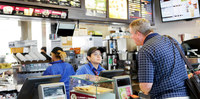
McDonald’s Faces California Labor Lawsuits
According to the Los Angeles Times (3/13/14), lawsuits filed against McDonald’s allege the fast food chain did not pay employees for all hours worked, failed to properly compensate for overtime and breaks, and illegally changed pay records.
Meanwhile, the lawsuits in Michigan allege McDonald’s employees were prevented from clocking in for pay until customers came to the restaurant, even if they had been required to be onsite before then. Included in the lawsuits is a claim that the company uses software to set a labor-cost-to-revenue ration target and when that target is exceeded, employees who were clocked in for their shifts are forced to clock out until the target ratio is once again achieved. Further, the lawsuit alleges McDonald’s made employees pay for their own uniforms, pushing their wages below minimum wage.
The lawsuit in New York alleges workers were required to pay for the cost of cleaning their uniforms. “The plaintiffs contend that McDonald’s failure to reimburse employees for uniform cleaning violates the New York state requirement to pay workers weekly for uniform maintenance and often also violates both federal and state minimum wage laws,” attorneys for the plaintiffs said.
The Associated Press (3/13/14) reports that approximately 30,000 employees could be affected by the lawsuit. Both company-owned and franchise-owned McDonald’s restaurants are named in the lawsuits, which seek back pay and compensatory damages.
Attorneys for the plaintiffs said the company’s practices not only violated state and federal laws but also caused “substantial financial burden” for the employees.
The lawsuits were filed on March 12 and 13. Earlier in 2014, a McDonald’s franchise in Pennsylvania reportedly agreed to pay more than $200,000 in back pay and wages to around 300 employees after the Department of Labor accused the company of improperly deducting wages from paychecks and not properly paying overtime. According to the Examiner (2/19/14), in 2012 the Department of Labor fined a franchise in Denver more than $55,000 for violations of minimum wage and recordkeeping.



About . TOS . Privacy . Disclaimer . Contact . Advertise . Member Login
This work is licensed under a Creative Commons Attribution-NoDerivs 3.0 Unported License ©2026 Online Legal Media. All rights reserved.
Visit other Online Legal Media Websites: