Healthcare Worker News
California FMLA Lawsuit Stymied by Tribal Immunity
However, there are various twists in this case given that the lawsuit was filed against the Morongo Band of Mission Indians - the operator of the slot facility - resulting in a ruling that sovereign immunity protects the tribe and its casino from FMLA claims.
The plaintiff in the California FMLA case is Crystal Muller, a former slot machine attendant who filed her complaint last November. According to court documents, Muller alleged she had fallen ill in 2010, requiring sick leave under FMLA. The leave had been approved. However, in mid-2013, Muller was terminated from her position. According to the California FMLA lawsuit, a manager at the casino had reported that Muller’s health issues were related to drug use, and that she was not capable of performing her job.
Muller countered that the drugs she was taking were prescribed for her disability - which wasn’t identified - and that the drugs did not impede her work performance in any way.
According to court documents, Muller lobbied for an appearance before the tribal council to plead her case. In her view, the real reason for her termination had little to do with drug use or job performance and everything to do with approved FMLA leave, and she sought arbitration for her case before her approved FMLA leave was set to expire. However, the plaintiff noted that she did not receive a response from the tribal council until a year later, only to be denied.
In her lawsuit, Muller was seeking either a court ruling forcing arbitration with the tribe through a court order or a grant of equitable relief. The defendants, in their response, moved to have the case dismissed - a move opposed by the plaintiff as being premature, given that in her view she had not exhausted all available remedies at the tribal level.
However, in her ruling, US District Judge Virginia A. Phillips noted that sovereign immunity protected the tribe and the casino it operated from claims under FMLA. Judge Phillips said the tribe did not consent to face FMLA claims by entering a gaming compact with the state of California that obligates the tribe to meet Fair Labor Standards Act requirements and waives sovereign immunity to casino-related personal injury and property damage claims.
“The court will not infer a waiver of immunity as to certain types of claims based on a separate, unrelated waiver of different categories of claims,” she wrote.
“Defendants correctly point out that no tribal remedies are available,” she wrote. “Exhaustion is not required, in a case such as this, where it would be futile.”
The judge also dismissed Muller’s claims against two individual tribal officers, finding their official actions are protected by the tribe’s immunity.
The case is Crystal A. Muller v. Morongo Casino Resort and Spa et al., Case No. 5:14-cv-02308, in the US District Court for the Central District of California.

Class-Action Status Given to Apple Wage and Hour Lawsuit
The initial lawsuit - which was dismissed in 2014 after a Supreme Court decision in a different case - was refiled. It alleges that because the security check is for the sole benefit of Apple and is done in all Apple retail stores across the US, that employees should be paid. Typically, employees undergo security screening after they have clocked out for their meal break or at the end of the day, meaning any time spent waiting for a manager to be free to do a check is unpaid time.
According to the initial lawsuit, that time can add up. For an employee leaving twice during a shift, the wait can mean anywhere from 10 to 15 unpaid minutes. For full-time employees, that adds up to uncompensated overtime.
The lawsuit calls Apple’s conduct regarding the unpaid security checks “illegal and improper” and says employees throughout the US are owed millions of dollars in wages and overtime. Amanda Frlekin, a named plaintiff in the original lawsuit, recorded between 10 and 15 uncompensated minutes during every shift, adding up to between 50 and 90 minutes over the course of the week.
“This daily 10-15 minute uncompensated waiting time during security checks was done in order to undergo searches for possible contraband and/or pilferage of inventory,” the lawsuit alleges. “Because such screening is designed to prevent and deter employee theft, a concern that stems from the nature of the employee’s work (specifically, their access to high value electronics and merchandise), the security checks and consequential wait time are necessary to the employee’s primary work as retail Specialists and done solely for Apple’s benefit.”
Workers are allegedly prohibited from leaving the store prior to a screening, and employees who refuse the security checks can face disciplinary action, including termination.
Apple has argued that the time spent undergoing bag checks is negligible and therefore should not be compensated. It also argues that not all managers conduct security screenings.
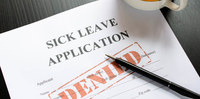
Will Paid Sick Leave Spur California Labor Lawsuits?
If an employer denies an employee accrued paid sick leave and/or retaliates in any way when an employee tries to use paid sick leave, that employee can now file a labor law complaint with the California Labor Commissioner’s Office. After a complaint is filed, the Commissioner’s Office has the authority to investigate the complaint and determine if damages and penalties will be awarded.
Many of those 6.5 million workers (about three-quarters of the state’s low-wage workers) who will benefit from this new law for the first time are parents who have to take care of their children. Too often children would show up at school sick because the (often single) parent feared getting fired if they didn’t show up at work. Having to send a sick child to school or leaving a sick child at home alone is heart-wrenching. Hillary Clinton said that no one should have “to choose between keeping a paycheck and caring for a new baby or a sick relative.”
And many employees who were never given paid sick leave, or any paid time off, are workers earning minimum wage. People in restaurants and retail who are barely scraping by and go to work sick (yes, the person who cooked your food could have the flu). Assembly member Lorena Gonzalez, D-San Diego, said that “We just want employers to know it’s not an option, and employees can’t be penalized for using their paid sick days. They can’t be fired or have their hours cut. It’s important for them to know they have the right to earn these paid sick days.”
The new law is complicated, and another reason why paid sick leave complaints may spur lawsuits. But every employee should know their rights and exactly what is covered. In a nutshell, for each 30 hours that somebody works, they get one hour of sick leave. The AB 1522 says that businesses will be required to show how many hours of paid sick leave workers have earned on their pay stubs. Employers can either choose to have workers accrue one hour of paid sick leave for every 30 hours worked, or grant employees three days of paid sick leave upfront, to be used within a one-year period.
Every business is required to provide this benefit, even if it only has one employee. Whenever possible, employees must provide “reasonable advance notification” orally or in writing of their desire to use the leave when the need for sick leave is foreseeable. Of course you can’t always know beforehand when you will be sick but you can also use sick leave for the following:
• the diagnosis, care or treatment of an existing health condition
• the preventive care of an employee
• an employee’s personal family member (including spouses, registered domestic partners, children, parents, grandparents, and siblings)
• employees who are victims of domestic violence, sexual assault, or stalking
If they haven’t done so already, employers might want to familiarize themselves with the new paid sick leave law and revise their policies and procedures. And employees shouldn’t rely on their employers to explain their benefits.
California Labor Paid Sick Leave Laws Clarified, Still Complicated
In sum, The Healthy Workplaces, Healthy Families Act of 2014 (AB 1522) was signed into law by Governor Jerry Brown last year for a planned two-stage implementation at the beginning of 2015. Various changes to record keeping and the posting of notices were brought in at the first of the year, followed by the implementation of changes to accruals and reporting on July 1.
The aforementioned changes to the California labor code were part of the original adoption of AB 1522. However, employers found the rollout somewhat overwhelming, requiring an update to AB 1522 in an effort to straighten out some of the confusion.
That update came in the form of AB 304, a bill that Governor Brown swiftly signed into law on July 14 and is effective immediately. The amendments provide some clarification with regard to compliance over payments, provisions for time off and so on. The clarifications are important not only for the employer - in order to properly comply - but also the employee, for whom a basic understanding of the new provisions is important in order to identify whether or not an employer is properly conforming to the new guidelines.
One of the clarifications with regard to California and labor law stemming from the quick passage of AB 304 has to do with record keeping: while an employer can know the reason(s) and purposes for which an employee uses paid sick time, there is no requirement in record-keeping protocols for maintaining documentation to that end.
Were an employer to maintain documentation with regard to the purposes for paid sick leave, or were an employee to find himself getting stiffed on sick pay and sick leave, he needs to be able to identify incidents of noncompliance in order to initiate and pursue a California labor lawsuit, as required.
AB 304 clarifies protocols for calculating paid sick leave, and the employer now has two options for doing so: 1) a calculation formula akin to the regular rate of pay for overtime calculation for the workweek in which paid sick time is used, and 2) the original calculation protocol dividing the employee’s total wages, not including overtime premium pay, by the employee’s total hours worked in the full pay periods of the prior 90 days of employment.
The July 14th amendment also provides for alternate accrual methods beyond the formula of one hour for each 30 hours worked, provided the accrual is on a regular basis and the employee will have 24 hours of paid sick leave available by the 120th calendar day of employment.
There is also clarification, for the purposes of California labor employment law, with regard to the right an employer has in limiting an employee’s use of paid sick days to 24 hours or 3 days either: (1) in each year of employment (by anniversary year, for example); or (2) in each calendar year; or (3) in any specified 12-month period.
Among other provisions in AB 304 is clarification over the requirement that an employee, to be eligible for paid sick leave, must be in a position to have worked for the same employer for 30 days, as opposed to simply working for any employer in the state of California.
There is a somewhat complicated grandfather clause for those employees who were provided paid sick leave or paid time off prior to the implementation of AB 1522 at the first of the year, and for whom a different method for accruing sick time may have been used. This clause allows for a more gradual accrual, provided the employee accrues eight hours of paid sick leave in the first three months of employment and was eligible to earn 24 hours of sick leave or paid time off within nine months of employment.
At the end of the day, California state labor laws are intended to level the playing field and provide fairness for the employee. A mutual understanding of California employee labor law is an important prerequisite for the employer to properly implement new laws, and for the employee to understand when those statutes are being accidentally or purposefully circumvented…

Respecting Caitlin Jenner and Her Community Under the Law
For some time now, California labor law has protected transgendered individuals from discrimination and harassment. However, a decision by the Superior Court of California, County of Sacramento last spring held that denying transgender employees the right to use gender-identity appropriate facilities remains a violation of the state’s anti-discrimination laws, and other statutes entrenched in the California Labor Code.
That decision, released in March of 2014, held that transgendered employees in the state of California have the right to use gender-identity appropriate change room and washroom facilities in the state of California. Various other states have enacted similar updates to their laws.
Now, the Feds have finally entered the pool with an update to federal codes that mirror California and labor law, as well as similar laws in other jurisdictions related to transgendered individuals.
To that end, the Occupational Safety and Health Administration (OSHA) on June 1 published A Guide to Restroom Access for Transgender Workers.
“The core principle is that all employees, including transgender employees, should have access to restrooms that correspond to their gender identity,” said Assistant Secretary of Labor for Occupational Safety and Health Dr. David Michaels, in a released statement. “OSHA’s goal is to assure that employers provide a safe and healthful working environment for all employees.”
The guide itself is detailed, but in sum, the rule is stated simply thus: if a female has transgendered, either emotionally or physically (or both) to male and therefore identifies as male, then that individual has the right and freedom to use the men’s washroom.
The same holds true for Bruce Jenner, who now identifies as Caitlin. It wasn’t that long ago that Jenner was being interviewed on national television about his story and his ongoing transition to female, the gender to which Jenner now identifies. This week, the release of the Caitlin Jenner photo shoot for the cover of Vanity Fair is a stark representation of what Jenner was revealing just a few weeks ago.
Therefore, applying the Bruce Jenner/Caitlin Jenner example to the rule of law, Bruce Jenner identifies as female now (as Caitlin Jenner) and thus, has the right to use the women’s washroom.
The OSHA guide, and the corresponding law, is founded upon the core belief that all employees in the workplace should be permitted, without retaliation, use of the facility that best matches his or her gender identification. At the end of the day, however, the OSHA guide notes that the employee should determine “the most appropriate and safest option for him - or herself.”
OSHA also identifies best polices that provide additional options that transgendered employees may choose, but are at the same time not a requirement. Such options, as available, could include: “Single-occupancy gender-neutral (unisex) facilities, and: Use of multiple-occupant, gender-neutral restroom facilities with lockable single occupant stalls.
“Under these best practices, employees are not asked to provide any medical or legal documentation of their gender identity in order to have access to gender-appropriate facilities,” states the guideline. “In addition, no employee should be required to use a segregated facility apart from other employees because of their gender identity or transgender status. Under OSHA standards, employees generally may not be limited to using facilities that are an unreasonable distance or travel time from the employee’s worksite.”
The guidelines also speak to the existence of local and state laws and statutes, such as California labor employment law, about which all employees should be conversant.
To summarize, transgendering has long passed the signpost of sensationalism. Rather, gender identification in any form has progressed from tolerance to widespread acceptance; and yet another indication of this is the release, this summer, of Becoming Us, an unscripted “docuseries” on ABC Family, documenting the life of 17-year-old Ben Lehwald of Evanston, Illinois. In the series, which is produced by Ryan Seacrest Productions, Ben’s father Charlie transitions to Carly. The narrative is told from Ben’s perspective as he watches his dad go through his divorce from Ben’s mom Suzy, before undergoing gender reassignment surgery.
In the grand scheme of things, washroom assignment (or reassignment) should be the least of a transgendered individual’s worries. Nonetheless, it is an issue that many states have been grappling with for some time - including California and labor law observed by the state. Now, the Department of Labor through the OSHA guideline will ensure that the rights of everyone are quite properly observed and respected behind the washroom stall.
Caitlin Jenner will use the women’s washroom. It’s only appropriate. And it’s also the law.

Caregivers Still Waiting for California Overtime
“My mother has physical and mental disabilities and can’t be left alone,” Charlene explains,” but I am not about to put her into a long-term nursing facility where she will waste away.” If and when the Brown administration’s decision to deny California overtime is overturned, paying caregivers a fair wage and overtime would still save the government a huge amount of money.
If Charlene did place her mother in a skilled nursing facility, the annual cost is more than $65,000. According to a 2012-13 report from the Legislative Analyst’s Office, the annual cost for someone with an average number of IHSS hours is closer to $13,000.
“In addition to making $9 per hour and working about 14 hours a day without overtime pay, my checks are constantly delayed, even though I have direct deposit set up,” says Charlene. “The inconsistency of receiving my paychecks has caused me to pay interest on my monthly expense bills and extra bank charges. And stress. This whole system is so unfair and legal action is the only place where I can turn.”
According to responses (mostly women) from a PayScale salary survey, caregivers in the Los Angeles area receive an average pay of $9.96 per hour. Earnings can vary between $8.10 per hour and $16.48. Only one in eight respondents receives medical and dental coverage.
Dana (not her real name) typically works 13 or 14 hours a day, also without any overtime pay. She has been employed as a caregiver by 123Home Care for the past two years. “When the company hired me I agreed to $11 per hour with overtime after working more than 9 hours a day, or 45 hours per week,” says Dana. She is still waiting for overtime pay.
“The family I work for cut back on the nurse visits - from once a day to twice a week, but their mother is getting worse. I wound up working 70 hours one week up until a few months ago, when I reduced my schedule to 55 hours a week,” Dana explains. “I contacted my employer at 123Home Care regarding overtime pay. He told me that my regular pay rate is reduced because I work more than 12 hours a day and the balance is paid to me in overtime. I was never told that during orientation and I believe this company is violating California labor laws and the FLSA (Wages and Fair Labor Standards Act).
Charlene and Dana were hopeful this past March when President Obama said that his administration would soon announce the details of a reform to overtime rules nationwide. “What we’ve seen is, increasingly, companies skirting basic overtime laws, calling somebody a manager when they’re stocking groceries and getting paid $30,000 a year,” President Obama told the The Huffington Post in an interview. “Those folks are being cheated.”
More than 400,000 caregivers anticipate Brown’s ruling to be overturned on appeal. With $183.6 million in the current state budget and $314.2 million in Brown’s proposed 2015-16 state budget, clearly the money is there to pay Charlene and Dana and countless other workers the overtime pay they are entitled to. Given the cost of nursing homes and other care facilities, it would be a win-win situation for all…
For more information, here is the court ruling.

Subsidiary of Kaiser Permanente Hit with Overtime Pay Laws Class Action
Employees in the state of California who reach an earnings plateau, or who are working at a management job and thus paid an annual salary, are usually exempt from overtime pay: the thought being, a job commanding such a high rate of pay requires, from time to time, that extra hours should be expected and tolerated as necessary, without the need for additional compensation.
Some employers, however, have attempted to skirt around this by incorrectly classifying non-management personnel as exempt, in an effort to save dollars.
The overtime pay laws class action, filed in California in March, alleges that Senior Systems Administrators employed by Kaiser spent the lion’s share of their days performing non-managerial tasks. Such tasks included, as alleged in court documents, the repair and replacement of personal computers and servers in Kaiser call centers, installations of software and operating systems, password resets and other tasks that are considered by the plaintiffs to be non-managerial in nature.
It is also alleged in the overtime laws class action that employees serving as Senior Systems Administrators did not supervise other employees of Kaiser, which is usually a function of management personnel and therefore exempt from overtime pay according to the provisions of California overtime law.
It is sometimes the case that an employer will hire an employee for a job that is meant to be managerial in nature, and thus would be exempt from overtime pay. However, if the majority of tasks performed by the employee are non-managerial, with no provision or opportunity to supervise others, then the management profile of the particular job is suspect.
The lawsuit did not specify what damages are being sought by plaintiffs in the California overtime law class action. The lawsuit also alleges unfair competition, and failure to provide accurate, itemized statements in accordance with California labor statutes.
Kaiser Foundation Hospitals Inc. is a subsidiary of Kaiser Permanente and boasts 30 wholly owned community hospitals throughout California, Hawaii and Oregon. Plaintiffs are seeking various unspecified damages and a trial by jury.
The overtime pay laws class-action lawsuit is Bernard Howard et al v. Kaiser Foundation Hospitals Inc., Case No. 37-2015-00008539-CU-OE-CTL, filed March 12 and currently pending in the San Diego County Superior Court for the State of California.

California Labor Law: Popular “Day Rate” for Personal Attendants No Longer Legal
The problem is that many employers of personal attendants either are unaware of or refuse to accept this change in overtime laws.
According to Daniel Chaleff, a partner at the employment law firm of Rehwald Glasner & Chaleff, “The Domestic Workers Bill of Rights law requires that caregivers, housekeepers, maids and childcare providers, who work in private households as personal attendants, must be paid a minimum of $9 an hour for the first 9 hours of work, and time-and-a-half - $13.50 - for more than 9 hours worked in a day.
“In my experience, many caretakers of people with disabilities, the elderly, and the sick are being paid under a day rate, for example $80 to $120 per day,” Chaleff says. “Paying personal attendants a day rate is illegal under the new law, which requires employers to pay overtime to personal attendants who work more than nine hours a day.”
As Chaleff notes, at the current minimum wage, a personal attendant working 24 hours in a day must be paid $283.50 per day, well above the typical $80 to $120 day rate.
Domestic workers are employees performing work in someone’s home. They include live-ins and personal attendants. Domestic workers qualify as personal attendants, if they don’t spend more than 20 percent of the total hours worked in a week performing duties other than supervising, feeding and dressing the person cared for. Exceptions to the law may include certain relatives.
Prior to the enacting of the Domestic Workers Bill of Rights, employers were able to use the personal attendant exception to avoid paying their domestic workers overtime. The new law removes that exception and requires employers to pay their personal attendants overtime.
A personal attendant who is not paid for all hours worked, including overtime, can file a lawsuit against his or her employer to recover unpaid wages and overtime. The damages can include reasonable attorney’s fees, associated litigation costs, interest and penalties.
The new law contains a “sunset” provision, which means it is only in effect until January 1, 2017. After that point, the law will be repealed unless another statute is enacted. To determine whether another statute is enacted, the governor will convene a committee - including personal attendants and their employers - to report on the effects of the law.

Facility Workers Owed $1.6 Million: Labor Commissioner
And according to The Fresno Bee (1/23/14), the workers have the Office of the California Labor Commissioner in their corner. Last May, the Labor Commissioner cited Bedford for various violations to the California labor code. Among them, the failure to pay minimum wage and overtime, failure to issue itemized wage statements allowing employees to accurately track their hours and wages, and violations to mandated meal and rest breaks.
Bedford, which is identified as operating six assisted living facilities in and around Fresno and Clovis, has appealed the Labor Commissioner’s spring 2013 decision. At a hearing based at the Fresno office of the department of Fair Labor Standards and Enforcement, Bedford owner Stephanie Costa was expected to claim that Bedford possesses time sheets that show all employees had been paid according to California labor employment law.
However, an investigation by the Labor Commissioner found that Bedford owed 11 workers a total of $1.3 million in unpaid overtime during a period spanning November 2011 through April of last year. The Labor Commissioner also accused the employer of failure to pay $17,025 in minimum wage and $95,053 in premiums representing missed meal and rest breaks. Bedford was also cited for $114,500 in penalties.
Advocates say that while the Bedford case is not an isolated incident, it remains one of the more serious affronts, or so it is alleged, to California employee labor law.
The protest was staged on the eve of Bedford’s defense of its citation by the Office of the Labor Commissioner to Fair Labor Standards and Enforcement. The outcome of Bedford’s appeal is not known
At the protest, former employee Nerissa Roque told The Fresno Bee that she had toiled at Bedford for 14 months providing what she described as ’round-the-clock care to residents. “We love the people we take care of,” Roque was quoted as saying. “But we also need to be paid fairly.
“This is an injustice,” Roque continued. “We are very upset and sad and want the owner to pay us what we are owed,” according to California and labor law.

California Overtime and Home Healthcare Workers
In December 2011, the Obama administration proposed regulations to give the nation’s nearly two million homecare workers minimum wage and overtime protections - workers who have been exempt from both protections. (A decision is expected within the next few months.)
In California, about 360,000 largely unionized homecare workers are employed by In-Home Supportive Services, a state program subsidizing homecare services for around 450,000 elderly, blind and disabled residents. But many workers, such as “personal attendants” and those employed directly by private households such as babysitters, are not paid overtime.
Under the California labor law, home healthcare workers are protected by the state’s minimum wage and overtime laws, but revising the FLSA would mean new overtime rules on California. Some people - including California Governor Jerry Brown - opposing this proposal estimate it will cost $150 million per year. The Los Angeles Times reported that Governor Brown would likely respond to the new rule by limiting the hours state homecare workers may work, effectively cutting the amount of care beneficiaries receive and pitting advocates for the disabled against labor.
California is one of 16 states that already extends minimum wage and overtime protection to home healthcare workers. The general rule in California is that all employees are entitled to overtime for work past eight hours in a day. In the healthcare field, however, many employers implement what is known as an “alternative workweek.” (Visit the state of California Division of Labor Standards Enforcement for more information on overtime laws regarding alternative workweek.)
Most of the home healthcare industry is also opposing this new rule. Industry officials argue that changing labor laws, particularly overtime laws, would result in decreased home healthcare workers’ hours and that, in turn, could force the elderly into nursing homes. On the other hand, the CSS and other proponents of the proposed rule say that these workers should have the same rights and protections, including California overtime laws, as other workers, and that increased wages and overtime pay will result in lower turnover rates.
The main reason that Congress proposes this rule change is to exempt “companions for the elderly” from FLSA protections, and thereby encourage friends and neighbors to help out the elderly in their neighborhoods and communities. It isn’t their intent to keep two million home healthcare workers from earning fair wages.
Meanwhile, industry groups are hopeful that the new rule will contain modifications to address their concerns. If it doesn’t, they will likely seek legal help.



About . TOS . Privacy . Disclaimer . Contact . Advertise . Member Login
This work is licensed under a Creative Commons Attribution-NoDerivs 3.0 Unported License ©2026 Online Legal Media. All rights reserved.
Visit other Online Legal Media Websites: