Restaurant & Food Service News

California Labor Paid Sick Leave Laws Clarified, Still Complicated
In sum, The Healthy Workplaces, Healthy Families Act of 2014 (AB 1522) was signed into law by Governor Jerry Brown last year for a planned two-stage implementation at the beginning of 2015. Various changes to record keeping and the posting of notices were brought in at the first of the year, followed by the implementation of changes to accruals and reporting on July 1.
The aforementioned changes to the California labor code were part of the original adoption of AB 1522. However, employers found the rollout somewhat overwhelming, requiring an update to AB 1522 in an effort to straighten out some of the confusion.
That update came in the form of AB 304, a bill that Governor Brown swiftly signed into law on July 14 and is effective immediately. The amendments provide some clarification with regard to compliance over payments, provisions for time off and so on. The clarifications are important not only for the employer - in order to properly comply - but also the employee, for whom a basic understanding of the new provisions is important in order to identify whether or not an employer is properly conforming to the new guidelines.
One of the clarifications with regard to California and labor law stemming from the quick passage of AB 304 has to do with record keeping: while an employer can know the reason(s) and purposes for which an employee uses paid sick time, there is no requirement in record-keeping protocols for maintaining documentation to that end.
Were an employer to maintain documentation with regard to the purposes for paid sick leave, or were an employee to find himself getting stiffed on sick pay and sick leave, he needs to be able to identify incidents of noncompliance in order to initiate and pursue a California labor lawsuit, as required.
AB 304 clarifies protocols for calculating paid sick leave, and the employer now has two options for doing so: 1) a calculation formula akin to the regular rate of pay for overtime calculation for the workweek in which paid sick time is used, and 2) the original calculation protocol dividing the employee’s total wages, not including overtime premium pay, by the employee’s total hours worked in the full pay periods of the prior 90 days of employment.
The July 14th amendment also provides for alternate accrual methods beyond the formula of one hour for each 30 hours worked, provided the accrual is on a regular basis and the employee will have 24 hours of paid sick leave available by the 120th calendar day of employment.
There is also clarification, for the purposes of California labor employment law, with regard to the right an employer has in limiting an employee’s use of paid sick days to 24 hours or 3 days either: (1) in each year of employment (by anniversary year, for example); or (2) in each calendar year; or (3) in any specified 12-month period.
Among other provisions in AB 304 is clarification over the requirement that an employee, to be eligible for paid sick leave, must be in a position to have worked for the same employer for 30 days, as opposed to simply working for any employer in the state of California.
There is a somewhat complicated grandfather clause for those employees who were provided paid sick leave or paid time off prior to the implementation of AB 1522 at the first of the year, and for whom a different method for accruing sick time may have been used. This clause allows for a more gradual accrual, provided the employee accrues eight hours of paid sick leave in the first three months of employment and was eligible to earn 24 hours of sick leave or paid time off within nine months of employment.
At the end of the day, California state labor laws are intended to level the playing field and provide fairness for the employee. A mutual understanding of California employee labor law is an important prerequisite for the employer to properly implement new laws, and for the employee to understand when those statutes are being accidentally or purposefully circumvented…

Respecting Caitlin Jenner and Her Community Under the Law
For some time now, California labor law has protected transgendered individuals from discrimination and harassment. However, a decision by the Superior Court of California, County of Sacramento last spring held that denying transgender employees the right to use gender-identity appropriate facilities remains a violation of the state’s anti-discrimination laws, and other statutes entrenched in the California Labor Code.
That decision, released in March of 2014, held that transgendered employees in the state of California have the right to use gender-identity appropriate change room and washroom facilities in the state of California. Various other states have enacted similar updates to their laws.
Now, the Feds have finally entered the pool with an update to federal codes that mirror California and labor law, as well as similar laws in other jurisdictions related to transgendered individuals.
To that end, the Occupational Safety and Health Administration (OSHA) on June 1 published A Guide to Restroom Access for Transgender Workers.
“The core principle is that all employees, including transgender employees, should have access to restrooms that correspond to their gender identity,” said Assistant Secretary of Labor for Occupational Safety and Health Dr. David Michaels, in a released statement. “OSHA’s goal is to assure that employers provide a safe and healthful working environment for all employees.”
The guide itself is detailed, but in sum, the rule is stated simply thus: if a female has transgendered, either emotionally or physically (or both) to male and therefore identifies as male, then that individual has the right and freedom to use the men’s washroom.
The same holds true for Bruce Jenner, who now identifies as Caitlin. It wasn’t that long ago that Jenner was being interviewed on national television about his story and his ongoing transition to female, the gender to which Jenner now identifies. This week, the release of the Caitlin Jenner photo shoot for the cover of Vanity Fair is a stark representation of what Jenner was revealing just a few weeks ago.
Therefore, applying the Bruce Jenner/Caitlin Jenner example to the rule of law, Bruce Jenner identifies as female now (as Caitlin Jenner) and thus, has the right to use the women’s washroom.
The OSHA guide, and the corresponding law, is founded upon the core belief that all employees in the workplace should be permitted, without retaliation, use of the facility that best matches his or her gender identification. At the end of the day, however, the OSHA guide notes that the employee should determine “the most appropriate and safest option for him - or herself.”
OSHA also identifies best polices that provide additional options that transgendered employees may choose, but are at the same time not a requirement. Such options, as available, could include: “Single-occupancy gender-neutral (unisex) facilities, and: Use of multiple-occupant, gender-neutral restroom facilities with lockable single occupant stalls.
“Under these best practices, employees are not asked to provide any medical or legal documentation of their gender identity in order to have access to gender-appropriate facilities,” states the guideline. “In addition, no employee should be required to use a segregated facility apart from other employees because of their gender identity or transgender status. Under OSHA standards, employees generally may not be limited to using facilities that are an unreasonable distance or travel time from the employee’s worksite.”
The guidelines also speak to the existence of local and state laws and statutes, such as California labor employment law, about which all employees should be conversant.
To summarize, transgendering has long passed the signpost of sensationalism. Rather, gender identification in any form has progressed from tolerance to widespread acceptance; and yet another indication of this is the release, this summer, of Becoming Us, an unscripted “docuseries” on ABC Family, documenting the life of 17-year-old Ben Lehwald of Evanston, Illinois. In the series, which is produced by Ryan Seacrest Productions, Ben’s father Charlie transitions to Carly. The narrative is told from Ben’s perspective as he watches his dad go through his divorce from Ben’s mom Suzy, before undergoing gender reassignment surgery.
In the grand scheme of things, washroom assignment (or reassignment) should be the least of a transgendered individual’s worries. Nonetheless, it is an issue that many states have been grappling with for some time - including California and labor law observed by the state. Now, the Department of Labor through the OSHA guideline will ensure that the rights of everyone are quite properly observed and respected behind the washroom stall.
Caitlin Jenner will use the women’s washroom. It’s only appropriate. And it’s also the law.

California Labor Lawsuit No Piece of Cake
According to court documents, the lawsuit was filed in March 2015 against L'Amande French Bakery, which is owned by Ana and Goncal Mointinho de Almeida and has locations in Beverly Hills and Torrance. Plaintiffs allege the defendants abused US immigration laws to get workers into the country, lied to workers to get them to the US and forced employees to work in “illegal, oppressive, and discriminatory conditions as domestic servants, physical laborers engaged in landscaping and building maintenance, and retail bakery workers doing a substantial amount of menial work at Defendant’s French bakeries.”
To keep employees in line, the defendants reportedly told the employees that if they did not work, they would each owe more than $11,000. Further, the lawsuit alleges the defendants threatened and intimidated employees into lying during a state labor enforcement agency investigation.
The plaintiffs allege they were told by the bakery’s owners that if they moved to the US from the Philippines, they would work as skilled bakery chefs and managers. Instead, they were put to work painting, cleaning and landscaping at a rental property for $2 an hour. Some workers were also forced to sleep on the floor in the Almeidas’ laundry room. Workers who were in the bakery were at first required to work 13 hours per day, seven days a week with no overtime and no sick days. The lawsuit alleges employees were paid as little as $3 an hour.
“To conceal evidence of these wage and hour violations, Defendants altered or destroyed the workers’ timecards and told them not to accurately report their actual time worked,” the lawsuit alleges. The defendants also isolated workers from each other and prevented them from speaking their native language. Employees were reportedly told if they worked for the bakery for three years, their $11,000 debt would be forgiven.
The plaintiffs allege that when they spoke out about their abuses they were retaliated against, including being fired or being written up.
Among the plaintiffs is a woman who said she was hired to be a nanny but spent less than 20 percent of her time on nanny duties and was instead forced into domestic servant roles.
The workers say they were all brought to the US under the E-2 visa process, which allows wealthy foreign nationals to bring foreign workers to the US to be engaged in executive or supervisory duties, or because of specialized skills essential to a company’s success.

Former Executive Chef Files Class-Action California Labor Lawsuit
The lawsuit names Harvest Management Sun LLC (Harvest), an entity that operates a chain of assisted-living and independent-living facilities across the country under the Holiday Retirement banner. The class action was filed by a California man on behalf of any and all employees of Harvest who may have been denied overtime under California and labor law, as well as similar statutes observed by other states and, federally, the Fair Labor Standards Act.
The plaintiff - who was not named in the report - worked as an executive chef at one of Holiday’s independent-living homes in Pinole. The complaint alleges that the position of executive chef was classified as a management position by the defendant, but that the plaintiff had very few managerial responsibilities. The plaintiff alleges that he typically worked more than 50 hours in any given week, but was not paid overtime in accordance with good practice under California and employment law.
The lawsuit, which also affects the company’s Simi Hills facility in the Simi Valley and The Bonaventure located in Ventura, seeks damages for affronts to California labor employment law going back four years in the state; together with similar affronts to federal law under the Fair Labor Standards Act going back two to three years.
The plaintiffs are seeking unspecified damages, back pay for uncompensated overtime hours, as well as attorney’s fees and costs.
Many a California labor lawsuit has taken an employer to task for misclassifying an employee as exempt from claiming overtime due to having management responsibilities, while having few if any real management duties to perform. While some employers appear to misclassify in error, there are many others who undertake the misclassification in an attempt to save money by not paying an employee overtime for work performed beyond the standard 40-hour workweek or eight-hour day, as mandated under California labor law. Managers, who are correctly classified as exempt, are normally paid a higher salary that takes into account the expectation for working longer hours.
The class-action California labor lawsuit was filed earlier this month in US District Court for the Northern District of California.

Plaintiffs in California Labor Law Class Action Take On Olive Garden
The defendant is the venerable Olive Garden franchise, which is operated by GMRI Inc. Earlier this month a federal judge granted a partial class certification in a California labor lawsuit brought against GMRI over the missed rest period issue.
The lawsuit is Antonio Romo, Jonathan Macias and Claudia Garcia v. GMRI Inc., doing business as Olive Garden, case number 5:12-cv-00715, in the US District Court for the Central District of California. According to court records, the plaintiffs had originally filed two complaints alleging California labor code violations in 2012 and 2103 respectively. The two lawsuits were consolidated when they were removed to California federal court, and originally involved a third subclass with regard to an alleged failure on the defendant’s part to reimburse employees for the purchase of nonslip shoes.
However, the plaintiffs subsequently withdrew their petition for certification in that subclass.
There were various reasons noted by Senior US District Judge Justin L. Quackenbush for denying certification for the meal break subclass. However, he did give a nod to the subclass with regard to missed or inadequate rest periods as required under California labor employment law.
Under the California labor code, an employee who works a shift lasting 7.5 hours is entitled to not one but two paid rest breaks. Plaintiffs allege that manager guidelines observed by Olive Garden managers reflect the provision for a single, 10-minute paid rest period to an employee working a shift of that length.
“GMRI has not presented such overwhelming evidence that GMRI in fact had a policy of providing second rest breaks to employees, sufficient to inject fatal uncertainty as to the question of commonality,” Judge Quackenbush wrote in his certification filed with the Court earlier this month, on August 12.
The rest period subclass that achieved certification includes all nonexempt, and/or all workers paid on an hourly basis, who were employees at Olive Garden restaurants operated by GMRI in the state of California from January 2011 until the date of certification.
Rest breaks and meal periods are entrenched in California employee labor law as a necessary right of employment for all employees meeting the criteria. When employers allegedly deny employees their breaks as mandated under California state labor laws, employees are not shy about pursuing their employment rights through the courts…

Plaintiffs Ring the Taco Bell in California Labor Lawsuit
At issue in the California labor law dispute are meal breaks for employees of Taco Bell that are alleged to have been observed outside of legislated parameters mandated by the California labor code.
To wit, California labor employment law holds that non-exempt employees in the state are entitled to a meal break lasting no less than 30 minutes and taken without the need or requirement to perform any work, prior to the end of their fifth consecutive hour of work. However, the class action against defendant Taco Bell claims that plaintiffs are denied an opportunity for a meal break until they have worked five full hours.
According to court records, the California labor lawsuit has underpinnings in an action originally filed by two former employees of Taco Bell, Lisa Hardiman and Sandrika Medlock. The two plaintiffs claimed meal break and overtime violations in the original lawsuit in 2007. The lawsuit was consolidated with other cases in 2009, with plaintiffs starting to lobby for certification as a class action two years after that, in 2011.
That certification for the so-called late meal break class was achieved last year.
In one of the latest developments, the late meal break class petitioned US Magistrate Judge Stanley A. Boone last month to grant the class summary judgment with regard to the late meal break claims, citing alleged violations of the Private Attorney General Act for the State of California (PAGA).
“The court certified the meal period claims because Taco Bell implemented and enforced a common meal period policy/procedure that failed to provide class members with timely meal periods as required under the California Labor Code,” the motion said.
2014 marks the 10th anniversary since the PAGA was enacted in the state. In sum, the California labor employment law statute provides private citizens an avenue for pursuing civil penalties on behalf of the California Labor and Workforce Development Agency. In so doing, private citizens have the opportunity to enforce California labor code.
The amended California labor lawsuit will represent all nonexempt hourly paid Taco Bell employees working in the state of California from September 7, 2003 to July 1, 2013. The criteria is that the employees would have worked more than six hours in a day, and who did not receive the required meal break after working more than five hours.
It has been reported that the class could involve 28,000 class members in the California labor lawsuit. The case is In re: Taco Bell Wage and Hour Actions, Case No. 1:07-cv-01314, in the US District Court for the Eastern District of California.
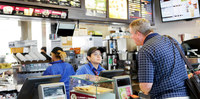
McDonald’s Faces California Labor Lawsuits
According to the Los Angeles Times (3/13/14), lawsuits filed against McDonald’s allege the fast food chain did not pay employees for all hours worked, failed to properly compensate for overtime and breaks, and illegally changed pay records.
Meanwhile, the lawsuits in Michigan allege McDonald’s employees were prevented from clocking in for pay until customers came to the restaurant, even if they had been required to be onsite before then. Included in the lawsuits is a claim that the company uses software to set a labor-cost-to-revenue ration target and when that target is exceeded, employees who were clocked in for their shifts are forced to clock out until the target ratio is once again achieved. Further, the lawsuit alleges McDonald’s made employees pay for their own uniforms, pushing their wages below minimum wage.
The lawsuit in New York alleges workers were required to pay for the cost of cleaning their uniforms. “The plaintiffs contend that McDonald’s failure to reimburse employees for uniform cleaning violates the New York state requirement to pay workers weekly for uniform maintenance and often also violates both federal and state minimum wage laws,” attorneys for the plaintiffs said.
The Associated Press (3/13/14) reports that approximately 30,000 employees could be affected by the lawsuit. Both company-owned and franchise-owned McDonald’s restaurants are named in the lawsuits, which seek back pay and compensatory damages.
Attorneys for the plaintiffs said the company’s practices not only violated state and federal laws but also caused “substantial financial burden” for the employees.
The lawsuits were filed on March 12 and 13. Earlier in 2014, a McDonald’s franchise in Pennsylvania reportedly agreed to pay more than $200,000 in back pay and wages to around 300 employees after the Department of Labor accused the company of improperly deducting wages from paychecks and not properly paying overtime. According to the Examiner (2/19/14), in 2012 the Department of Labor fined a franchise in Denver more than $55,000 for violations of minimum wage and recordkeeping.

Upscale Sushi Restaurant Hit with California Labor Code Allegations
Urasawa is both the name of the restaurant and the owner, Hiroyuki Urasawa. The chef has created a brand for himself and is popular amongst well-heeled clientele who regularly visit his establishment in an alcove above Rodeo Drive. According to the Honolulu Star-Advertiser (7/21/13), the pristine sushi bar - described as one of the most renowned sushi restaurants in the US - serves dishes that include caviar and 24-karat gold flakes “for iron.” Patrons spend lavishly and Urasawa is said to spare no expense for his valued guests.
However, it is alleged that his kitchen staff is denied overtime under California labor law, working for the same pay over a 12-hour shift. An investigation by the California Labor Department, according to the Star-Advertiser, found that workers are also denied rest breaks.
Former employee Heriberto Zamora has filed a California labor lawsuit in an effort to secure back wages. The Mexican immigrant worked at Urasawa for a period of five years, starting as a dishwasher and eventually worked his way to food preparation. At his peak, he was making $11.50 per hour.
However, in comments to the Star-Advertiser, Zamora claimed he would routinely put in 60-hour weeks for that rate of pay, without provision for overtime, or meal or rest periods as required under the California labor code. Zamora also describes having to urinate in a sink designed to rinse floor mops after Urasawa allegedly forbade him to use customer restrooms during business hours.
Previously, when Zamora was promoted to food preparation and granted a raise in pay to $9 per hour, he was also allegedly required to buy his own set of knives, costing $700.
“It was always about the customers, making sure that they were happy,” said Zamora, 26, in comments published in the Star-Advertiser. “None of the employees were treated very well. We knew people were paying a lot to eat there, but for us, it was no different.”
One day, after he had been at his station for about nine hours, Zamora began coughing and felt like he was running a fever. He asked to book off sick and return home. The owner, Zamora said, fired him on the spot.
California labor employment law is designed to protect workers’ rights. “There are countless examples in which workers are taking home less than they’ve earned,” said Julie Su, the state labor commissioner. Investigators are said to wait outside, watching workers come and go, comparing what they see to the time records kept on employers’ books. “It’s a perversion of the concept of minimum wage - it goes from being some kind of floor to instead being some kind of ceiling,” Su said.
Urasawa appealed a ruling issued in June, hitting him with a fine of $55,000 for failure to pay overtime under California and labor law, and to provide breaks to Zamora and three others.

What Rights Do Illegal Immigrants Have regarding Wage and Hour Issues?
Moises worked as a cook at Mel’s Diner for six years before it was sold six months ago. The new owner asked him to continue working in the same position at the same rate: $12 per hour, 40 hours per week.
First California labor law violation: Moises says he typically worked 50 hours per week but he never got overtime pay.
“I asked the new boss about California overtime compensation but he told me they never pay anyone overtime,” says Moises. Other employees worked overtime but they didn’t get paid either, so I wasn’t singled out. The previous owner never scheduled us for more than 40 hours per week, but sometimes we would work an extra few hours and always get paid time and a half.”
Second California labor law violation: California wrongful termination?
Moises had a minor “incident” that triggered his termination. “One day I had a problem,” he says. “I was pulled over by the police and jailed overnight because I forgot my driver’s license - I had left it at home. My friend called my boss (I tried to call him first from jail) and told him what happened. The next day I showed up at work and he said, ‘I don’t need you anymore,’ and said I have too many problems. But I think it was because I asked for overtime. They said they have too many cooks but I know they don’t have enough cooks.”
Third California labor law violation: Not receiving last paycheck in a timely manner.
“I was fired one month ago and I still haven’t received this last paycheck,” he says. Moises went back to Mexico but his wife and two daughters, ages seven and three (they were born in the US), stayed in the US. “I sent my wife to the restaurant to get my check. My boss said he wouldn’t give it to her, using the excuse that he doesn’t know her, but that is not true.”
Moises, age 28, has been working illegally in California for the past 10 years. He is in the process of getting his green card. His wife is a US resident and she has applied for citizenship. “I gave my boss a fake social security number; it is a number I have used for the entire time I was in the US. I never had a problem with it. I bought it from someone on the street in Mexico for $80.
“My boss has taken advantage of me because I worked illegally,” Moises adds. “Everyone knows there are a lot of illegals in the US; illegals who want to move here to work and get a better life. I hope to return to the US when I am legal; right now I am trying to fix my status in the US. My family can visit me here but I don’t think I can go to the US for about a year. Meanwhile, I have a construction job here in Mexico City, but I would rather be a cook in California.”
LawyersandSettlements (LAS):
Do the above labor law violations apply to illegal immigrants, i.e., overtime violation, wrongful termination (not even sure if wrongful termination applies to any employee because California is an “at will” state) and not getting the last paycheck on the day of termination?
Attorney David Yeremian (DY):
Yes. According to the CA website of the California Department of Industrial Relations, “All California workers - whether or not they are legally authorized to work in the United States - are protected by state laws regulating wages and working conditions.” The website states that all California workers have the right:
• To receive a minimum wage of $8.00 per hour
• To earn overtime pay - with some exceptions - after working more than 8 hours/day or more than 40 hours/week
• To file wage claims with the state labor commissioner if they believe their employer has violated state wage laws
• To file workplace safety and health complaints with Cal/OSHA, the state’s workplace safety and health program
• To work in an environment free from retaliation for exercising their rights
LAS: Can Moises get a letter from a notary public stating that his wife can receive his last paycheck?
DY: A notarized authorization letter may work; but Moises’ employer is not obligated to give his paycheck to anyone other than him.
LAS: Is the employer in violation of CA labor law for hiring Moises with a fake security card?
DY: The Immigration Reform and Control Act, a federal law, makes it illegal for an employer to knowingly hire undocumented aliens.
LAS: Moises has a fake social security card. What rights does he have re: getting overtime and his last paycheck? Moises says he paid taxes from his pay stubs.
DY: See response to Question 1 above.
LAS: If Moises paid taxes, doesn’t he have a right to get his last paycheck?
DY: Yes, Moises has a right to get his last paycheck. In fact, pursuant to California Labor Code Section 201, an employer who discharges an employee must immediately pay all compensation due and owing.
David Yeremian is an experienced litigator and business counselor, and co-founder of Orshansky & Yeremian LLP. He has worked on a wide variety of litigation matters including employment. The employment discrimination lawyers in Los Angeles provide free consultations to discuss your case fully.

Where Are California Labor Laws When You Need Them?
A few months ago, Casandra thought she was coming down with the flu and called in sick. She took a day off work, and that night she told her General Manager - by text message - she was getting worse and they needed to find someone else to open the restaurant the next day.
“This restaurant is part of a franchise; they have seven other restaurants with about 70 servers so they could easily have found someone to take my place and open the next morning,” says Casandra. “I never called in sick, and in fact, I was their top waitress so what happened to me was utterly surprising.
“Two days later I received an e-mail from the GM, which was also surprising. She told me to return my keys to the restaurant when I pick up my final paycheck. So I assumed I was terminated, even though she couldn’t come right out and say so. I didn’t go back right away, one reason is because it was a 45-minute commute each way.
“And I was heartbroken. We worked so well together for all these years; we even opened this restaurant together and (I thought) we were also friends. The following week I went to a doctor who told me that I was pregnant and I had a blood test. The results showed that my blood count was too low and my doctor said I likely had a miscarriage. That was confirmed a few days later, and I think that was due to the stress of getting fired.”
Casandra didn’t reply to the GM’s e-mail. The following week she handed in her keys, got her last paycheck and filed for unemployment. Another surprise: her employer appealed the decision, saying that Casandra quit. “I guess the employer didn’t know that the GM sent me an e-mail, firing me,” says Casandra. “The employment Development Office was on my side. They said that I deserved to get unemployment, but I only received three unemployment checks.”
Casandra admits that she doesn’t understand anything about the appeals process. She was supposed to attend a scheduled hearing but thought that the appeal was already taken care of because she was receiving benefits. “Because I didn’t show up at the hearing, the employer automatically won the decision of the appeal, so as of June 28, I no longer get unemployment benefits.
“I tried to call the California Unemployment Department but trying to speak to a human is just about impossible. You cannot leave a message. Instead you get a message which says, “There are too many calls coming in and not enough employees due to federal budget cuts so please try again later.” At that point I went online and filed a claim with LawyersandSettlements. I don’t know who else to call or where else to go.”
Casandra has no idea why she was fired unless it is for personal reasons. “To make this story even longer, I was in a relationship for several years and we separated. My ex-boyfriend later asked the GM for work and he got a job as a cook - at the same restaurant as me. He is still working there.”
Casandra doesn’t want to believe that is the reason: how could a business operate with policies outside of the California labor code? Now her only recourse is to file a California labor lawsuit, and get another job.
“I dedicated myself to this company and loved my job and this is what I get in return,” she adds. “I am devastated; getting wrongfully terminated is more than a slap in the face.”



About . TOS . Privacy . Disclaimer . Contact . Advertise . Member Login
This work is licensed under a Creative Commons Attribution-NoDerivs 3.0 Unported License ©2026 Online Legal Media. All rights reserved.
Visit other Online Legal Media Websites: