Building & Construction News

California FMLA Lawsuit Stymied by Tribal Immunity
However, there are various twists in this case given that the lawsuit was filed against the Morongo Band of Mission Indians - the operator of the slot facility - resulting in a ruling that sovereign immunity protects the tribe and its casino from FMLA claims.
The plaintiff in the California FMLA case is Crystal Muller, a former slot machine attendant who filed her complaint last November. According to court documents, Muller alleged she had fallen ill in 2010, requiring sick leave under FMLA. The leave had been approved. However, in mid-2013, Muller was terminated from her position. According to the California FMLA lawsuit, a manager at the casino had reported that Muller’s health issues were related to drug use, and that she was not capable of performing her job.
Muller countered that the drugs she was taking were prescribed for her disability - which wasn’t identified - and that the drugs did not impede her work performance in any way.
According to court documents, Muller lobbied for an appearance before the tribal council to plead her case. In her view, the real reason for her termination had little to do with drug use or job performance and everything to do with approved FMLA leave, and she sought arbitration for her case before her approved FMLA leave was set to expire. However, the plaintiff noted that she did not receive a response from the tribal council until a year later, only to be denied.
In her lawsuit, Muller was seeking either a court ruling forcing arbitration with the tribe through a court order or a grant of equitable relief. The defendants, in their response, moved to have the case dismissed - a move opposed by the plaintiff as being premature, given that in her view she had not exhausted all available remedies at the tribal level.
However, in her ruling, US District Judge Virginia A. Phillips noted that sovereign immunity protected the tribe and the casino it operated from claims under FMLA. Judge Phillips said the tribe did not consent to face FMLA claims by entering a gaming compact with the state of California that obligates the tribe to meet Fair Labor Standards Act requirements and waives sovereign immunity to casino-related personal injury and property damage claims.
“The court will not infer a waiver of immunity as to certain types of claims based on a separate, unrelated waiver of different categories of claims,” she wrote.
“Defendants correctly point out that no tribal remedies are available,” she wrote. “Exhaustion is not required, in a case such as this, where it would be futile.”
The judge also dismissed Muller’s claims against two individual tribal officers, finding their official actions are protected by the tribe’s immunity.
The case is Crystal A. Muller v. Morongo Casino Resort and Spa et al., Case No. 5:14-cv-02308, in the US District Court for the Central District of California.

Class-Action Status Given to Apple Wage and Hour Lawsuit
The initial lawsuit - which was dismissed in 2014 after a Supreme Court decision in a different case - was refiled. It alleges that because the security check is for the sole benefit of Apple and is done in all Apple retail stores across the US, that employees should be paid. Typically, employees undergo security screening after they have clocked out for their meal break or at the end of the day, meaning any time spent waiting for a manager to be free to do a check is unpaid time.
According to the initial lawsuit, that time can add up. For an employee leaving twice during a shift, the wait can mean anywhere from 10 to 15 unpaid minutes. For full-time employees, that adds up to uncompensated overtime.
The lawsuit calls Apple’s conduct regarding the unpaid security checks “illegal and improper” and says employees throughout the US are owed millions of dollars in wages and overtime. Amanda Frlekin, a named plaintiff in the original lawsuit, recorded between 10 and 15 uncompensated minutes during every shift, adding up to between 50 and 90 minutes over the course of the week.
“This daily 10-15 minute uncompensated waiting time during security checks was done in order to undergo searches for possible contraband and/or pilferage of inventory,” the lawsuit alleges. “Because such screening is designed to prevent and deter employee theft, a concern that stems from the nature of the employee’s work (specifically, their access to high value electronics and merchandise), the security checks and consequential wait time are necessary to the employee’s primary work as retail Specialists and done solely for Apple’s benefit.”
Workers are allegedly prohibited from leaving the store prior to a screening, and employees who refuse the security checks can face disciplinary action, including termination.
Apple has argued that the time spent undergoing bag checks is negligible and therefore should not be compensated. It also argues that not all managers conduct security screenings.
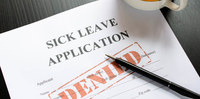
Will Paid Sick Leave Spur California Labor Lawsuits?
If an employer denies an employee accrued paid sick leave and/or retaliates in any way when an employee tries to use paid sick leave, that employee can now file a labor law complaint with the California Labor Commissioner’s Office. After a complaint is filed, the Commissioner’s Office has the authority to investigate the complaint and determine if damages and penalties will be awarded.
Many of those 6.5 million workers (about three-quarters of the state’s low-wage workers) who will benefit from this new law for the first time are parents who have to take care of their children. Too often children would show up at school sick because the (often single) parent feared getting fired if they didn’t show up at work. Having to send a sick child to school or leaving a sick child at home alone is heart-wrenching. Hillary Clinton said that no one should have “to choose between keeping a paycheck and caring for a new baby or a sick relative.”
And many employees who were never given paid sick leave, or any paid time off, are workers earning minimum wage. People in restaurants and retail who are barely scraping by and go to work sick (yes, the person who cooked your food could have the flu). Assembly member Lorena Gonzalez, D-San Diego, said that “We just want employers to know it’s not an option, and employees can’t be penalized for using their paid sick days. They can’t be fired or have their hours cut. It’s important for them to know they have the right to earn these paid sick days.”
The new law is complicated, and another reason why paid sick leave complaints may spur lawsuits. But every employee should know their rights and exactly what is covered. In a nutshell, for each 30 hours that somebody works, they get one hour of sick leave. The AB 1522 says that businesses will be required to show how many hours of paid sick leave workers have earned on their pay stubs. Employers can either choose to have workers accrue one hour of paid sick leave for every 30 hours worked, or grant employees three days of paid sick leave upfront, to be used within a one-year period.
Every business is required to provide this benefit, even if it only has one employee. Whenever possible, employees must provide “reasonable advance notification” orally or in writing of their desire to use the leave when the need for sick leave is foreseeable. Of course you can’t always know beforehand when you will be sick but you can also use sick leave for the following:
• the diagnosis, care or treatment of an existing health condition
• the preventive care of an employee
• an employee’s personal family member (including spouses, registered domestic partners, children, parents, grandparents, and siblings)
• employees who are victims of domestic violence, sexual assault, or stalking
If they haven’t done so already, employers might want to familiarize themselves with the new paid sick leave law and revise their policies and procedures. And employees shouldn’t rely on their employers to explain their benefits.

California Labor Paid Sick Leave Laws Clarified, Still Complicated
In sum, The Healthy Workplaces, Healthy Families Act of 2014 (AB 1522) was signed into law by Governor Jerry Brown last year for a planned two-stage implementation at the beginning of 2015. Various changes to record keeping and the posting of notices were brought in at the first of the year, followed by the implementation of changes to accruals and reporting on July 1.
The aforementioned changes to the California labor code were part of the original adoption of AB 1522. However, employers found the rollout somewhat overwhelming, requiring an update to AB 1522 in an effort to straighten out some of the confusion.
That update came in the form of AB 304, a bill that Governor Brown swiftly signed into law on July 14 and is effective immediately. The amendments provide some clarification with regard to compliance over payments, provisions for time off and so on. The clarifications are important not only for the employer - in order to properly comply - but also the employee, for whom a basic understanding of the new provisions is important in order to identify whether or not an employer is properly conforming to the new guidelines.
One of the clarifications with regard to California and labor law stemming from the quick passage of AB 304 has to do with record keeping: while an employer can know the reason(s) and purposes for which an employee uses paid sick time, there is no requirement in record-keeping protocols for maintaining documentation to that end.
Were an employer to maintain documentation with regard to the purposes for paid sick leave, or were an employee to find himself getting stiffed on sick pay and sick leave, he needs to be able to identify incidents of noncompliance in order to initiate and pursue a California labor lawsuit, as required.
AB 304 clarifies protocols for calculating paid sick leave, and the employer now has two options for doing so: 1) a calculation formula akin to the regular rate of pay for overtime calculation for the workweek in which paid sick time is used, and 2) the original calculation protocol dividing the employee’s total wages, not including overtime premium pay, by the employee’s total hours worked in the full pay periods of the prior 90 days of employment.
The July 14th amendment also provides for alternate accrual methods beyond the formula of one hour for each 30 hours worked, provided the accrual is on a regular basis and the employee will have 24 hours of paid sick leave available by the 120th calendar day of employment.
There is also clarification, for the purposes of California labor employment law, with regard to the right an employer has in limiting an employee’s use of paid sick days to 24 hours or 3 days either: (1) in each year of employment (by anniversary year, for example); or (2) in each calendar year; or (3) in any specified 12-month period.
Among other provisions in AB 304 is clarification over the requirement that an employee, to be eligible for paid sick leave, must be in a position to have worked for the same employer for 30 days, as opposed to simply working for any employer in the state of California.
There is a somewhat complicated grandfather clause for those employees who were provided paid sick leave or paid time off prior to the implementation of AB 1522 at the first of the year, and for whom a different method for accruing sick time may have been used. This clause allows for a more gradual accrual, provided the employee accrues eight hours of paid sick leave in the first three months of employment and was eligible to earn 24 hours of sick leave or paid time off within nine months of employment.
At the end of the day, California state labor laws are intended to level the playing field and provide fairness for the employee. A mutual understanding of California employee labor law is an important prerequisite for the employer to properly implement new laws, and for the employee to understand when those statutes are being accidentally or purposefully circumvented…

Respecting Caitlin Jenner and Her Community Under the Law
For some time now, California labor law has protected transgendered individuals from discrimination and harassment. However, a decision by the Superior Court of California, County of Sacramento last spring held that denying transgender employees the right to use gender-identity appropriate facilities remains a violation of the state’s anti-discrimination laws, and other statutes entrenched in the California Labor Code.
That decision, released in March of 2014, held that transgendered employees in the state of California have the right to use gender-identity appropriate change room and washroom facilities in the state of California. Various other states have enacted similar updates to their laws.
Now, the Feds have finally entered the pool with an update to federal codes that mirror California and labor law, as well as similar laws in other jurisdictions related to transgendered individuals.
To that end, the Occupational Safety and Health Administration (OSHA) on June 1 published A Guide to Restroom Access for Transgender Workers.
“The core principle is that all employees, including transgender employees, should have access to restrooms that correspond to their gender identity,” said Assistant Secretary of Labor for Occupational Safety and Health Dr. David Michaels, in a released statement. “OSHA’s goal is to assure that employers provide a safe and healthful working environment for all employees.”
The guide itself is detailed, but in sum, the rule is stated simply thus: if a female has transgendered, either emotionally or physically (or both) to male and therefore identifies as male, then that individual has the right and freedom to use the men’s washroom.
The same holds true for Bruce Jenner, who now identifies as Caitlin. It wasn’t that long ago that Jenner was being interviewed on national television about his story and his ongoing transition to female, the gender to which Jenner now identifies. This week, the release of the Caitlin Jenner photo shoot for the cover of Vanity Fair is a stark representation of what Jenner was revealing just a few weeks ago.
Therefore, applying the Bruce Jenner/Caitlin Jenner example to the rule of law, Bruce Jenner identifies as female now (as Caitlin Jenner) and thus, has the right to use the women’s washroom.
The OSHA guide, and the corresponding law, is founded upon the core belief that all employees in the workplace should be permitted, without retaliation, use of the facility that best matches his or her gender identification. At the end of the day, however, the OSHA guide notes that the employee should determine “the most appropriate and safest option for him - or herself.”
OSHA also identifies best polices that provide additional options that transgendered employees may choose, but are at the same time not a requirement. Such options, as available, could include: “Single-occupancy gender-neutral (unisex) facilities, and: Use of multiple-occupant, gender-neutral restroom facilities with lockable single occupant stalls.
“Under these best practices, employees are not asked to provide any medical or legal documentation of their gender identity in order to have access to gender-appropriate facilities,” states the guideline. “In addition, no employee should be required to use a segregated facility apart from other employees because of their gender identity or transgender status. Under OSHA standards, employees generally may not be limited to using facilities that are an unreasonable distance or travel time from the employee’s worksite.”
The guidelines also speak to the existence of local and state laws and statutes, such as California labor employment law, about which all employees should be conversant.
To summarize, transgendering has long passed the signpost of sensationalism. Rather, gender identification in any form has progressed from tolerance to widespread acceptance; and yet another indication of this is the release, this summer, of Becoming Us, an unscripted “docuseries” on ABC Family, documenting the life of 17-year-old Ben Lehwald of Evanston, Illinois. In the series, which is produced by Ryan Seacrest Productions, Ben’s father Charlie transitions to Carly. The narrative is told from Ben’s perspective as he watches his dad go through his divorce from Ben’s mom Suzy, before undergoing gender reassignment surgery.
In the grand scheme of things, washroom assignment (or reassignment) should be the least of a transgendered individual’s worries. Nonetheless, it is an issue that many states have been grappling with for some time - including California and labor law observed by the state. Now, the Department of Labor through the OSHA guideline will ensure that the rights of everyone are quite properly observed and respected behind the washroom stall.
Caitlin Jenner will use the women’s washroom. It’s only appropriate. And it’s also the law.

Los Angeles Files California Overtime Lawsuit
According to the city attorney’s news release, Mackone Development Inc. - the primary contractor - and subcontractors Pak’s Cabinet, Lectrfy, Southern California Steel, KCC General Construction, King Wire Partitions, Inc., Nader Construction and their operators are all named as defendants in the lawsuit. Feuer alleges the defendants not only stole more than $250,000 in wages from employees, but also harassed and intimidated employees to cover up the illegal activities.
In 2009, Mackone Development received the $9.5 million contract to build the South Los Angeles Animal Care Center facility. Construction took place from 2010-2013 and employee wages were governed by prevailing wage laws. Among the alleged violations included in the lawsuit were Pak’s Cabinet paying employees as little as $8 an hour when prevailing wage rules required payment of $49 per hour; KCC General Construction paying some employees as little as $5 an hour when prevailing wage law required $45 per hour; Lectrfy, Inc., not paying prevailing wage or most overtime and paying employees for fewer hours than they worked; and Mackone Development not paying prevailing wages for all hours worked.
“The Defendants named in this complaint are, individually and collectively, liable for stealing wages from the workers they employed and promised to pay for their work on this City project, and for covering up of this theft,” the complaint states. “The impact on the workers was significant; not only were they and their families severely damaged financially, but many were subject to overt harassment and intimidation as part of the Defendants’ efforts to conceal their illegal schemes.”
The lawsuit seeks restitution to all employees and civil penalties of up to $2,500 per violation.
A spokesperson for Mackone said the city attorney’s allegations are false and irresponsible and argued that the city agreed in writing that Mackone was not responsible for the other companies’ failure to pay prevailing wages, according to the Los Angeles Times (11/13/14).
When Feuer announced the charges against the companies, he also announced a wage theft hotline to encourage employees to report incidents of wage theft.

Bay Area Contractor on Hook for Almost $1 Million in California Labor Lawsuit
The claim, against Ghilotti Brothers Inc. (Ghilotti Brothers, Ghilotti) of the Bay Area, was wage fraud. Which, of course, is in violation of California labor law.
According to San Jose Mercury News Business (4/24/14), the complaint revolved around work performed by many Spanish-speaking laborers prior to and following their shifts - primarily, loading and unloading trucks. For employees who are paid at or near minimum wage, tasks performed off the clock can translate to wage fraud given that all hours of work, properly documented, might ordinarily result in the payment of overtime according to statutes entrenched in California labor code.
The plaintiffs also allege that the defendant discouraged them from taking meal breaks and rest periods, further adding to the allegation of wage fraud and violation of California employment labor law.
The three lead plaintiffs in the class-action California labor lawsuit - Jose Ramirez, Luis Gomez and Marck Mena Ortega - allege their employer distributed English-language forms with their paychecks and required all employees to sign. It was alleged the forms warranted that Ghilotti had provided the employee all appropriate compensation. The problem with the form, said the plaintiffs, was that many employees are Spanish-speaking and thus did not understand what they were signing.
According to court documents, the lawsuit was originally filed in 2012 at Alameda County Superior Court, prior to the case being transferred to federal court in San Francisco. The California labor employment law settlement was granted final approval by US District Court Judge Charles Breyer on April 22.
Under the terms of the California labor law settlement, a total of $530,000 will be distributed to the 242 class members over the course of the next three years. The three lead plaintiffs will also receive an extra $15,000 for representing the class - although it was unclear if the three will receive $15,000 as a collective or individually. The remainder of the settlement will go toward attorney’s fees and court costs.
As part of the California employee labor law settlement, Ghilotti is required to establish a system whereby employees have the capacity to accurately record their start and stop times for work. The attorney representing the three lead plaintiffs - who still work for Ghilotti - noted in comments published in San Jose Mercury News Business that the problem(s) represented by this California class action is not unique in an industry that has a tendency to play fast, loose and lax with California prevailing wage law.
San Jose Mercury News Business reports that Ghilotti Brothers has reported more than $100 million in annual revenues.

Alleged Violations to California Labor Law No Holiday for Affected Workers
Regardless of the motivating factors, it often takes an official investigation and a California labor lawsuit to right those wrongs.
While it appears as if a lawsuit has not materialized so far in the case of alleged lapses of California labor code on a construction site for a new Holiday Inn Express, the California Labor Commissioner’s Office has nonetheless filed a lien against the property in question, located in Eureka, in an effort to recover almost a quarter of a million dollars in unpaid wages.
According to the Eureka Times Standard (8/13/13), the mechanic’s lien was filed earlier this month against the property located at 815 West Wabash Ave. and pertains to wages that were to have been paid, according to California and labor law, from January through May of this year.
According to the report, Carpenters Local 751 filed a complaint alleging various California labor employment law violations. That complaint led to an investigation launched March 27 under the auspices of the California Labor Commissioner’s Office together with the California Occupational Safety and Health Administration and California’s Labor Enforcement Task Force.
The investigation, it is reported, revealed that some paychecks issued to employees were returned NSF, with the unpaid wages also extending to meal and rest period violations. The investigation also found 13 workplace safety violations, including unsafe ladders, failure to provide fall protection and scaffolding, inadequate training to recognize fall hazards, and unguarded saws.
“It’s like any other illegal activity,” said Peter Melton, a spokesperson with the Department of Industrial Relations, in comments published in the Eureka Times Standard. “Supposedly, there’s a financial gain which causes people to cut corners and not obey the law, but the downside is if you get caught, you have to pay the penalty.”
According to the report, the total amount of unpaid wages in question added up to more than $247,600 owed to 31 workers who toiled on the Holiday Inn Express new build, a facility that was slated to open in the spring but now has been delayed until the fall. The property is reported to be owned by Shailesh Patel and Jayshree Patel Revocable Trust, with Jansen Construction and PacWest Contracting identified as the contractors. It is not known if the mechanic’s lien, brought according to allegations of wrongdoing under California employee labor law, has been appealed.

Contractors Fined $748,366 Over California Labor Law Violations
“Failure to pay the proper prevailing wage is a form of wage theft,” said Labor Commissioner Su, in a statement.
Legal Monitor Worldwide (6/7/13) reported the California and labor law citations stemmed from work performed on four public works projects undertaken by the prime contractors and their subcontractors.
According to the report, Cyrcon Builders was hired to perform work on Gateways Hospital and Mental Health Center in Los Angeles. Cyrcon, in turn, subcontracted carpentry and masonry work to KAY General Services, d/b/a Rudy’s Construction. The latter was found by investigators to be in violation of California labor employment law due to wage violations, and Rudy’s was assessed $98,187 for unpaid wages, $24,075 in penalties and $2,307 in apprenticeship training funds.
In another example of a violation to California prevailing wage law, a subcontractor hired by Tutor Perini Corp. was cited for various violations in association with work performed on a newly built branch of the Orange County Public Library in Laguna Niguel. The subcontractor, Cal Framing, failed to pay prevailing wage and overtime to 25 workers and was assessed $117,837 in unpaid wages, $30,800 in penalties and $539 in contributions to a Department of Industrial Relations-approved training program for the California Apprenticeship Council.
Yet another contractor, Tidwell Concrete Construction, found itself facing the wrath of the California Labor Commissioner over work performed at the Miramar Library Learning Resource Center. Tidwell, originally hired for the new build by the San Diego Community College District, was found following an investigation to have violated California employee labor law through the failure to pay 16 workers the correct California prevailing wage, together with failure to make CAC training fund contributions. Tidwell was also found not to have hired the correct number of apprentices as required.
Tidwell was assessed $152,079 in unpaid wages, $100,950 in penalties, $7,926 in unpaid training fund contributions and $16,000 in apprenticeship fines, according to the report.
“We will crack down on not only the subcontractors who steal workers’ wages and fail to pay apprenticeship training contributions,” said Labor Commissioner Su, in a statement, “but also on the general contractors so we put proper incentives on them to deal only with honest, law-abiding businesses in California.”
According to various reports, one of the mandates behind the aggressive pursuit of wrongdoing by investigators with the Office of the California Labor Commissioner is to ensure honest businesses get a fair shake in the market, and don’t suffer loss of potential contracts to other bidders able to low-ball on a contract by not paying their workers, and committing other violations to California state labor laws. Also cited were Intermountain Electric of Denver and Campbell Certified Inc. of Oceanside.

California Labor Law Violations Total Almost $2 Million
According to a release from the Office of the California Labor Commissioner (PR Newswire [5/7/13]), the penalties relate to various California prevailing wage and apprenticeship violations associated with three public works projects undertaken by the contractors involved.
Those contractors were identified as: B.A. Marble & Granite Inc., which performed work on the DeNeve Residence Halls project at the Westwood Campus of UCLA; Phoenix Floors, associated with work undertaken at the Learning Resource Center at Saddleback Community College in Orange County; and Johnson Business Holdings, doing business as Production Plumbing, which was hired for the Global Green Generational (G3) Charter School at the Vaughn Next Century Learning Center in Pacoima.
All three were hit with wage, training fund and penalty assessments under the California labor code, stemming from three separate investigations by Division of Labor Standards Enforcement. Total fines equated to about $1.8 million.
“Let these enforcement actions serve as notice that wage theft - whether it be through nonpayment of overtime, failure to pay proper prevailing wage, underreporting of hours worked, bounced checks used to pay working people, and cheating on apprenticeship training funds - will not be tolerated in this state,” said Labor Commissioner Julie A. Su, who has vigorously defended California labor employment law since assuming office.
Looking at specifics, Production Plumbing was found to have willfully misclassified nine workers in an attempt to pay a lower California prevailing wage. The plumber was also found to have issued NSF checks to employees, and under-reported hours of work.
Phoenix Floors was found to have falsified certified payroll records, which is an affront to California labor code. Following an investigation, it was revealed that Phoenix Floors established a scheme whereby a third party, an employee, was paid 90 percent of the invoice amount and used that money to pay out wages to 30 workers, who were subsequently paid far less than the prevailing wage for the project. Among other citations, Phoenix failed to pay overtime.
Of the three California labor employment law cases, B.A. Marble & Granite Inc. (B.A. Marble) came away with the biggest hit following an investigation through the Division of Labor Standards Enforcement, a division of the Department of Industrial Relations (DIR). According to the release, B.A. Marble was found to have failed to pay 55 employees proper wages under California state labor laws. B.A. Marble was also found to have falsified documents, intimidated their workers in an attempt to impede the investigation and failed to provide requested information.
B.A. Marble was a subcontractor brought into the UCLA project by primary contractor PCL Construction Services, Inc. Labor Commissioner Su ordered tile contractor B.A. Marble to pay $539,051 in wages, $4,693 in apprenticeship training funds and $652,600 in fines for the failure to pay 55 employees the proper wage.
“The Labor Commissioner has reinvigorated public works enforcement in the state,” said Christine Baker, director of the Department of Industrial Relations. Total fines and penalties in the California employee labor law case were $1,821,453.



About . TOS . Privacy . Disclaimer . Contact . Advertise . Member Login
This work is licensed under a Creative Commons Attribution-NoDerivs 3.0 Unported License ©2026 Online Legal Media. All rights reserved.
Visit other Online Legal Media Websites: