
Wage & Hour News

Bay Area Contractor on Hook for Almost $1 Million in California Labor Lawsuit
The claim, against Ghilotti Brothers Inc. (Ghilotti Brothers, Ghilotti) of the Bay Area, was wage fraud. Which, of course, is in violation of California labor law.
According to San Jose Mercury News Business (4/24/14), the complaint revolved around work performed by many Spanish-speaking laborers prior to and following their shifts - primarily, loading and unloading trucks. For employees who are paid at or near minimum wage, tasks performed off the clock can translate to wage fraud given that all hours of work, properly documented, might ordinarily result in the payment of overtime according to statutes entrenched in California labor code.
The plaintiffs also allege that the defendant discouraged them from taking meal breaks and rest periods, further adding to the allegation of wage fraud and violation of California employment labor law.
The three lead plaintiffs in the class-action California labor lawsuit - Jose Ramirez, Luis Gomez and Marck Mena Ortega - allege their employer distributed English-language forms with their paychecks and required all employees to sign. It was alleged the forms warranted that Ghilotti had provided the employee all appropriate compensation. The problem with the form, said the plaintiffs, was that many employees are Spanish-speaking and thus did not understand what they were signing.
According to court documents, the lawsuit was originally filed in 2012 at Alameda County Superior Court, prior to the case being transferred to federal court in San Francisco. The California labor employment law settlement was granted final approval by US District Court Judge Charles Breyer on April 22.
Under the terms of the California labor law settlement, a total of $530,000 will be distributed to the 242 class members over the course of the next three years. The three lead plaintiffs will also receive an extra $15,000 for representing the class - although it was unclear if the three will receive $15,000 as a collective or individually. The remainder of the settlement will go toward attorney’s fees and court costs.
As part of the California employee labor law settlement, Ghilotti is required to establish a system whereby employees have the capacity to accurately record their start and stop times for work. The attorney representing the three lead plaintiffs - who still work for Ghilotti - noted in comments published in San Jose Mercury News Business that the problem(s) represented by this California class action is not unique in an industry that has a tendency to play fast, loose and lax with California prevailing wage law.
San Jose Mercury News Business reports that Ghilotti Brothers has reported more than $100 million in annual revenues.

Plot Thickens in Raiderette California Labor Lawsuit
The lawsuit, filed January 22 in Alameda County Superior Court, alleges that “Raiderettes” - the named tagged to cheerleaders employed by the team - effectively earn less than $5 per hour, a sum far below minimum wage grids and California prevailing wage, once rehearsals, charity events and other costs the women allegedly have to bear themselves are taken into account.
According to the lawsuit, Raiderettes are paid $125 for each of the 10 pre-season and regular season home games. Plaintiffs in a lawsuit that is proposed as a class action representing all Raiderette cheerleaders who have toiled for the team over the past four years, allege the women are required to pay all their own travel costs and other expenses - including makeup and hair for the team’s annual swimsuit calendar photo shoot - together with various fines for missing altogether or reporting late for rehearsals, and bringing the wrong pom-poms to practice.
The lawsuit also alleges the team withholds pay until the end of the football season.
The DOL launched an investigation from the federal side about a week after the lawsuit was brought. However, according to The San Francisco Chronicle (3/20/14), the feds closed their investigation after it was determined the California Raiders constitutes a “seasonal” operation and thus is exempt from federal minimum wage laws.
However, it is expected the lawsuit will go ahead, given that the state of California does not recognize such an exemption for season operators. As well, at $8 per hour, the minimum wage in California is 75 cents above the current federal standard - a rate that is about to rise to $9 in July, with a corresponding rise to $10 per hour January 1, 2016 for the state of California.
According to The Chronicle, the Raiders are lobbying to have the lawsuit removed from the courts and transferred to the Office of the Commissioner for the National Football League, for arbitration. The report references a claim made by the team, and officially filed in court papers March 20 in Alameda County Court, that all cheerleaders agree, as per their employment contract, to refer any and all disputes with or involving the team to binding arbitration before the commissioner.
So far, there has been no response from the plaintiffs as to the fate and future of their lawsuit, which claims that the Raiderette’s compensation package and costs violate California labor employment law. It is not known what role the employment contract will play in the matter, and whether or not an employment contract will circumvent the California labor lawsuit.
The lawsuit, alleging violations to the California labor code, was originally brought by “Lacy T” (surnames withheld according to team policy), a 28-year-old stay-at-home mom. She was soon joined by a co-plaintiff. The lawsuit is seeking class-action status.
According to the action, the team is not meeting the California prevailing wage. It is not known what role the team’s seasonal status will have, given the state does not recognize the same seasonal criteria observed by the feds. All eyes will be watching - and not just for the pom-poms, either…
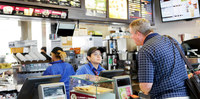
McDonald’s Faces California Labor Lawsuits
According to the Los Angeles Times (3/13/14), lawsuits filed against McDonald’s allege the fast food chain did not pay employees for all hours worked, failed to properly compensate for overtime and breaks, and illegally changed pay records.
Meanwhile, the lawsuits in Michigan allege McDonald’s employees were prevented from clocking in for pay until customers came to the restaurant, even if they had been required to be onsite before then. Included in the lawsuits is a claim that the company uses software to set a labor-cost-to-revenue ration target and when that target is exceeded, employees who were clocked in for their shifts are forced to clock out until the target ratio is once again achieved. Further, the lawsuit alleges McDonald’s made employees pay for their own uniforms, pushing their wages below minimum wage.
The lawsuit in New York alleges workers were required to pay for the cost of cleaning their uniforms. “The plaintiffs contend that McDonald’s failure to reimburse employees for uniform cleaning violates the New York state requirement to pay workers weekly for uniform maintenance and often also violates both federal and state minimum wage laws,” attorneys for the plaintiffs said.
The Associated Press (3/13/14) reports that approximately 30,000 employees could be affected by the lawsuit. Both company-owned and franchise-owned McDonald’s restaurants are named in the lawsuits, which seek back pay and compensatory damages.
Attorneys for the plaintiffs said the company’s practices not only violated state and federal laws but also caused “substantial financial burden” for the employees.
The lawsuits were filed on March 12 and 13. Earlier in 2014, a McDonald’s franchise in Pennsylvania reportedly agreed to pay more than $200,000 in back pay and wages to around 300 employees after the Department of Labor accused the company of improperly deducting wages from paychecks and not properly paying overtime. According to the Examiner (2/19/14), in 2012 the Department of Labor fined a franchise in Denver more than $55,000 for violations of minimum wage and recordkeeping.

Not Withholding Taxes from Employee Violates California Labor Law
“I gave my social insurance number and all other necessary documents to the accounting department when I was hired at this resort hotel,” says Fabiola, who was paid hourly. “There is no doubt that I was a paid employee and not an independent contractor.”
After receiving a few paychecks, Fabiola asked why taxes weren’t being deducted. “My manager said it was better for me, that I would make more money this way,” she says. “I didn’t want to make any trouble - I didn’t want to lose my job - so I didn’t ask again.”
Fabiola continued working for about six months, until she was asked to work the graveyard shift. “Again the manager told me that I would make more money so I asked him again about tax deductions,” she says. “He got mad at me and got even madder when I declined to work graveyard.”
Just days after that confrontation, just before Fabiola was getting into her uniform, her manager said that she wasn’t on the schedule. She asked him why she wasn’t working, what was going on? “He told me that business had slowed down and they had to cut back my hours but to please be patient,” she says.
“I called a few days later but this time the manager said I was fired,” says Fabiola. “What had I done wrong? In the six months I worked here I never had a complaint. I called the lady in accounting - she signs the paychecks. I explained to her that I had been fired and asked her why she never took taxes off my checks. She said that I had to speak to the manager.
“I called the manager and said that I had to notify the Labor Department because I have been fired without a reason and I asked him again about my taxes. He replied, ‘It was because you were rude to a customer.’ I knew he was lying.”
Soon after she was wrongfully terminated, Fabiola received a letter from the hotel’s accountant. It said that she was an independent contractor and therefore responsible for all her taxes. And because she has been designated as a contractor rather than an employee, Fabiola has been denied unemployment insurance.
Employers often misclassify their employees as independent contractors to avoid paying payroll taxes, and other labor laws such as the minimum wage or overtime, comply with other wage and hour law requirements such as providing meal periods and rest breaks, or reimburse their workers for business expenses incurred in performing their jobs.
As well, independent contractors are not covered under workers compensation insurance, and are not liable for payments under unemployment insurance, disability insurance or social security.
If your employer is withholding payroll taxes, you can contact the California labor board to seek enforcement of the law, whereas independent contractors must go to court to settle their disputes or enforce other rights under their contracts. Both employees and independent contractors, however, can seek legal help.

Facility Workers Owed $1.6 Million: Labor Commissioner
And according to The Fresno Bee (1/23/14), the workers have the Office of the California Labor Commissioner in their corner. Last May, the Labor Commissioner cited Bedford for various violations to the California labor code. Among them, the failure to pay minimum wage and overtime, failure to issue itemized wage statements allowing employees to accurately track their hours and wages, and violations to mandated meal and rest breaks.
Bedford, which is identified as operating six assisted living facilities in and around Fresno and Clovis, has appealed the Labor Commissioner’s spring 2013 decision. At a hearing based at the Fresno office of the department of Fair Labor Standards and Enforcement, Bedford owner Stephanie Costa was expected to claim that Bedford possesses time sheets that show all employees had been paid according to California labor employment law.
However, an investigation by the Labor Commissioner found that Bedford owed 11 workers a total of $1.3 million in unpaid overtime during a period spanning November 2011 through April of last year. The Labor Commissioner also accused the employer of failure to pay $17,025 in minimum wage and $95,053 in premiums representing missed meal and rest breaks. Bedford was also cited for $114,500 in penalties.
Advocates say that while the Bedford case is not an isolated incident, it remains one of the more serious affronts, or so it is alleged, to California employee labor law.
The protest was staged on the eve of Bedford’s defense of its citation by the Office of the Labor Commissioner to Fair Labor Standards and Enforcement. The outcome of Bedford’s appeal is not known
At the protest, former employee Nerissa Roque told The Fresno Bee that she had toiled at Bedford for 14 months providing what she described as ’round-the-clock care to residents. “We love the people we take care of,” Roque was quoted as saying. “But we also need to be paid fairly.
“This is an injustice,” Roque continued. “We are very upset and sad and want the owner to pay us what we are owed,” according to California and labor law.

California Starts the Year with Two Unpaid Overtime Lawsuits
While Carter Brothers LLC is based in Atlanta, the 15 current and former workers behind the lawsuit are from Sacramento.
According to the lawsuit, filed February 4 in US District Court at Sacramento, the workers were trained by Carter Brothers to install residential security equipment in the state under contract with AT&T Digital Life. The Sacramento Business Journal (2/11/14) reports that when the joint venture between Carter Brothers LLC and AT&T failed, there were many layoffs. Those laid off, the lawsuit contends, did not receive unemployment benefits, disability pay or workers’ compensation as required under California labor law due to the fact they were classified as independent contractors.
However, according to the lawsuit, the workers were dispatched to job sites in AT&T trucks and were made to wear AT&T uniforms. The workers in their unpaid overtime lawsuit allege they toiled 12-14 hours each day without overtime, provision to offset travel expenses or extra training as needed.
AT&T is named as a co-defendant, amongst others, in the overtime pay lawsuit. The plaintiffs are hoping for class-action status. The legal firm involved in the action surmises that the misclassification could affect upwards of 70 to 80 workers in the state, not to mention workers based in Chicago and Dallas. According to the Sacramento Business Journal, millions of dollars’ worth of lost wages, various benefits and overtime pay that went unpaid according to provisions in overtime pay laws are at stake.
Carter Brothers LLC was founded in 2000 by NFL Hall of Famer and ESPN commentator Cris Carter and his brother John. Cris is currently the Chairman.
The case is Ramses Gutierrez et al v. Carter Brothers Security Services LLC et al, Case No. 2:14-at-00150
Meanwhile a federal class-action lawsuit was filed earlier this month against Gerawan Farming. Plaintiffs allege the company failed to pay minimum wage, overtime pay according to California overtime law and state-guaranteed rest breaks.
The plaintiffs named in the California overtime lawsuit are Rafael Marquez Amaro and Jesus Alarcon Urzua. According to the Fresno Bee (2/4/14), the lawsuit was filed on behalf of thousands of field workers who toiled for Gerawan and were paid by the piece over the previous four years. Plaintiffs claim the actual take-home pay was below the minimum wage guaranteed by the state of California.
The case is Amaro & Urzua, et al v. Gerawan Farming Inc. et al, Case No. 1:2014cv00147, February 3, 2014 at California Eastern District Court.

Second Cheerleader Joins California Labor Lawsuit
The lawsuit, which seeks class-action status, was initially filed by Lacy T. in January 2014. Since that time, Sarah G. joined the lawsuit, which claims Raiderettes are not paid properly for all the hours they put into their time as a cheerleader. Specifically, they claim they are not paid minimum wage for all hours given to the Raiderettes. Although they are paid $125 per home game, they allege they are not paid for time spent at mandatory practices or mandatory promotional events.
Furthermore, they allege, if they fail to bring proper equipment or gear to their rehearsals, they can be fined. The lawsuit alleges, for example, that plaintiff Sarah G. was fined $10 for not handing in her written bio on time.
The plaintiffs also allege they have to pay out of pocket for cheerleading-related expenses such as travel expenses and hairstyling, even though the team provides a hairstylist they are forced to use. Finally, the lawsuit alleges, the cheerleaders do not get paid for their time spent cheerleading until the end of the season - months after their work for the team has begun.
According to the lawsuit (case number RG14710815, in the Superior Court for the State of California, County of Alameda), Raiderettes must attend all preseason, regular season and postseason football games, even if they are benched for the game. They must also attend all practices, rehearsals, workouts preparations, drills, fittings, photo sessions, meetings, events and functions as directed by the Raiders.
The lawsuit alleges that the contract the cheerleaders are forced to sign contains provisions that violate California law, including a provision waiving legal claims against the Raiders. They are also allegedly prohibited from discussing the fees they receive with anyone.
The California Department of Labor is concerned enough that it is now investigating the Oakland Raiders’ treatment of its cheerleaders. Meanwhile, a similar lawsuit has been filed against the Cincinnati Bengals, alleging the Ben-Gals, the Bengals cheerleading team, is paid well under the Ohio minimum wage. That lawsuit is case number 1:14-cv-00136-MRB, Brenneman v. Cincinnati Bengals, Inc.

Cheerleader’s California Labor Code Lawsuit Gets Attention by the Feds
A handful of other teams have come under DOL scrutiny, suggesting that abuse could be more widespread. Chairman of the Center for Labor Research and Education at UC Berkley, Ken Jacobs, said in comments published in The San Francisco Chronicle (The Chronicle, 1/31/14) that such alleged violations of California labor code by the Oakland Raiders and other teams does not sit well from a public relations standpoint.
“I can imagine that this would be something the Raiders would want to resolve,” Jacobs said in comments published in The Chronicle. “If this practice is common for the other teams, you might very well see other investigations.”
Most in California are familiar with the story of Lacy T., a 28-year-old stay-at-home mom who has found fault with the pay practices of the venerable California football team. Not only can various fines and expenses, together with the loss of meal breaks, rest periods and overtime pay, eat into the effective hourly wage, but wages are also allegedly withheld until the end of the football season. As a result, according to the lawsuit, Raiderettes do not benefit from any infusion of cash while they are actively engaged with the club during the football season.
The plaintiff, who filed her lawsuit in Alameda County Court as a proposed class action, alleges that such practices violate labor laws. To that end, the newfound involvement of the federal DOL suggests that not just California labor employment law is being circumvented in such cases.
A spokesperson for the DOL’s regional office in San Francisco would not comment further on grounds that the matter is currently an open case. However, Jose Carnevali confirmed in comments published in The Chronicle that the federal investigation concerned “the team’s cheerleading squad,” and not merely the plaintiff who filed the lawsuit.
There have been other investigations around the country involving professional sports teams, with settlements in tow. The DOL recently announced an investigation into an allegation that interns with the Miami Marlins and the San Francisco Giants are unpaid.
This past August, according to The Chronicle, the San Francisco Giants paid $544,000 in back wages to 74 employees of the team following a federal investigation into various violations to California state labor laws over a three-year period.
Beyond the public relations hit a major sports team may incur as the result of an investigation into wage infractions, is the possibility of a costly settlement that could see a team spending more money at the end of the day than it otherwise might have spent had the enterprise simply paid proper wages, and adhered to California labor code from the beginning.
To that end, the DOL has the authority to mandate the reimbursement of owed wages at twice the rate of wages illegally withheld. The federal minimum wage currently sits at $7.25 per hour. The minimum wage observed by the state of California is currently $8 per hour, but is set to rise to $9 per hour in July, in accordance with California prevailing wage law.

Cheerleader Files California Labor Lawsuit

California Labor Lawsuit Nets $4.7 Million Settlement
The lawsuit was filed against Schneider Logistics and alleged that the company illegally deducted wages from employees and did not pay overtime. The plaintiffs alleged that Schneider held an invalid election for an alternative workweek schedule, which, according to The Huffington Post (12/10/13), cut employees out of overtime pay, misled employees into voting for the alternate workweek schedule, had employees sign waivers that they did not want their meal breaks and failed to provide employees with a regular schedule.
Among the claims against Schneider, as listed in court documents, were unpaid overtime, breach of contract, unlawful rest breaks, unpaid reporting time and paying secret wages. At least one employee, according to The Huffington Post, said he did not understand his rights and he felt pressured into signing them away. He also said the forms he signed were in English but he can only read Spanish, so he often did not understand the forms he signed.
Ultimately, Schneider agreed to settle the lawsuit for $4.7 million, including payments to class members, fines to the Labor Workforce Development Agency, attorneys’ fees and costs, and class administration costs. Schneider also agreed to terminate the alternate workweek, and agreed to not use waivers asking employees to sign away their rights to overtime pay.
Up to 568 current and former hourly employees are affected by the settlement, which received preliminary approval from the judge. In agreeing to the settlement, Schneider Logistics did not admit any wrongdoing.
Some of Schneider Logistic’s actions, however, came under fire by a judge earlier in 2013. According to reports, attorneys with the company met with employees to interview them about working conditions, but allegedly did not tell the employees that any information given during the interviews could be used against them in court. The judge, who found the actions “fundamentally misleading and deceptive,” found that Schneider could not use the employees’ sworn declarations against them in court.
The Schneider lawsuit is Franklin Quezada v. Schneider Logistics Transloading and Distribution, U.S. District Court for the Central District of California, No. 12cv02188.



About . TOS . Privacy . Disclaimer . Contact . Advertise . Member Login
This work is licensed under a Creative Commons Attribution-NoDerivs 3.0 Unported License ©2026 Online Legal Media. All rights reserved.
Visit other Online Legal Media Websites: