
Wage & Hour News

Collecting California Labor Law Settlements Remains a Challenge
Su has been aggressively trying to bring that number down - a number, according to a 2010 UCLA study, estimated to be $26 million in lost wages each week affecting workers in Los Angeles County alone.
But it’s a tough go. And in spite of impressive California labor code victories during Su’s tenure, the majority of assessed penalties and wage claims are never paid by the perpetrators. According to the Los Angeles Times (6/27/13), a study undertaken by the National Employment Law Project and the UCLA Labor Center discovered the collection rate remains painfully low.
The report, covering a three-year period from 2008 to 2011 and entitled, “Hollow Victories: The Crisis in Collecting Unpaid Wages for California Workers,” found that only 17 percent of court-ordered claims for back pay and penalties under California labor employment law are ever collected. Even with signed judicial orders and settlement agreements in place, less than half of penalties and unpaid wages - $165 million out of $390 million so ordered - were ever successfully collected.
Su is aware of such lax compliance with California and labor law orders, and in June, issued citations against an LA-based garment manufacturer after it was discovered the company had changed its name to avoid paying previous citations assessed for non-compliance. The most recent citation, in response to the alleged attempt to avoid compliance with a previous California labor law violation, will cost the company $300,000 in new wage and hour violations.
But will they pay?
The Times article told the story of a worker who won a $20,000 California prevailing wage judgment against her employer in 2009. However, plaintiff Anita Herrera never had a chance to enjoy her windfall. Rather than pay the court-ordered judgment, Herrera’s former employer changed its name, acquired new business licenses and moved into new offices. “I feel very defrauded,” Herrera told the LA Times, in Spanish. “The company continues with its contracts and continues doing business.”
Beyond Labor Commissioner Su’s efforts to bring justice to bear against employers who skirt around court-ordered citations and penalties as mandated by California state labor laws, a new bill introduced to legislators in Sacramento would mandate the placement of wage liens against an employer’s property as a means to ensure that adequate assets are available to undertake payment of any settlement once a California labor law judgment is rendered. Dubbed the Fair Paycheck Act, AB 1164 is nonetheless getting a rough ride by business groups and lobbyists, and has stalled.
Assemblywoman Bonnie Lowenthal (D-Long Beach) vows to re-introduce the measure to state legislators next year.
Meanwhile, in addressing the issue of cited employers doing an end run around California labor law and court-mandated settlements and repayment orders, Su referenced her $300,000 order to the unnamed garment manufacturer. “This case demonstrates our commitment not just to addressing wage theft but also to cracking down on the shell games used to avoid detection,” said Labor Commissioner Julie Su.
In the meantime, disadvantaged workers must remain vigilant in holding their employers to account for violations to California prevailing wage law and other affronts to state employment statutes, knowing those charged with upholding labor laws will continue putting teeth into laws designed to hold employers accountable.

California Labor Law: Tip Pools Complex
A recent decision in New York is reminiscent of one in California from 2009. The lawsuit in New York involved Starbucks baristas, who alleged shift supervisors should not be eligible to participate in the tip pool because they are supervisors and make more than the baristas. According to NBC News (6/26/13), the New York Court of Appeals found that shift supervisors are eligible to share in the tip pool because their main duty is to serve food and drinks.
The court found, however, that assistant store managers should not be included in the tip pool because they have too many managerial duties, including hiring and firing, so they could not be classified as wait staff.
In 2008, Starbucks faced a similar lawsuit in California (Chau vs. Starbucks), with the Superior Court of the State of California finding that the coffee chain must pay its baristas $100 million to settle a lawsuit, arguing shift managers should not be part of the tip pool.
But in 2009, the California Court of Appeals in San Diego ruled that shift supervisors are eligible to share in the tip pool, reversing the lower court decision. The Los Angeles Times (6/3/09) reported at the time that the court found that shift supervisors performed the same tasks as baristas.
Under California state law, employers or agents of employers cannot receive any part of a tip left for an employee, with the legal definition of an employer or agent being someone who has the authority to supervise or direct workers. Baristas argued they should not share their tips with shift supervisors because they were managerial, but Starbucks said its shift supervisors spent up to 95 percent of their time making and taking coffee orders, essentially the same work that baristas perform. Furthermore, Starbucks argued that although shift supervisors had some supervision authority, they could not hire or discipline baristas, limiting their authority.
As with so many labor laws involving pay, the important thing is not the worker’s job title, but the actual duties the worker performs. So it is not enough to say that the employee is managerial. The duties the employee regularly performs must reflect that title for that employee to be exempt from overtime pay and tips.

Keep On Trucking - Past California Overtime?
Christopher believes, as evidenced by many people and even some attorneys online, that it boils down to that old adage - too many cooks spoil the broth. “Overtime for commercial drivers is regulated by the US Department of Transportation and the Federal Motor Carrier Safety Administration,” Christopher says, “and they dictate how long we can drive, including breaks and overtime. Add to the fray our employer’s rules and regulations and California labor law, because it seems like a lot depends upon individual and state contracts and it gets complicated.”
California labor law attorneys seem to agree on the fact that there is no definable answer to Christopher’s overtime question - and that the overtime laws for truckers can be complex, mainly because the Department of Transportation and the Department of Labor overlap and have different regulations. And Christopher doesn’t even know if he is exempt from overtime. Most truckers are paid by the mile, whereas Christopher is paid by the hour. Some commercial drivers are classified as independent contractors and others salaried. It gets complicated.
Christopher says he talked to his HR rep and she told him that no one gets paid overtime, even though some of the other drivers in the company drive out of state. Currently, Christopher drives only interstate, i.e., in California only (If you drive in “interstate commerce,” you are not entitled to overtime. If you do not, you can claim overtime pay), but Christopher says he is slated to drive out of state soon, adding another reason why he is entitled to overtime compensation.
Christopher’s truck is licensed at 45,000 lbs and he hauls mattresses for the factory that makes them. “I have been working here for 15 months and so far I have probably chalked up 200 hours of overtime,” he says. “I always work 10-12-hour days, and once or twice a week I drive about 14 hours a day.
“A typical day starts around 4 am when I arrive at the factory and pick up the 18-wheel truck. My first stop is anywhere from three to more than six hours away, and that is when I take my first break. All six of us drivers do this every day. Next up, it is a matter of where the next stop takes me. It can be anywhere from one hour or four hours away, and we have an average of eight or nine stops a day.”
When it comes to meal breaks, Christopher may have a claim. While truck driver exemptions apply to California labor law, they do not apply to California meal breaks, so truck drivers are usually entitled to a 30-minute meal break. As of April 2012, the California Supreme Court decided that employers are required to provide employees “off-duty” meal breaks. This section of the law applies to Christopher:
No employer shall employ any person for a work period of more than five (5) hours without a meal period of not less than 30 minutes, except that when a work period of not more than six (6) hours will complete the day’s work the meal period may be waived by mutual consent of the employer and the employee. Unless the employee is relieved of all duty during a 30 minute meal period, the meal period shall be considered an “on duty” meal period and counted as time worked. An “on duty” meal period shall be permitted only when the nature of the work prevents an employee from being relieved of all duty and when by written agreement between the parties an on-the-job paid meal period is agreed to. The written agreement shall state that the employee may, in writing, revoke the agreement at any time. California Code of Regulations, Title 8, §11040.
“I sometimes take lunch on the side of the road. I usually get something to go and eat lunch while I’m driving - multi-tasking saves me time - it means I will get home 30 minutes earlier. I get home exhausted. I’m 45 years old and this is affecting my health.
“I e-mailed the California labor board several months ago and never got a reply. I am frustrated - all I want is an answer besides that my question is complex, a gray area, yadda yadda. Why can’t we get an answer? I would appreciate anything at this point.”

Contractors Fined $748,366 Over California Labor Law Violations
“Failure to pay the proper prevailing wage is a form of wage theft,” said Labor Commissioner Su, in a statement.
Legal Monitor Worldwide (6/7/13) reported the California and labor law citations stemmed from work performed on four public works projects undertaken by the prime contractors and their subcontractors.
According to the report, Cyrcon Builders was hired to perform work on Gateways Hospital and Mental Health Center in Los Angeles. Cyrcon, in turn, subcontracted carpentry and masonry work to KAY General Services, d/b/a Rudy’s Construction. The latter was found by investigators to be in violation of California labor employment law due to wage violations, and Rudy’s was assessed $98,187 for unpaid wages, $24,075 in penalties and $2,307 in apprenticeship training funds.
In another example of a violation to California prevailing wage law, a subcontractor hired by Tutor Perini Corp. was cited for various violations in association with work performed on a newly built branch of the Orange County Public Library in Laguna Niguel. The subcontractor, Cal Framing, failed to pay prevailing wage and overtime to 25 workers and was assessed $117,837 in unpaid wages, $30,800 in penalties and $539 in contributions to a Department of Industrial Relations-approved training program for the California Apprenticeship Council.
Yet another contractor, Tidwell Concrete Construction, found itself facing the wrath of the California Labor Commissioner over work performed at the Miramar Library Learning Resource Center. Tidwell, originally hired for the new build by the San Diego Community College District, was found following an investigation to have violated California employee labor law through the failure to pay 16 workers the correct California prevailing wage, together with failure to make CAC training fund contributions. Tidwell was also found not to have hired the correct number of apprentices as required.
Tidwell was assessed $152,079 in unpaid wages, $100,950 in penalties, $7,926 in unpaid training fund contributions and $16,000 in apprenticeship fines, according to the report.
“We will crack down on not only the subcontractors who steal workers’ wages and fail to pay apprenticeship training contributions,” said Labor Commissioner Su, in a statement, “but also on the general contractors so we put proper incentives on them to deal only with honest, law-abiding businesses in California.”
According to various reports, one of the mandates behind the aggressive pursuit of wrongdoing by investigators with the Office of the California Labor Commissioner is to ensure honest businesses get a fair shake in the market, and don’t suffer loss of potential contracts to other bidders able to low-ball on a contract by not paying their workers, and committing other violations to California state labor laws. Also cited were Intermountain Electric of Denver and Campbell Certified Inc. of Oceanside.

Property Management Firm Hit with California Labor Lawsuit
To that end, a California labor lawsuit has been filed. According to a release from PRWeb Newswire (5/29/13), Lyon Management Group Inc. - a property management enterprise - provides bonus pay and non-discretionary commissions to its workers based on their performance on the job in communities at which the individuals are based. However, according to the California labor lawsuit, the bonus and commissions are not factored in with their regular rate of pay when additional hours above an eight-hour day, or 40-hour week, are logged, for which overtime must be paid according to California labor code.
By not including the bonus pay and commissions, employees are being shortchanged, according to the California and labor law case, which has been filed as a pending class action.
According to the California labor lawsuit, filed May 8 in Orange County Superior Court, Lyon Management Group “failed and still fails to include the commission and bonus compensation as part of the employees’ regular rate of pay for purposes of calculating overtime pay.” Such failure, the complaint continues, “has resulted in a systematic underpayment of overtime compensation” to non-exempt, hourly employees.
According to California labor employment law, only employees working in certain positions, or those who work in management, can be classified as exempt from claiming overtime pay. A popular gambit amongst many employers is to misclassify their employees as exempt from claiming overtime in order to avoid paying same to deserving employees.
However, in this California employee labor law case, the defendant correctly pays its non-exempt employees overtime. The quarrel the plaintiff has with the firm is the alleged failure to include bonus pay and non-discretionary commission with regular pay, for the calculation of overtime. Employees, as such, would be in for a bigger pay packet were the defendant to include all pay - including bonus pay and commissions - prior to calculating overtime.
The California and labor law action alleges that wage statements issued to the plaintiff and other prospective members of the class violate California state labor laws and, specifically, California Labor Code Section 226(a).
The California labor lawsuit is Sullivan v. Lyon Management Group, Case No. 30-2013-00649432-CU-BT-CXC

California Labor Law Violations Total Almost $2 Million
According to a release from the Office of the California Labor Commissioner (PR Newswire [5/7/13]), the penalties relate to various California prevailing wage and apprenticeship violations associated with three public works projects undertaken by the contractors involved.
Those contractors were identified as: B.A. Marble & Granite Inc., which performed work on the DeNeve Residence Halls project at the Westwood Campus of UCLA; Phoenix Floors, associated with work undertaken at the Learning Resource Center at Saddleback Community College in Orange County; and Johnson Business Holdings, doing business as Production Plumbing, which was hired for the Global Green Generational (G3) Charter School at the Vaughn Next Century Learning Center in Pacoima.
All three were hit with wage, training fund and penalty assessments under the California labor code, stemming from three separate investigations by Division of Labor Standards Enforcement. Total fines equated to about $1.8 million.
“Let these enforcement actions serve as notice that wage theft - whether it be through nonpayment of overtime, failure to pay proper prevailing wage, underreporting of hours worked, bounced checks used to pay working people, and cheating on apprenticeship training funds - will not be tolerated in this state,” said Labor Commissioner Julie A. Su, who has vigorously defended California labor employment law since assuming office.
Looking at specifics, Production Plumbing was found to have willfully misclassified nine workers in an attempt to pay a lower California prevailing wage. The plumber was also found to have issued NSF checks to employees, and under-reported hours of work.
Phoenix Floors was found to have falsified certified payroll records, which is an affront to California labor code. Following an investigation, it was revealed that Phoenix Floors established a scheme whereby a third party, an employee, was paid 90 percent of the invoice amount and used that money to pay out wages to 30 workers, who were subsequently paid far less than the prevailing wage for the project. Among other citations, Phoenix failed to pay overtime.
Of the three California labor employment law cases, B.A. Marble & Granite Inc. (B.A. Marble) came away with the biggest hit following an investigation through the Division of Labor Standards Enforcement, a division of the Department of Industrial Relations (DIR). According to the release, B.A. Marble was found to have failed to pay 55 employees proper wages under California state labor laws. B.A. Marble was also found to have falsified documents, intimidated their workers in an attempt to impede the investigation and failed to provide requested information.
B.A. Marble was a subcontractor brought into the UCLA project by primary contractor PCL Construction Services, Inc. Labor Commissioner Su ordered tile contractor B.A. Marble to pay $539,051 in wages, $4,693 in apprenticeship training funds and $652,600 in fines for the failure to pay 55 employees the proper wage.
“The Labor Commissioner has reinvigorated public works enforcement in the state,” said Christine Baker, director of the Department of Industrial Relations. Total fines and penalties in the California employee labor law case were $1,821,453.

Nurses Allege Violations of California Labor Laws
According to ABS-CBN News (5/17/13), nurses at Bellflower Medical Center in California allege they have had their pay days moved around and have been given paychecks that bounced when they cashed them. One employee says that since January 11, multiple checks have bounced, sometimes repeatedly, leaving employees without pay owed them for hours worked.
The same medical center was reportedly involved in a settlement with the federal government, after it was accused of fraudulently charging Medicare for fake procedures. Meanwhile, the California Department of Labor Relations fined the medical center $7 million for paying employees late and bouncing checks.
According to a news release from the California Department of Labor Relations (online at dir.ca.gov; 3/14/13), Pacific Health Corporation was cited $524,300 for late payments to employees and for bouncing checks. The company, which owns four medical centers in California, including Bellflower, was also cited more than $6.5 million for not providing complete and accurate itemized wage statements to employees.
“Employers have an obligation to pay workers the wages they’ve earned,” said California Department of Industrial Relations Director Christine Baker. “Forcing employees to wait for payment, or depriving them of promised benefits, are illegal acts and cause unacceptable hardship.”
The news release notes that Bellflower Medical Center was told that it would face further civil penalties if it continued to violate labor laws. In February 2013, the department received reports of delayed wages and insufficient funds for checks. On investigation, the department allegedly also found employee benefits were deducted from paychecks but not paid, resulting in coverage being canceled.
As a result, the department fined Bellflower $7 million.
-2.jpg)
California Labor Lawsuit Filed against Trucking Company
The Los Angeles Times (5/15/13) reports that truck drivers for a southern California trucking company have filed a lawsuit against the company alleging they were misclassified as independent contractors so their employer could avoid paying them overtime and giving them breaks.
The plaintiffs allege that rather than being independent contractors they acted as employees by driving trucks owned by the company. The Times article notes that five lawsuits were filed by Attorney General Jerry Brown against California trucking companies, alleging they violated state labor laws and misclassified employees as independent contractors.
Meanwhile, three contractors have been fined a total of $1.8 million for violations of public works regulations. A news release issued by California Labor Commissioner Julie A. Su noted that the companies willfully violated labor law and affected 94 workers in the process.
“Let these enforcement actions serve as notice that wage theft - whether it be through nonpayment of overtime, failure to pay proper prevailing wage, underreporting of hours worked, bounced checks used to pay working people, and cheating on apprenticeship training funds - will not be tolerated in this state,” said Labor Commissioner Su.
One contractor was ordered to pay almost $550,000 in wages and $650,000 in fines for not properly paying employees. According to the labor commissioner, the company also falsified documents and intimidated workers in an effort to prevent the commissioner’s investigation. A second contractor was ordered to pay $275,000 in wages and almost $125,000 in fines after being found to pay much less than the prevailing wage for its project, and failing to pay proper overtime.
The third contractor was ordered to pay more than $180,000 in wages and $30,000 in penalties for misclassifying workers in an attempt to pay them less, for underreporting hours and for issuing checks without enough funds.

California State Labor Comish Fights On against Labor Law Violations
To that end, Su and her team have achieved settlements amounting to more than a half million dollars following an investigation into recent California labor code violations. As stated in a press release issued by the Office of the California Labor Commissioner (4/25/13), four general contractors involved with four different public works projects in the State face wage assessments and penalties totaling $610,186.
According to the report, Joseph Brothers Inc. of San Leandro was hired by three general contractors to undertake drywall work and related construction on three projects under the auspices of the State of California. Joseph Brothers Inc., it was alleged, committed various violations under California prevailing wage law - including the issuance of NSF checks to their workers.
However, while it was alleged that Joseph Brothers committed the violations under California employee labor law, the general contractors hiring Joseph Brothers were held jointly responsible for the unlawful actions of its subcontractor.
“Construction contractors are on notice that the Labor Commissioner has reinvigorated and focused her public works enforcement efforts to provide a fair and level playing field for those businesses who comply with public works requirements,” stated Christine Baker, director of the Department of Industrial Relations (DIR).
The wage violations were against 28 workers employed by Joseph Brothers. All 28, according to the release, will receive the full value of their earned California prevailing wages under the terms of the California labor lawsuit settlement.
The general contractors were involved in the following public works projects: a sanitary sewer in Martinez for the Central Contra Costa Sanitary District, a low income apartment housing project on Addison Street in Berkeley and the Twin Cities police station in Corte Madera. Joseph Brothers is a drywall and carpentry subcontractor hired by the three general contractors, identified as Bobo Construction of Elk Grove, who will pay $225,000 in wages and penalties. Midstate Construction of Petaluma faces $31,437 in penalties; and Jeff Luchetti Construction of Larkspur will be required to ante up $54,249.
In addition to reimbursing their workers for lost wages, Joseph Brothers Inc. faces $37,650 in additional penalties.
A fourth general contractor hired to undertake work at the Oakland Library branch located on 81st Street faces penalties totaling $299,500 in association with various California labor employment law violations against three workers. An investigation by the Office of the Labor Commissioner found that three employees of NBC General Contractors Corporation were not paid for all hours worked.
It was further alleged in the California labor lawsuit that workers were required to pay a portion of their wage to their employer in the form of a kickback. In April 2011, the president of NBC General, Monica Ung, pleaded guilty in Alameda Superior Court to various charges under California state labor laws, according to the release.
“Wage theft on public works projects in California not only cheats workers of their hard-earned wages, it is a violation of the public trust,” said Labor Commissioner Su, in the California and labor law release. “These cases send a message to general contractors that they should make sure they are working with legitimate contractors who abide by the law, and my office will do everything in our power to recover unpaid wages.”
It also sends a message to workers that you shouldn’t just roll over and take employer abuse. You have a right to compensation.
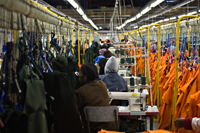
Will Latest California Labor Law Citation Finally End Sweatshops?
O & K Apparel Inc. has been ordered by California Labor Commissioner Julie A. Su to pay its 110 employees $113,000 in California overtime wages plus penalties of $61,450 for failing to pay proper overtime, and $307,250 for issuing improper itemized/deduction statements.
In a press release (April 11), Christine Baker, director of the Department of Industrial Relations (DIR), which is a division of the Labor Commissioner’s office, said that employers must pay workers the wages they’ve earned. “And the Labor Commissioner’s office will protect [the employees’] rights, as well as the rights of honest businesses and taxpayers.”
O & K Apparel Inc., which is based in Los Angeles, makes women’s garments and has been paying its employees by the piece, or “piecework.” The California labor code states that garment contractors are required to provide accurate itemized statements to employees showing total hours worked by the employees, and if paid by the piece, they must show the number of pieces produced for specific manufacturers and the rate of pay for each piece in addition to the total hours worked.
In a statement, Labor Commissioner Su said there is no place for sweatshop conditions in our 21st century economy. “Piece rate payment cannot be used as an end-run around the basic requirement that all workers in California receive a just day’s pay for a hard day’s work, including overtime pay for overtime hours worked. In addition, California law requires itemized wage statements so employees know how much they worked and what they earned. In this case, the pay stubs did not include any of that information, which makes it hard for workers to know when their wages are being stolen right out from under them.”
Will some employers never learn? Back in March 2008, seven Hispanic workers filed a federal overtime lawsuit against City Wide Insulation of Madison, claiming that the company violated the federal Fair Labor Standards Act. City Wide thought it could get away with not paying its employees overtime because, they argued, their workers were compensated on a piecework basis. But the judge didn’t see it that way and the workers received about $19,000 each.
More recently, Walmart had its knuckles wrapped regarding piecework. This pay scheme left over from the dark ages intended to make employees work faster and faster within an 8-hour day. But they often work through lunch and don’t take breaks, because if the containers aren’t unloaded in time, they don’t get paid. Walmart lawsuits filed by piecework employees are pending…



About . TOS . Privacy . Disclaimer . Contact . Advertise . Member Login
This work is licensed under a Creative Commons Attribution-NoDerivs 3.0 Unported License ©2026 Online Legal Media. All rights reserved.
Visit other Online Legal Media Websites: