Compliance News

California Labor Laws Like the Wild West for Limo Drivers
Jo and his wife did their research. They discovered that the limo company owner violated the California labor code by demanding that Jo pay the deductible charges when the limo he was driving was damaged - and it wasn’t even his fault. (Even if it was his fault, charging the driver is questionable.) The Industrial Welfare Commission that regulates wages, hours and working conditions in the transportation industry clearly states that:
No employer shall make any deduction from the wage or require any reimbursement from an employee for any cash shortage, breakage, or loss of equipment, unless it can be shown that the shortage, breakage, or loss is caused by a dishonest or willful act, or by the gross negligence of the employee.
This is how the accident occurred. “My passengers didn’t shut the rear door properly when I dropped them off,” Jo explains. “Pulling away I heard road noise so I hit the brake. The back door swung open and hit a planter in the hotel driveway. It put a crack in the plastic door, so I called the owner and told him what happened. He said it just needed a little touch-up. I worked that weekend, and about a week later I got a text message from the owner, asking what are we going to do about the door damage?”
Jo knew that other drivers had been charged deductible costs. But he knew that the owner was indeed violating the California labor code so Jo was prepared.
“I offered to drive the limo to the repair shop on my own time,” says Jo. “As well, I recently got a ticket for parking in a bus zone and the owner agreed to pay half. I suggested that I would pay all the parking violation, and he pay all the damage: I thought this agreement was more than fair.”
At the end of September, Jo’s boss took him up on the offer but he hasn’t been called in to work since. Instead, the owner’s mother called and asked Jo what he intended to do about the damage. “I told her about the arrangement we made but she kept on raising the question,” says Jo. That is two strikes against Jo’s boss: retaliation is also a violation of the California labor code.
Limo drivers and California overtime
Jo’s second issue is overtime. He worked for about 18 months, on call. All the drivers are on call. In the busy season they typically work 50-60 hours a week and in the low season (January through March) about 15-20 hours.
“Last year I probably drove 100 trips and 75 percent of those were over eight hours,” says Jo. “Most business generates from San Francisco and most people tour the wine country, so we rarely get back within eight hours. Our rate of pay worked like this: he had three different types of vehicles that I drove. When no one was in the vehicle, the pay rate was $9 per hour. When I had passengers in a Lincoln sedan, it was $15 per hour; passengers in the Chevy Suburban was $17 per hour and the limo was $20 per hour.
“He explained that these different rates had to do with the tip included in the rate people were charged. About 50-60 percent would still tip; thankfully, some people are pretty generous, especially coming back from a wine tour.”
Jo and his wife found out that he is eligible for overtime when they researched the limo damage and deductible issue. Jo didn’t confront the owner about overtime because other drivers had brought it up in the past and didn’t get called back.
“I was retired when I took this job and now I’m back in retirement,” Jo adds. “It was fun and I would like to continue but I don’t want to be used and abused again. About a dozen drivers are in the same boat as me - nobody here gets overtime. I asked drivers of other companies if they got paid overtime and some do, some don’t. It’s like the Wild West for us limo drivers regarding overtime and other labor laws.”
Back in 2011, employment lawyer Mark Thierman filed a class-action lawsuit on behalf of Las Vegas limousine drivers against Bell Trans, Nevada’s largest limousine company, alleging failure to pay minimum wage and overtime. Theirman pointed out that California limo drivers are also eligible for California overtime pay.
Brent, a limo driver in San Mateo, was in the same situation as Jo, and he retained an experienced California overtime attorney. “I’ve worked at this limo company for five years and have never been paid overtime,” Brent said. He also worked similar hours as Jo. “My attorney said that I should be paid from the moment I go to work until the moment I leave.”
Many limo drivers and drivers of lighter vehicles for delivery, transit, courier and related services have successfully resolved overtime wage cases. More often than not, these California drivers have been deprived of meal and rest breaks and they are also recovering compensation for these California labor law violations.

Various Sides Line Up on California Labor Law Proposal
Business groups claim the proposed bill will serve as a business and jobs killer in California. Critics of the bill say that California labor law is fine just the way it is, thank you.
Under current statutes, a primary contractor cannot be held liable for the behavior of a subcontractor in terms of violations to California and labor law. The proposed bill would impose a certain degree of liability on the businesses hiring those subcontractors.
The proposed bill is a priority for labor unions in the state. Caitlin Vega, a lobbyist for the California Labor Federation, told the Sacramento Bee (9/22/14) that the new legislation will do a better job at holding contractors accountable to California labor employment law.
Business advocates hate it. “Worker protection laws in California are already in place for labor violations and should be enforced,” said John Kabateck, executive director of the California chapter of the National Federation of Independent Business, in comments published in the Sacramento Bee. “The only thing this bill is going to do is hurt our state’s economy and jobs.”
That view is mirrored by blogger Andrea Deveau of TechNet, identified as “the national, bipartisan network of innovation economy CEOs and senior executives.”
Deveau, identified as the Executive Director of TechNet, notes in the Fox&Hounds blog (9/26/14) that AB 1897 will impact a California labor lawsuit in that an employee that alleges a violation to have occurred would only be able to litigate against the third-party business, and not against the employer that actually (and allegedly) committed the violation. Business groups view this as unfair and misguided.
However, a respondent to the Fox&Hounds blog noted a multi-year relationship with small sub-contractors. The respondent noted that there was rarely, if ever, overtime paid for work performed beyond an eight-hour day or a 40-hour week. The respondent also noted that whenever a California labor lawsuit was launched, the small subcontractor would simply file for bankruptcy and shut down in an effort to avoid the litigation, only to soon resurface under a different business name and address.
AB 1897, say advocates, will improve adherence to California state labor laws by requiring businesses and contractors to have a stake in the behavior of their subcontractors, and in so doing provide better oversight - and perhaps make better choices in the subcontractors they hire.
“This bill is really about promoting responsible contracting,” lobbyist Vega said, in comments published in the Sacramento Bee. “This bill is going to help the companies that are following the law and being responsible, and this bill is going to help get companies out of the business that have a model of cheating workers.”
The other proposed bill to land on Governor Brown’s desk would prohibit contracts containing a clause requiring an individual to waive all rights to pursue a California labor lawsuit regarding a civil rights claim. The California Chamber of Commerce doesn’t like that one, either…

California Labor Lawsuit Gets Class-Action Status
The Walmart lawsuit was filed by truck drivers who alleged the company violated the California Labor Code and other labor laws by not paying minimum wage and by not providing meal and rest breaks. The Trucker (9/17/14) reports that the plaintiffs claim Walmart’s piece-rate pay does not provide minimum wages and does not provide pay for all mandatory duties performed that are related to their work, including time spent washing, fueling, weighing the trucks and completing paperwork.
“The court finds that plaintiffs have met the commonality requirement for the proposed class of drivers,” District Judge Susan Illston wrote in her decision. “While Wal-Mart argues that there are varying circumstances in which individual drivers may be granted pay at the discretion of general transportation managers, this does not negate plaintiffs’ assertion that there is a general default policy, defined in the driver reference and pay manuals, against paying drivers for certain tasks.”
The court also wrote that she found Walmart’s argument that the plaintiffs did not show how they could determine which drivers performed which tasks or how long was spent on those tasks unpersuasive. Judge Illston wrote that there were common questions concerning Walmart’s pay formula, which would allow for class certification regarding wages and wait times.
The court did, however, note that if the class members have major variations in the length of time spent involved in mandatory activities such as paperwork or fueling, that Walmart could move to decertify the class. The plaintiffs’ motion to certify wage statements as a class was denied.
According to court documents, the lawsuit was originally filed in 2008. There are reportedly approximately 500 potential members of the class. The drivers also argued that they are paid $42 for 10-hour layovers.
The lawsuit is Ridgeway v. Wal-Mart Stores Inc., No. C 08-05221, US District Court, Northern District of California.

SpaceX Faces California Labor Lawsuits
According to the Los Angeles Times (8/12/14), lawsuits have been filed against SpaceX alleging the company violated various labor laws. One lawsuit alleges the company violated state law by not providing meal and rest breaks and by forcing employees to work off the clock. The lawsuit alleges employees were not only denied their breaks, they were not paid for those missed breaks.
Court documents filed in the case note that class members regularly worked more than five and 10 hours a day without being given first and/or second uninterrupted meal periods. Employees were also allegedly subject to “…pressure from SpaceX’s management and supervisors to perform work at the expense of their meal and rest periods…” That pressure included denying a “significant number” of employees’ first meal periods and refusal to allow second meal periods on shifts of over 10 hours.
The lawsuit alleges that shift and production schedules did not provide employees with proper opportunities to take their breaks, even though employees did not waive their right to a break. Labor laws require employers in California to provide one 30-minute meal break for non-exempt employees whose shift is more than five hours and a second 30-minute break for shifts of more than 10 hours per day (under certain circumstances, the second 30-minute break can be waived).
“On certain weekend shifts, SpaceX also required Plaintiff and the Class Members to choose between taking a single meal period or receiving two rest periods…” court documents note.
Furthermore, according to the lawsuit, employees were not compensated for time worked, including overtime worked, when their hours were rounded down, which also resulted in inaccurate wage statements.
The lawsuit seeks to represent non-exempt current or former employees, estimated in court documents to be more than 100 individuals.
A different lawsuit filed in August alleges SpaceX illegally laid off hundreds of employees without providing them with proper notice or compensation.
The wage and hour lawsuit is Smith v. Space Exploration Technologies Corp., et al, case number BC554258 in the Superior Court of California, County of Los Angeles.

California Labor Lawsuit against Apple Certified Class Action
According to RE/CODE (7/22/14), the lawsuit was filed in 2011 by Brandon Felczer and other employees, who alleged Apple owed its retail and corporate employees back wages. As many as 20,000 workers could be included in the class.
In allowing the class-action certification, San Diego Superior Court Judge Ronald S. Prager broke the class into six subclasses: a meal break class for retail employees, a meal break class for corporate employees, a rest break class for retail employees, a rest break class for corporate employees, a waiting time penalty subclass and a wage statement subclass.
Brandon Felczer alleged in his lawsuit that he was forced to work five hours or more at a time without a meal break, a violation of California labor law. Furthermore, he alleges that when he quit his job he gave 72-hours notice but did not receive his final paycheck until two days later and did not receive sufficient waiting fees.
According to the judge’s ruling, Apple argued that plaintiffs were provided timely rest breaks. The judge, however, found that under Apple’s meal period policy, non-exempt non-manager employees were not told they were permitted to take their meal break within the first five hours of every shift. The policy reportedly stated that non-exempt employees who work more than five hours at any time during a work shift must take at least a 30-minute meal period, and that meal periods cannot be taken at the end of a shift to allow the employee to leave work early.
“Thus, as stated, it can be argued that Defendant’s meal break policy never authorized, permitted or made its non-exempt employees aware that they had the right to take a meal period within (italics in original) the first five hours prior to August 1, 2012,” the judge noted in his ruling.
The lawsuit is Felczer et al vs Apple Inc, case number 37-2011-00102593-CU-OE-CTL, in the Superior Court of California, County of San Diego.
In 2013, Apple employees in California filed a lawsuit against the company alleging they were wrongly denied overtime wages because they were not paid for time they spent off-the-clock waiting for security checks prior to leaving stores.

Affected Workers Try to Put the Kibosh in Bosch Attempt to Dismiss
There are also allegations that Bosch directed the foreign workers to repay tax refunds. The defendant attempted to have the lawsuit dismissed. However, the plaintiffs argued in California federal court last month against the granting of any motion to dismiss.
According to court documents, the lead plaintiff in the case was hired by the American subsidiary of Robert Bosch GmbH as an engineer and came to the US from India on a work visa. Suraj Kamath alleged in his November 2013 lawsuit that Bosch announced in 2012 that all non-US citizens employed by the company were required to repay all tax refunds across a four-year period from 2006 to 2011. The employer, according to plaintiff documents, remitted income payments on behalf of non-US citizens to taxation authorities.
“Bosch informed plaintiff that, if he did not sign a form declaration promising to pay Bosch the full amount of his tax refunds, Bosch would fire him, require him to return to India, make his life miserable, make sure that his life and career would be destroyed, make sure that he would not find another job anywhere and pursue criminal and civil lawsuits against him,” the complaint said.
The California labor lawsuit is Suraj Kamath v. Robert Bosch LLC et al., Case No. 2:13-cv-08540, in the US District Court for the Central District of California.
Meanwhile, the state’s driven labor commissioner is taking adherence to the California labor code to new heights with an awareness campaign that is intended to bring the message of fair and equitable pay and working conditions to low-wage workers throughout California.
“Immigrant workers in low-wage industries are especially vulnerable to wage theft, but may not be aware of their rights, may fear retaliation, or may mistakenly believe that they are not protected,” said Labor Commissioner Su, in comments published in an official state news release (4/30/14). “Another barrier is lack of trust in government or understanding of how the Labor Commissioner’s office can help. This campaign aims directly at these barriers by dispelling myths and educating workers on how to fight wage theft.”
The awareness campaign, which will be distributed through print, electronic and social media, is an addendum to increased enforcement of California labor employment law by Su’s office and that of the Division of Labor Standards Enforcement, which falls under the Department of Industrial Relations (DIR).
Violations to California and labor law not only cheat an employee out of earned pay, meal breaks and rest periods, but also provide the company responsible with an unfair advantage over those competitors abiding by the rules.
“The mission of the Department of Industrial Relations is to protect all workers with comprehensive labor laws and proactive enforcement throughout the state,” said Christine Baker, DIR Director. “This campaign increases familiarity with workers’ rights and employer’s responsibilities, and supports our efforts to level the playing field for law-abiding businesses.”
When the California labor code is not followed, a California labor lawsuit often results.

Fleet Service Workers Now Boarding Class-Action California Labor Lawsuit
At issue are allegations made by unionized fleet service workers employed at San Francisco International Airport by US Airways Inc. (US Airways). In a complaint certified as a class-action lawsuit April 4 by a California federal judge, some 554 full- and part-time fleet service workers allege they have been stiffed out of overtime pay and meal breaks by their employer. According to California labor code, workers are legally entitled to meal breaks and overtime pay.
The airline, however, argues that provisions in the Railway Labor Act, under which contracts and collective bargaining agreements are negotiated with the International Association of Machinist and Aerospace Workers (IAMAW) union, trump state labor statutes. Together with an interpretation of California labor and employment law that US Airways claims exempts a so-called shift trade policy from overtime obligations under the federal labor code, the defendant held that class-action status should not be granted.
However, US District Judge Charles R. Breyer aligned with the plaintiffs’ motion for class certification.
The fleet service workers are responsible for the loading and off-loading of planes, de-icing tasks, and establishing ramps to the aircraft. Collective bargaining agreements set out when meal breaks are taken and when overtime is paid, according to the unique demands of an industry that puts a great deal of importance on the timeliness of scheduled flights at a busy airport. There are also provisions for shift swaps, so-called “pick-up” shifts, and other provisions unique to the airline industry.
However, as the workers perform their tasks in the state of California, California and labor law comes into play. Lead plaintiffs in the class action, Joseph Timbang Angeles and Noe Lastimosa, contend that members of the class have been stiffed from overtime and have also worked off the clock by way of various pre-shift and post-shift activities.
The defendants claim that any employee who clocks in a few minutes earlier than his or her established start time, and/or clocks out a few minutes beyond the normal end of his or her shift, is not necessarily performing work.
Percolating in the background is the ongoing need to ensure a plane is ready to go and a flight is allowed to leave on time. Were a worker to forego a rest or meal period in order to ensure a plane is readied on schedule, is that meal period made up later? Is there a wage provision to compensate for missed meal periods?
US Airways holds that plaintiffs’ claims are preempted by federal airline labor laws. The plaintiffs disagree, and their California labor lawsuit - filed in November 2012 - will now move forward as a class action. The case is Angeles et al. v. US Airways Inc., Case No. 3:12-cv-05860, US District Court for the Northern District of California.

California Labor Law Gets New Look for New Year
Critics suggest that a boost to the minimum wage - currently $8.00 per hour until the end of June - will only result in higher prices and higher costs, effectively voiding their windfall. And industry watchers maintain there will always be those employers who attempt to grow their own coffers on the backs of their workers, by skirting around various tenets of California labor code, including overtime exemptions.
Still, advocates for workers’ rights hail the changes, which mostly took effect January 1, as a continuing step - but baby steps, all - in the right direction.
According to The Californian (1/1/14), the minimum wage for the state will rise to $9 per hour effective July 1 this year. The hourly minimum, according to California and labor law, further rises to $10 January 1, 2016.
But there are a number of other updates to California and labor law that went into effect the first of the year. Among them, is a law that prevents employers from threatening to report workers who complain about legitimate job-related concerns and seek payment of legally due wages to immigration authorities. Such has been the case in the past when an employee, seeking legally due wages and getting nowhere with the employer, files a California labor lawsuit.
The new provisions to California labor employment law also provides that certain in-home workers, such as nannies and personal attendants for individuals who are ill, disabled or elderly, will now qualify for overtime - and will now be governed by a bill of rights.
California employee labor law also prohibits employers from forcing seasonal employees, or other employees who work outdoors, to continue working during mandated “recovery periods” in an effort to avoid debilitating or deadly sunstroke.
Victims of crime will also be allowed time off from work to appear, as needed, as part of court proceedings involving violent crime, domestic violence or sexual assault, among others.
The change to California prevailing wage law is by far getting the most traction in the press.
“We were able to improve upon existing protections as well as support workers in a number of new ways, including increasing the minimum wage,” said Steve Smith, a spokesman for the California Labor Federation, in comments featured in The Californian on New Year’s Day. “If you look at this year, compared to over the past decade, it would be hard to argue that there’s been a better year for worker legislation.”
Governor Jerry Brown appears poised to continue to push improvements, as he is able, through California state labor laws.

Unions Launch California Labor Lawsuit Over Contract Clause Clawback
According the Contra Costa Times (12/3/13), the dispute centers on a clause in a recently negotiated contract that provides for six weeks of paid leave to care for a newborn, or an ill or injured family member - in addition to normal provisions for vacation pay and sick leave.
The BART board, according to the report, is characterizing the paid leave agreement as a clerical error in the contract and voted November 21 - following initial agreement of the proposed contract by both sides - to require that approval of the proposed contract be conditional on a new union vote on a revised contract without the paid leave clause.
The paid leave provisions would saddle the BART transit authority with additional costs, although it would depend on how many union members would take advantage of the perk. The labor contract would cost BART $67 million over four years. The paid leave provision could cost the Authority an additional $6 million, to $44 million over the life of the contract.
BART wants the paid leave provision struck from the contract. The unions are sticking to their guns, saying that the provision was in the original proposed contract that was agreed to by both parties.
The unions involved in this California labor code dispute are Amalgamated Transit and Service Employees International. According to the newspaper report, the unions had previously launched legal action against BART over alleged issues surrounding California and labor law this past June.
When both sides reached a tentative agreement October 21 - an agreement that both unions ratified - it was thought that legal action against the transit authority could come to an end.
That doesn’t appear to be the case now. The unions are seeking, through the courts, to force the employer to accept the terms of the proposed contract as agreed and as ratified by the union membership according to the tenets of California and labor law.
A professor of law is quoted in the report as saying that there is no precedent for an employer, having negotiated a contract and signed off individual tentative agreements, to come back and attempt to back away from a previously agreed-to clause.
While the California labor lawsuit is at play, various members of the bargaining unit noted that an out-of-court settlement might be possible, and that the door has been left open for further negotiations, provided they are meaningful. The report noted that a judge, rather than decide on the legality of the employer’s attempt to back away from an agreed-to provision, could simply order the two sides back to the bargaining table.
The transit authority appears poised to try its luck in court, rather than enter into new talks. “I’m not aware of any case where a member of the judiciary has told an elected board, ‘You have to accept this unratified contract no matter what it costs,’” BART board Vice President Joel Keller said, in a statement to the Contra Costa Times. “And if it is forced upon us, it could result in a fare increase.”
The California labor lawsuit was filed in Alameda County Superior Court December 3.
Janitors Allege Ross Dress for Less Equates Work for Less
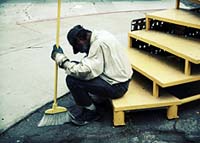
Ross Dress for Less (Ross) is a clothing chain based in Pleasanton. According to a report in the Contra Costa Times (9/6/13), Ross is accused of contracting janitorial services through USM Inc. (USM), an enterprise headquartered in Pennsylvania. USM, as a go-between or sub-contractor, then hires janitors and janitorial companies to actually undertake janitorial services at Ross’ 1,000 stores across the country.
The crux of the California labor lawsuit, brought by three residents of Oakland, is that Ross allegedly shortchanges USM, through the provision of funding less than what might be reasonably required to undertake the hiring of qualified janitorial staff or contractors.
The result, according to the California labor code complaint, is such under-funding leads to the hiring of so-called “fly-by-night” enterprises, which in turn use immigrant labor, denying those workers adequate pay for work performed.
The California labor lawsuit, filed last month in Alameda County Superior Court, was originally put by three Oakland residents who accuse Ross of violations under California labor employment law. However, it has been reported that lawyers close to the case are hoping to see the lawsuit evolve to a class action.
“Ross knows, or should know that the funds provided to USM under their agreement(s) are not sufficient to allow USM to comply with all applicable local, state and federal laws,” the lawsuit states. For those workers toiling as janitors in Ross locations in the state of California, reduced pay stemming from the alleged underfunding for provision of janitorial services constitutes an alleged violation of California prevailing wage law.
According to the California employee labor lawsuit, the three plaintiffs were issued paychecks that were late, reflected values that were insufficient compared with the work performed, or checks that lacked overtime pay for work performed at Ross locations. The plaintiffs worked for firms contracted by USM Inc. to provide janitorial services for Ross Dress for Less.
California labor law works in concert with federal wage provisions under the Fair Labor Standards Act (FLSA) in order to uphold statutes and provisions designed to ensure workers are provided an adequate wage within the eyes of the law and fair play. When that doesn’t happen, workers have various regulatory and legal options to pursue a claim.



About . TOS . Privacy . Disclaimer . Contact . Advertise . Member Login
This work is licensed under a Creative Commons Attribution-NoDerivs 3.0 Unported License ©2026 Online Legal Media. All rights reserved.
Visit other Online Legal Media Websites: