
California Labor Law News

Nurses Allege Violations of California Labor Laws
According to ABS-CBN News (5/17/13), nurses at Bellflower Medical Center in California allege they have had their pay days moved around and have been given paychecks that bounced when they cashed them. One employee says that since January 11, multiple checks have bounced, sometimes repeatedly, leaving employees without pay owed them for hours worked.
The same medical center was reportedly involved in a settlement with the federal government, after it was accused of fraudulently charging Medicare for fake procedures. Meanwhile, the California Department of Labor Relations fined the medical center $7 million for paying employees late and bouncing checks.
According to a news release from the California Department of Labor Relations (online at dir.ca.gov; 3/14/13), Pacific Health Corporation was cited $524,300 for late payments to employees and for bouncing checks. The company, which owns four medical centers in California, including Bellflower, was also cited more than $6.5 million for not providing complete and accurate itemized wage statements to employees.
“Employers have an obligation to pay workers the wages they’ve earned,” said California Department of Industrial Relations Director Christine Baker. “Forcing employees to wait for payment, or depriving them of promised benefits, are illegal acts and cause unacceptable hardship.”
The news release notes that Bellflower Medical Center was told that it would face further civil penalties if it continued to violate labor laws. In February 2013, the department received reports of delayed wages and insufficient funds for checks. On investigation, the department allegedly also found employee benefits were deducted from paychecks but not paid, resulting in coverage being canceled.
As a result, the department fined Bellflower $7 million.
-2.jpg)
California Labor Lawsuit Filed against Trucking Company
The Los Angeles Times (5/15/13) reports that truck drivers for a southern California trucking company have filed a lawsuit against the company alleging they were misclassified as independent contractors so their employer could avoid paying them overtime and giving them breaks.
The plaintiffs allege that rather than being independent contractors they acted as employees by driving trucks owned by the company. The Times article notes that five lawsuits were filed by Attorney General Jerry Brown against California trucking companies, alleging they violated state labor laws and misclassified employees as independent contractors.
Meanwhile, three contractors have been fined a total of $1.8 million for violations of public works regulations. A news release issued by California Labor Commissioner Julie A. Su noted that the companies willfully violated labor law and affected 94 workers in the process.
“Let these enforcement actions serve as notice that wage theft - whether it be through nonpayment of overtime, failure to pay proper prevailing wage, underreporting of hours worked, bounced checks used to pay working people, and cheating on apprenticeship training funds - will not be tolerated in this state,” said Labor Commissioner Su.
One contractor was ordered to pay almost $550,000 in wages and $650,000 in fines for not properly paying employees. According to the labor commissioner, the company also falsified documents and intimidated workers in an effort to prevent the commissioner’s investigation. A second contractor was ordered to pay $275,000 in wages and almost $125,000 in fines after being found to pay much less than the prevailing wage for its project, and failing to pay proper overtime.
The third contractor was ordered to pay more than $180,000 in wages and $30,000 in penalties for misclassifying workers in an attempt to pay them less, for underreporting hours and for issuing checks without enough funds.

Breastfeeding Discrimination at California Hospital
Cellenia’s son is eight months old and it hasn’t been easy juggling work and feeding him. “I requested three months of mat leave after my son was born but I wasn’t called back to work until he was five months old,” Cellenia says. “I work 3.30 p.m. until midnight and use a pump during my lunch break at 7:00 p.m., put the milk in the fridge and my mom feeds my son the next day while I’m at work. At the last hospital where I worked, the lactation room was only available to county workers - not security guards. They locked the room after a certain time so I had to get the Sheriff’s department to open it every evening; they knew I was there but they wouldn’t leave it open for me.”
Cellenia was recently transferred to another hospital (she didn’t want to work a six-day schedule at the last location) and she was provided with a room in the neo-natal ward, which happens to be where she works, making sure nobody unauthorized leaves with the babies. “Everyone knew me there, they talked to me and said it was fine to use the room,” Cellenia explains. “Everyone knew I was expressing milk for my baby and I was storing it in their fridge. I have no idea why this new nurse supervisor was against me.”
According to Cellenia, four days ago the supervisor took Cellenia’s milk out of the fridge and dumped it into the trash can. “She actually told me she threw it away and asked if I wanted it back,” Cellenia explains. “Then she said I couldn’t use this room anymore. It was only for patients and I had to go to another area on another floor but that area was locked. I have no idea why she is acting this way. She could have told me to take the milk away and put it into the employee fridge instead of throwing it in the trash.”
This incident happened during Cellenia’s 7:00 p.m. lunch break. She needed to pump her milk and the only room available was the public lunchroom for county employees, and it was a fair hike away.
“By the time I got there and tried to pump, no milk came out for my baby, I think because I was so stressed out,” she says. “I only had a few minutes and then I had to get back to my station - I was so upset.
A LawyersandSettlements attorney called me and said I should speak with my supervisor and see if something can be worked out before she meets with me next Monday. I don’t feel comfortable here anymore but these hospitals are the only ones available for me to work. So I don’t know what to do at this point.”
Cellenia likely has a case. A new Breastfeeding Discrimination bill, intended to prevent breast-feeding discrimination in the workplace, went into effect January 2013. Although the California Labor Code already requires employers to provide accommodations for women who are breastfeeding, this new law provides additional recourse for women who have encountered breastfeeding discrimination.
Pregnancy discrimination is a serious violation of the California labor code. Businesses and its supervisors - including hospitals - should be aware of this bill and if they haven’t done so already, should implement a breastfeeding policy. As well, employers should take seriously any complaints from employees relating to breastfeeding as they are as serious as any other complaint that is based on sex, race or age discrimination.

California State Labor Comish Fights On against Labor Law Violations
To that end, Su and her team have achieved settlements amounting to more than a half million dollars following an investigation into recent California labor code violations. As stated in a press release issued by the Office of the California Labor Commissioner (4/25/13), four general contractors involved with four different public works projects in the State face wage assessments and penalties totaling $610,186.
According to the report, Joseph Brothers Inc. of San Leandro was hired by three general contractors to undertake drywall work and related construction on three projects under the auspices of the State of California. Joseph Brothers Inc., it was alleged, committed various violations under California prevailing wage law - including the issuance of NSF checks to their workers.
However, while it was alleged that Joseph Brothers committed the violations under California employee labor law, the general contractors hiring Joseph Brothers were held jointly responsible for the unlawful actions of its subcontractor.
“Construction contractors are on notice that the Labor Commissioner has reinvigorated and focused her public works enforcement efforts to provide a fair and level playing field for those businesses who comply with public works requirements,” stated Christine Baker, director of the Department of Industrial Relations (DIR).
The wage violations were against 28 workers employed by Joseph Brothers. All 28, according to the release, will receive the full value of their earned California prevailing wages under the terms of the California labor lawsuit settlement.
The general contractors were involved in the following public works projects: a sanitary sewer in Martinez for the Central Contra Costa Sanitary District, a low income apartment housing project on Addison Street in Berkeley and the Twin Cities police station in Corte Madera. Joseph Brothers is a drywall and carpentry subcontractor hired by the three general contractors, identified as Bobo Construction of Elk Grove, who will pay $225,000 in wages and penalties. Midstate Construction of Petaluma faces $31,437 in penalties; and Jeff Luchetti Construction of Larkspur will be required to ante up $54,249.
In addition to reimbursing their workers for lost wages, Joseph Brothers Inc. faces $37,650 in additional penalties.
A fourth general contractor hired to undertake work at the Oakland Library branch located on 81st Street faces penalties totaling $299,500 in association with various California labor employment law violations against three workers. An investigation by the Office of the Labor Commissioner found that three employees of NBC General Contractors Corporation were not paid for all hours worked.
It was further alleged in the California labor lawsuit that workers were required to pay a portion of their wage to their employer in the form of a kickback. In April 2011, the president of NBC General, Monica Ung, pleaded guilty in Alameda Superior Court to various charges under California state labor laws, according to the release.
“Wage theft on public works projects in California not only cheats workers of their hard-earned wages, it is a violation of the public trust,” said Labor Commissioner Su, in the California and labor law release. “These cases send a message to general contractors that they should make sure they are working with legitimate contractors who abide by the law, and my office will do everything in our power to recover unpaid wages.”
It also sends a message to workers that you shouldn’t just roll over and take employer abuse. You have a right to compensation.

Fired for Pregnancy against California Labor Law

California Labor Law: High-Tech Firms Allegedly Violated Antitrust Laws
According to the Daily Reporter (4/5/13), the lawsuits were filed against Apple, Google and other high-tech companies, and alleged the technology firms worked together to prevent employee wages from rising and further to stop employees from leaving their employers. Among the allegations are that the firms enacted an anti-poaching provision, preventing other firms from approaching a company’s top employees. Furthermore, the lawsuits allege, workers who approached other companies for employment were turned away if they were already employed by one of the companies involved in the scheme.
Plaintiffs, software engineers who worked for the defendants, argue that the anti-poaching provisions prevented employees from finding higher-paying employment at other companies and artificially diminished demand for their services, which then kept their wages down because it was more difficult for the employees to undertake negotiations for better salaries. The lawsuits sought class-action status, but a judge recently determined that the individual circumstances of each employee were too different to allow for a class complaint.
An investigation by the US Justice Department resulted in a settlement with some of the companies involved in the lawsuit, although the companies did not admit wrongdoing.
Business Insider (4/6/13) reports that other firms involved in the lawsuits include Intel, Adobe, Intuit, Pixar and Lucasfilm. Although the judge denied class-action status, lawyers for the plaintiffs have the opportunity to request class-action status again, but with a more narrowly defined group.
The companies tried last year to have the lawsuits dismissed, but according to Reuters (4/19/12), Judge Lucy Koh, rejected that bid, finding that the six agreements were identical and reached in secrecy, indicating they were the result of collusion and not coincidence.
The case is In re: High-Tech Employee Antitrust Litigation, District Court, Northern District of California, No. 11-02509.
Meanwhile in a different lawsuit, a settlement has reportedly been reached between Tata Consultancy Services Inc and employees from India, who alleged they were forced to give their employer their tax refund checks. Thomson Reuters (4/9/13) reports that the settlement will see the defendant, who has admitted to no wrongdoing, pay $29.75 million.
The case is Gopi Vedachalam and Kangana Beri v. Tata Consultancy Services and Tata Sons, U.S. District Court for the Northern District of California, No. 06-00963.

Business Owner Jailed for California Labor Law Violation
According to the California labor code violation report, Samara was the subject of an investigation a year ago, in January 2012, by the Workers’ Compensation Insurance Fraud Unit. As a result of their investigation, Samara was found to be lacking worker’s compensation insurance for his employees at Tile Gallery Plus.
At his arraignment to face criminal charges in June of last year, Samara duly produced a certificate of insurance, thereby bringing him into compliance with California labor employment law.
However, the California Department of Standards and Labor Enforcement (DSLE) followed up on the file in November and found that Samara’s workers’ compensation coverage had lapsed. In fact, according to the District Attorney’s office, the policy was canceled a month after the accused appeared for his arraignment, due to non-payment of the premium.
According to the report, the DSLE responded to this latest indiscretion by issuing a number of citations for violations against California and labor law, including a “Stop Order,” directing that no employee should physically perform any work at Tile Gallery Plus without a current workers’ compensation policy, in good standing, in place and in force.
Workers’ compensation is required under California state labor laws, and serves to protect the well-being and livelihood of any employee injured on the job or unable to work for any reason. Employers who choose to circumvent the requirement put their employees (and by extension, their workers’ families) at risk, as well as opening themselves up to fines and potential litigation.
California employee labor law is strictly enforced by the Office of the Labor Commissioner for the state of California, as well as the California Department of Standards and Labor Enforcement (DSLE).
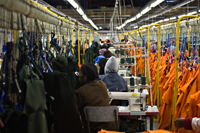
Will Latest California Labor Law Citation Finally End Sweatshops?
O & K Apparel Inc. has been ordered by California Labor Commissioner Julie A. Su to pay its 110 employees $113,000 in California overtime wages plus penalties of $61,450 for failing to pay proper overtime, and $307,250 for issuing improper itemized/deduction statements.
In a press release (April 11), Christine Baker, director of the Department of Industrial Relations (DIR), which is a division of the Labor Commissioner’s office, said that employers must pay workers the wages they’ve earned. “And the Labor Commissioner’s office will protect [the employees’] rights, as well as the rights of honest businesses and taxpayers.”
O & K Apparel Inc., which is based in Los Angeles, makes women’s garments and has been paying its employees by the piece, or “piecework.” The California labor code states that garment contractors are required to provide accurate itemized statements to employees showing total hours worked by the employees, and if paid by the piece, they must show the number of pieces produced for specific manufacturers and the rate of pay for each piece in addition to the total hours worked.
In a statement, Labor Commissioner Su said there is no place for sweatshop conditions in our 21st century economy. “Piece rate payment cannot be used as an end-run around the basic requirement that all workers in California receive a just day’s pay for a hard day’s work, including overtime pay for overtime hours worked. In addition, California law requires itemized wage statements so employees know how much they worked and what they earned. In this case, the pay stubs did not include any of that information, which makes it hard for workers to know when their wages are being stolen right out from under them.”
Will some employers never learn? Back in March 2008, seven Hispanic workers filed a federal overtime lawsuit against City Wide Insulation of Madison, claiming that the company violated the federal Fair Labor Standards Act. City Wide thought it could get away with not paying its employees overtime because, they argued, their workers were compensated on a piecework basis. But the judge didn’t see it that way and the workers received about $19,000 each.
More recently, Walmart had its knuckles wrapped regarding piecework. This pay scheme left over from the dark ages intended to make employees work faster and faster within an 8-hour day. But they often work through lunch and don’t take breaks, because if the containers aren’t unloaded in time, they don’t get paid. Walmart lawsuits filed by piecework employees are pending…

Dental Assistant Denied Breaks Led to Downward Spiral - Now Filing California Labor Lawsuit
Gina says that the day after Coast Dental bought out Small Care the registered dental assistants were trained on their new computer system. The following day, all six of the non-registered dental assistants (who helped Gina and her colleagues) were fired. “Three of us were left holding the bag because the workload didn’t change.”
One way to compensate for less staff was deny those workers “dangling the workload” their mandatory 10-minute breaks - one in the morning and one in the afternoon. “Nobody was happy with this situation, even the dentists were devastated,” says Gina. “We were all complaining and we were all working overtime because we were constantly slammed.
“It gets worse. There are ten operatory rooms. It’s a big clinic, so a cleaning service came in at night, along with the break room and the waiting room, but that was prior to the changeover. This new company delivered us cleaning equipment! We worked our buts off all day and then had to clean the entire clinic. We had to mop floors and do all the sterilization. We never signed up for this work but our office manager told us that if we wanted to work there we had no choice.
“At the point we didn’t want to work overtime (which we got paid for) but we had to look after our patients. They forced this whole production issue on us; it was all about making more money. They didn’t want us to work overtime but we had no choice. We constantly complained about not getting breaks. ‘Well take a break,’ they said. How could we take a break when no one could relieve us? We couldn’t leave the dentist and his patient.”
The dental assistants weren’t able to add their breaks to their time sheets as overtime because they clocked in and clocked out at lunchtime, and then clocked back in and out at the end of the day. “Sometimes we couldn’t even get to the bathroom because we were so slammed, but if we ran into the break room and grabbed something to drink, we would get into trouble,” Gina adds. “If you calculate all the days we worked without breaks, it’s a lot of money. Over a year, we probably took 5 percent of our breaks. We were all in the same boat, with the exception of the dentists.
“We complained to the dentists but they didn’t have any control over the corporation. In fact the dentists made it worse - they were running around like chickens with their heads cut off. They had to meet a certain quota and after that they could make more money so that wanted to book in additional crown preps (more money) and emergencies.
“It became very stressful and I was getting depressed. I am a single parent with two teenagers. I explained my work situation and family problems to my doctor. I saw him originally for my yearly physical (I’m almost 50) and I was prescribed Wellbutrin, an anti-depressant. At first I didn’t like the meds and stopped, but my doctor advised me to stay on them a bit longer. The stress at work got worse so I started self-medicating - I had a few drinks after work. Then I went back on Wellbutrin.
“My boss, the office manager, thought I was on drugs, but I just drink wine. Wellbutrin makes you act a bit weird. I knew I wasn’t being myself: I thought everyone was looking at me and sometimes I forgot things but I was always a hard worker and had lots of compliments. They made me take a drug test. I figured I couldn’t stay on Wellbutrin so I stopped taking it the next day. But I started drinking wine again as soon as I got off work. Anyway, I missed a day of work.
“The stress continued. I drank a bit too much one night and next morning I was still a bit drunk at work so they made me leave. I apologized profusely. To make a long story short, I went on a downward spiral and I ended up getting a DUI a few months later. I was incarcerated for 14 days for being drunk and disorderly in public and they fired me.
“But they said I quit because I didn’t show up for work. I have been denied unemployment and food stamps and cannot get any financial aid. I asked my boss for my job back but no dice so I’m looking for work but there aren’t many jobs out there right now. I am happy that I don’t have to go back there, but financially I am screwed. I had to borrow $1,000 from my dad and I’m surviving off my credit cards. My kids are OK - they get child support from their dad.
“There were a lot of stressful situations that led to this point but I have only myself to blame. I want to get reimbursed for my breaks and I want to get unemployment insurance. I put in an appeal about 10 days ago with unemployment but haven’t got a date yet for the judge to hear my case. Meanwhile, I filed a complaint with an employment attorney.
“We all knew it was against the law to deny our breaks but everyone was afraid to complain; we all talked about turning them in. I wish I had reported them to the California labor board before I got fired. And I wonder if any of this would have happened if I was able to take my breaks and not get so stressed out.”

The Road to Justice Under California Labor Law
To that end, Valley Vanguard Properties, Inc. (Valley Vanguard) and six subcontractors have been hit with wage and penalty assessments for violating California labor code over a road widening in concert with the installation of a Wal-Mart store in Kerman, California.
According to PR Newswire (3/26/13), Valley Vanguard was given the nod to build a new Wal-Mart facility on behalf of East Kerman Development, the developer of record on the project. In concert with the facility build - and in view of an expectation for increased traffic flow stemming from the facility - the City of Kerman made it a condition when approving the new Wal-Mart that Highway 180 would require an expansion to four lanes, in order to handle the traffic flow.
To that end, even though the highway is a public thoroughfare, the widening was undertaken through private funding, with Valley Vanguard handling the road widening in concert with the aforementioned subcontractors.
However, according to the release, Valley Vanguard and its subcontractors got into some hot water under California labor law.
“Developers and contractors in California should be aware that public works laws may be triggered when a project requires work on state roads or highways as a condition of the project’s construction approval,” said Christine Baker, director of the Department of Industrial Relations (DIR).
Those words were echoed by the Office of the California Labor Commissioner. “If a project with private funding requires a Caltrans encroachment permit,” stated Labor Commissioner Julie A. Su, “the private funding cannot be used to avoid public works laws and the requirement to pay workers prevailing wages.”
Following a complaint and subsequent investigation, Valley Vanguard and six subcontractors were ordered to pay wage and penalty assessments exceeding $300,000.
The penalties break down as follows: $263,670 in wages, $4,289 in training fund contributions and $45,745 in penalties as a result of the California labor employment law violations.
According to the release, the six subcontractors were identified as Barracuda Construction, Inc., Prestige Electric Corporation and Safety Network, Inc., all of Fresno; Clovis-based contractor Davis & Roberts Construction, Inc.; Kerman Telephone Co., based in Kerman; and R & L Gibbs Construction, based in Squaw Valley.
Streets and Highways Code Section 670.1 mandates the payment of prevailing wages for road and highway work requiring a Caltrans encroachment permit as a condition for residential and commercial construction. “Valley Vanguard, as the prime contractor for the highway expansion project,” said Commissioner Su, “is responsible for ensuring that all workers performing construction work on a public works project are paid the correct prevailing wage rates.”
Often, as the result of a complaint or violation report, the Labor Commissioner’s office will undertake a California labor lawsuit. Such an undertaking, while upholding California state labor laws, is important for two reasons...
To provide justice for workers who have been shortchanged out of their rightful provisions under California employee labor law, and to protect law-abiding corporations who respect and adhere to California prevailing wage law.



About . TOS . Privacy . Disclaimer . Contact . Advertise . Member Login
This work is licensed under a Creative Commons Attribution-NoDerivs 3.0 Unported License ©2026 Online Legal Media. All rights reserved.
Visit other Online Legal Media Websites: